Production Possibilities Frontier (PPF): Definition, Graph, and Examples

Table of Contents
The production possibilities frontier is one of the most foundational models in economics. It illustrates the trade-offs every economy faces when allocating scarce resources between competing uses — revealing the true cost of every economic choice. Whether you’re studying for a university economics exam or analyzing how nations allocate resources between consumption and investment, understanding the PPF (also called the production possibility curve, or PPC) is essential. This guide covers the definition, how to read the graph, opportunity cost on the frontier, real-world examples, and what causes the PPF to shift.
What is the Production Possibilities Frontier?
The production possibilities frontier (PPF) is a graph that shows the maximum possible combinations of two goods an economy can produce, given its available resources and current technology. It represents the boundary between what is achievable and what is not.
Points on the frontier are productively efficient — the economy is getting the maximum output from its resources. Points inside the frontier are inefficient (resources are underutilized). Points outside the frontier are unattainable with current resources and technology.
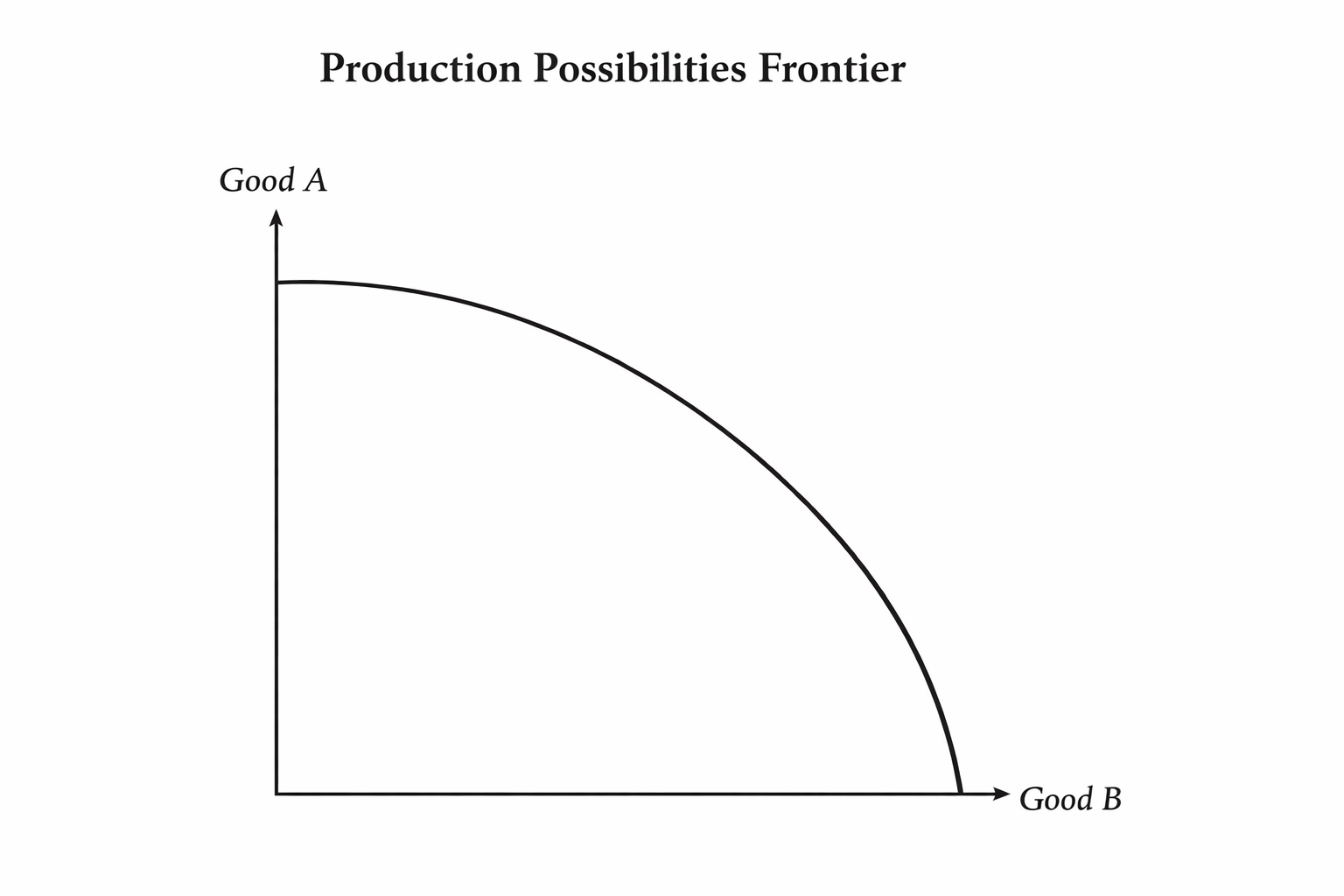
The PPF shows the feasible set of production possibilities, not the actual production point an economy chooses. Which combination a society selects depends on preferences, policies, and institutions — the PPF simply defines what is possible.
Every point on the frontier involves a trade-off: producing more of one good requires producing less of the other. This trade-off is the essence of opportunity cost — one of the most important concepts in economics.
How to Read the Production Possibilities Frontier Graph
The PPF plots one good on each axis. All points on or inside the curve are feasible; points beyond it are not. Here is how to interpret the three types of points:
| Point Location | Meaning | Example |
|---|---|---|
| On the frontier | Productively efficient — maximum output from available resources | 600 cars and 2,200 computers |
| Inside the frontier | Inefficient — resources are underutilized (e.g., unemployment, misallocation) | 300 cars and 1,000 computers |
| Outside the frontier | Unattainable — not possible with current resources and technology | 900 cars and 2,800 computers |
Straight-Line vs. Bowed-Out PPF
A straight-line PPF indicates constant opportunity cost — resources are equally suited to producing either good, so each additional unit costs the same amount of the other good. A bowed-out (concave) PPF indicates increasing opportunity cost — as an economy shifts more resources toward one good, each additional unit costs progressively more of the other good. Most real-world PPFs are bowed outward because resources tend to be specialized.
Movement Along vs. Shift of the PPF
Movement along the PPF represents a reallocation of existing resources between the two goods — the economy’s total capacity hasn’t changed, but it’s choosing a different production mix. A shift of the PPF means the economy’s total productive capacity has changed due to factors like technological progress (outward shift) or resource destruction (inward shift).
Don’t confuse these two changes. Moving from one point to another on the same frontier is a reallocation decision. The frontier itself shifting outward or inward reflects a change in the economy’s underlying capacity — a fundamentally different phenomenon.
Opportunity Cost on the Production Possibilities Frontier
The slope of the PPF at any point represents the opportunity cost of producing one more unit of the good on the horizontal axis, measured in units of the good on the vertical axis.
On a bowed-out PPF, opportunity cost is not constant — it increases as you produce more of one good. This happens because resources are specialized: early units of a good can be produced cheaply by shifting the most adaptable resources, but later units require pulling resources that are much better suited to the other good.
Opportunity cost calculated between two points on a bowed-out PPF applies only to that segment. The cost of the next unit will be different. Never treat a single opportunity cost ratio as if it holds everywhere along a curved frontier.
Production Possibilities Frontier Examples
Example 1: Cars and Computers
Suppose an economy can produce a maximum of 1,000 cars (if it devotes all resources to cars) or 3,000 computers (if it devotes all resources to computers). Two efficient points on the frontier are:
| Point | Cars | Computers |
|---|---|---|
| A | 600 | 2,200 |
| B | 700 | 2,000 |
Moving from Point A to Point B, the economy gains 100 cars but loses 200 computers. Over this segment:
Opportunity cost = |−200 / 100| = 2 computers per car
Each additional car in this range costs the economy 2 computers. At a different point on the frontier — say, where the economy is already producing 900 cars — the opportunity cost per car would be even higher, because the remaining resources are better suited to computer production.
Example 2: The U.S. Economy During World War II
During the Great Depression, the United States was operating well inside its PPF — with unemployment peaking near 25%, vast productive capacity sat idle. When World War II began, wartime mobilization first moved the economy toward the frontier by putting unemployed workers and idle factories back to use. At the same time, the production mix shifted heavily toward military goods: automobile plants retooled to build tanks and aircraft, and consumer rationing freed additional resources for the war effort. U.S. defense spending surged from about 2% of GDP in 1939 to over 40% by 1944.
After the war, massive investments in technology, education (the GI Bill), and infrastructure shifted the entire PPF outward. By the 1950s, the U.S. economy could produce more of both consumer and military goods than it could before the war — a textbook example of economic growth expanding the frontier.
Example 3: South Korea’s Economic Transformation
In 1960, South Korea’s GDP per capita was approximately $158 — comparable to some of the poorest nations in the world. The economy was largely agricultural with limited industrial capacity. Over the following decades, sustained investment in education (university enrollment grew from under 5% to over 70%), technology (Samsung, Hyundai, and other chaebols scaled globally), and physical capital (steel production rose from near zero to over 70 million tons per year) dramatically shifted the country’s PPF outward.
By 2023, South Korea’s GDP per capita exceeded $33,000 — a more than 200-fold increase. The economy now produces advanced semiconductors, automobiles, and consumer electronics alongside agricultural goods. This is one of the most dramatic outward PPF shifts in modern economic history, driven by exactly the factors the model predicts: capital accumulation, education, and technological progress.
What Shifts the Production Possibilities Frontier?
The PPF is not fixed — it can shift outward or inward over time as an economy’s productive capacity changes.
Outward Shifts (Economic Growth)
An outward shift means the economy can reach combinations of goods that were previously unattainable. Common causes include:
- Technological progress — new methods that increase output per unit of input
- Capital accumulation — investment in machinery, factories, and infrastructure
- Education and training — a more skilled workforce produces more output
- Discovery of new resources — additional raw materials expand productive capacity
A technological breakthrough in one industry can shift the PPF asymmetrically: the endpoint for that good moves outward while the other endpoint stays the same. For example, a leap in computer chip manufacturing shifts the computers endpoint but not the cars endpoint. The economy can now produce more of both goods in many combinations, though the maximum car output hasn’t changed.
For more on the factors driving long-run economic expansion, see our guide to economic growth determinants.
Inward Shifts (Economic Contraction)
The PPF can also shift inward, meaning the economy’s maximum output declines. Causes include:
- War and destruction — physical capital and infrastructure destroyed
- Natural disasters — hurricanes, earthquakes, or pandemics reducing productive capacity
- Resource depletion — exhaustion of key natural resources
- Institutional breakdown — collapse of legal systems, property rights, or governance
PPF vs Comparative Advantage
The production possibilities frontier and comparative advantage are closely related concepts, but they answer different questions.
Production Possibilities Frontier
- Shows trade-offs for one economy
- Illustrates scarcity and productive efficiency
- Opportunity cost read from the slope
- Answers: “What can this economy produce?”
Comparative Advantage
- Compares opportunity costs between two economies
- Determines who should specialize in what
- Often illustrated by comparing two PPFs
- Answers: “Who should produce what and trade?”
The two concepts connect directly: comparative advantage uses the PPF’s opportunity cost logic across economies. A country has a comparative advantage in the good for which it has a lower opportunity cost on its PPF. For a deeper exploration of specialization and trade, see our article on comparative advantage and trade.
Common Mistakes With the Production Possibilities Frontier
1. Confusing inefficient points with impossible points. A point inside the PPF is not impossible — the economy can produce there. It simply means resources are being wasted (perhaps due to unemployment or misallocation). Moving from an interior point to the frontier increases output without any trade-off.
2. Assuming the PPF is always bowed outward. A bowed-out shape (increasing opportunity costs) is the most common case because resources tend to be specialized. However, if resources are equally adaptable to producing either good, the PPF is a straight line with constant opportunity cost. The shape depends on the nature of the resources involved.
3. Confusing movement along the PPF with a shift of the PPF. Moving from one point to another on the same frontier means reallocating resources — total capacity hasn’t changed. A shift of the entire frontier means the economy’s productive capacity has grown (outward) or shrunk (inward). These are fundamentally different events.
4. Treating opportunity cost as constant along a bowed-out frontier. On a curved PPF, the opportunity cost of producing one more unit changes as you move along the curve. A ratio calculated between two specific points applies only to that segment. The next unit will cost more (or less) depending on direction.
Limitations of the PPF Model
The PPF is a powerful teaching tool, but like all economic models, it simplifies reality. Be aware of what it omits before applying its insights too literally.
1. Only two goods. Real economies produce millions of goods and services. The PPF simplifies to two goods to make trade-offs visible, but actual resource allocation decisions are far more complex.
2. Assumes fixed resources and technology. The PPF represents a snapshot at a single point in time. In reality, resources, technology, and labor skills change constantly. The model captures these changes as shifts of the frontier, but it cannot show dynamic adjustment paths.
3. Does not show the actual production choice. The PPF shows the set of feasible options — not which one the economy selects. The chosen point depends on societal preferences, government policy, and market outcomes, none of which the PPF model captures.
4. Ignores international trade. With trade, a country can consume beyond its domestic PPF by specializing in goods where it has a comparative advantage and importing the rest. The PPF shows production possibilities, not consumption possibilities.
Frequently Asked Questions
Disclaimer
This article is for educational and informational purposes only and does not constitute investment or economic policy advice. The examples and numerical illustrations are simplified for clarity and may not reflect the full complexity of real-world production decisions. Always consult authoritative sources and qualified professionals for policy or investment guidance.