The Phillips Curve: Inflation-Unemployment Trade-off & Sacrifice Ratio

Table of Contents
The Phillips curve is one of the most important — and most debated — relationships in macroeconomics. It describes the short-run trade-off between inflation and unemployment that policymakers face when managing the economy. Understanding why this trade-off exists, why it broke down in the 1970s, and what it costs to reduce inflation is essential for anyone studying monetary policy, central banking, or macroeconomic theory.
This guide covers the Phillips curve from its origins to its modern applications — including the expectations-augmented equation, the 1970s stagflation breakdown, the Volcker disinflation, the sacrifice ratio, and how central banks use the framework today.
What Is the Phillips Curve?
The Phillips curve describes an observed inverse relationship between the unemployment rate and the inflation rate. In periods of low unemployment, inflation tends to be higher. In periods of high unemployment, inflation tends to be lower.
The Phillips curve captures a short-run trade-off: when unemployment falls below the natural rate, inflation tends to rise. When unemployment exceeds the natural rate, inflation tends to fall. Most economists believe no permanent trade-off exists in the long run — the long-run Phillips curve is vertical at the natural rate of unemployment.
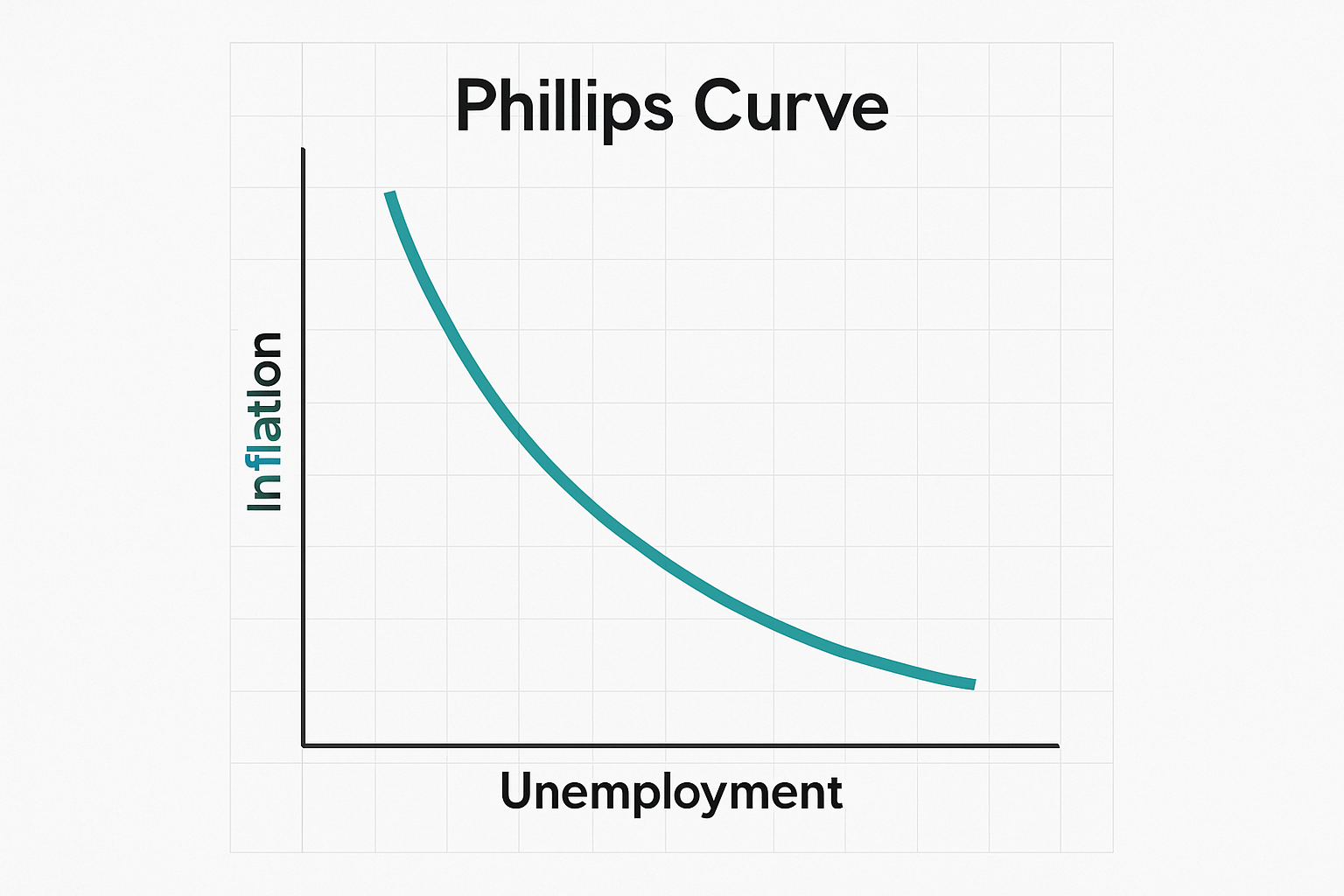
The relationship was first documented by A.W. Phillips in 1958, who found a negative correlation between unemployment and the rate of wage inflation using United Kingdom data from 1861 to 1957. Two years later, economists Paul Samuelson and Robert Solow found a similar pattern in U.S. data, coined the term “Phillips curve,” and proposed it as a policy menu — a set of inflation-unemployment combinations that policymakers could choose between using monetary and fiscal policy.
This idea was enormously influential. Throughout the 1960s, policymakers believed they could permanently “buy” lower unemployment by accepting somewhat higher inflation. That belief would be challenged in the decade that followed.
The Phillips curve sits at the intersection of two of the Federal Reserve’s core responsibilities — its dual mandate of maximum employment and stable prices. When these goals conflict in the short run, the Phillips curve framework helps policymakers understand the trade-offs involved. It also explains why central bank decisions about interest rates — which primarily affect aggregate demand — have predictable short-run effects on both inflation and unemployment.
The Expectations-Augmented Phillips Curve Equation
In 1968, Milton Friedman and Edmund Phelps independently argued that the original Phillips curve was incomplete because it ignored the role of inflation expectations. Their expectations-augmented version became the standard framework:
Where:
- π — actual inflation rate
- πe — expected inflation rate
- u — actual unemployment rate
- u* — natural rate of unemployment (NAIRU is often used as a practical estimate of u*)
- α — slope parameter measuring how responsive inflation is to the unemployment gap
When unemployment falls below the natural rate (u < u*), the term (u − u*) is negative, so actual inflation exceeds expected inflation. When unemployment rises above the natural rate, inflation falls below expectations. Crucially, the short-run Phillips curve shifts whenever expected inflation changes — there is no single, stable curve.
Suppose the natural rate of unemployment is 5%, expected inflation is 2%, and α = 0.5. If the central bank pushes actual unemployment down to 3%:
π = 2% − 0.5 × (3% − 5%) = 2% − 0.5 × (−2%) = 2% + 1% = 3%
Actual inflation rises to 3% — one percentage point above expectations. The economy is experiencing an inflation surprise because unemployment is 2 percentage points below the natural rate. If unemployment instead rises to 7%:
π = 2% − 0.5 × (7% − 5%) = 2% − 1% = 1%
Inflation falls to 1% — below expectations. Higher unemployment creates disinflationary pressure. This example illustrates why the short-run Phillips curve slopes downward: lower unemployment corresponds to higher inflation, and vice versa.
This is a simplified specification. A fuller version often includes a supply-shock term (such as changes in oil prices) to account for shifts in the curve that are not driven by the unemployment gap — a distinction that became critical during the 1970s. Including the supply-shock term, the equation becomes:
When ν is positive (e.g., an oil price spike), the curve shifts upward — inflation rises at every unemployment rate. When ν is negative (e.g., a technology-driven cost reduction), the curve shifts downward. This extension explains why stagflation can occur: a large positive supply shock raises inflation even when unemployment is high.
Short-Run vs Long-Run Phillips Curve
The most important insight from Friedman and Phelps is the distinction between the short-run and long-run Phillips curves. They represent fundamentally different economic realities.
Short-Run Phillips Curve
- Downward-sloping — trade-off between inflation and unemployment exists
- Holds for a given level of expected inflation
- Policymakers can temporarily reduce unemployment by creating unexpected inflation
- Shifts upward when expected inflation rises
- Relevant for: business cycle management, near-term policy
Long-Run Phillips Curve
- Vertical at the natural rate of unemployment (u*)
- No permanent trade-off between inflation and unemployment
- Monetary policy cannot permanently push unemployment below u*
- Friedman-Phelps (1968) natural-rate hypothesis
- Relevant for: long-term policy frameworks, central bank mandates
The mechanism behind this distinction is inflation expectations. When the central bank expands aggregate demand to push unemployment below the natural rate, inflation rises. Initially, workers and firms are surprised by the higher inflation, so the policy “works” — real wages fall, firms hire more, and unemployment drops. But over time, people come to expect the higher inflation rate. Workers demand higher nominal wages, firms raise prices further, and the short-run Phillips curve shifts upward. Unemployment returns to the natural rate, but now at a permanently higher inflation level.
This is the natural-rate hypothesis: any attempt to hold unemployment permanently below the natural rate produces not just higher inflation, but accelerating inflation. The policy implication is stark — in the long run, monetary policy determines the inflation rate but not the unemployment rate. Unemployment is ultimately determined by real factors: labor market institutions, demographics, technology, and the structure of the economy.
Why the Phillips Curve Broke Down in the 1970s
The 1960s appeared to validate the original Phillips curve. U.S. data from 1961 to 1968 traced an almost perfect negative relationship between inflation and unemployment. But the following decade shattered that stability.
In 1973, the Organization of Petroleum Exporting Countries (OPEC) restricted oil supply, nearly quadrupling world oil prices. A second shock followed in 1979 after the Iranian Revolution. These supply shocks shifted the aggregate-supply curve leftward, simultaneously raising prices (inflation) and reducing output (unemployment).
The Federal Reserve under Chairman Arthur Burns largely accommodated the shocks with expansionary monetary policy, allowing inflation expectations to ratchet upward. By 1980, CPI inflation peaked near 13.5% while unemployment stood at roughly 7% — a combination the simple 1960s policy-menu interpretation of the Phillips curve could not explain.
This combination of stagnant growth and high inflation — stagflation — demonstrated that supply shocks could shift the entire Phillips curve outward, creating a worse menu of inflation-unemployment combinations. The simple policy menu interpretation was dead.
The Phillips Curve in U.S. History
The Phillips curve’s behavior has varied dramatically across economic eras. The table below summarizes key episodes using annual-average CPI-U inflation and civilian unemployment rate (UNRATE) from FRED:
| Era | Avg Unemployment | Avg CPI Inflation | Phillips Curve Behavior |
|---|---|---|---|
| 1961–1969 | ~4.8% | ~2.4% | Stable downward-sloping relationship |
| 1970–1979 | ~6.2% | ~7.1% | Curve shifted outward; stagflation |
| 1980–1986 (Volcker) | ~8.0% | ~6.1% | Rode the curve downward via tight policy |
| 2010–2019 | ~6.2% | ~1.8% | Flat curve; low unemployment, low inflation |
| 2021–2023 | ~4.2% | ~5.7% | Steep short-run relationship re-emerged |
The pattern is clear: the Phillips curve is not a fixed relationship. Its slope, position, and stability depend on the inflation expectations regime, the types of shocks hitting the economy, and institutional factors like central bank credibility.
In the 1960s, the economy appeared to confirm the simple trade-off: as the Kennedy and Johnson administrations pursued expansionary policies, unemployment fell steadily while inflation crept up — exactly as the original Phillips curve predicted. The relationship was so tight that many economists believed it was a permanent structural feature of the economy.
The 1970s destroyed that confidence. Vietnam War spending, the Nixon-era policy of keeping unemployment low, and two OPEC oil shocks combined to produce stagflation — simultaneous high inflation and high unemployment. The short-run Phillips curve shifted outward repeatedly as inflation expectations ratcheted upward, validating the Friedman-Phelps critique that no stable menu existed.
The Volcker era (1980–1986) demonstrated the reverse: by deliberately tightening monetary policy and accepting a deep recession, the Fed brought inflation down sharply. The economy rode the Phillips curve in the opposite direction — higher unemployment in exchange for lower inflation — confirming that the short-run trade-off works in both directions.
The 2010s puzzled economists. Unemployment fell from nearly 10% to 3.5% over the decade, yet inflation remained stubbornly close to 2%. This “missing inflation” episode led many to question whether the Phillips curve had flattened to near irrelevance. Explanations included well-anchored inflation expectations, globalization suppressing wage pressures, and measurement challenges in capturing the true labor market slack.
The post-COVID period (2021–2023) reignited the debate. Massive fiscal stimulus, supply chain disruptions, and a rapid labor market recovery produced the steepest short-run Phillips curve relationship in decades. Inflation surged to levels not seen since the early 1980s, suggesting the relationship had not disappeared — it had merely been dormant while expectations remained anchored.
Remarkably, the subsequent disinflation of 2023–2024 proceeded with minimal increase in unemployment — what some economists called an “immaculate disinflation.” Whether this reflects the resolution of temporary supply shocks, well-anchored expectations allowing a painless adjustment, or simply luck remains an active area of debate. It does suggest that the Phillips curve’s behavior depends critically on whether inflation is driven primarily by demand or supply factors.
The Volcker Disinflation
The most dramatic test of the Phillips curve came when Paul Volcker became Federal Reserve Chairman in October 1979 with inflation running near 10% per year.
Volcker sharply tightened monetary policy. The daily effective federal funds rate briefly exceeded 20% — with a monthly average peak of about 19% in June 1981 — as the Fed deliberately contracted aggregate demand to break the inflationary spiral.
The results:
- CPI inflation fell from roughly 10% in 1981 to about 4% by 1983 — a reduction of approximately 6 percentage points
- Unemployment peaked at 10.8% in November–December 1982, about 4 percentage points above the rate when Volcker took office
- The U.S. experienced one of its deepest recessions since the Great Depression
The Volcker disinflation demonstrated that reducing entrenched inflation is possible but costly. It also raised a central question: could that cost have been lower with a more credible commitment?
The Volcker episode became a natural experiment for the rational expectations theory of disinflation. Economists like Robert Lucas and Thomas Sargent had argued that if a central bank credibly commits to lower inflation, the public will adjust expectations immediately, shifting the short-run Phillips curve downward and reducing the output cost. In practice, the sacrifice ratio was lower than historical estimates — but disinflation was far from painless. Survey data show that commercial forecasters’ inflation projections fell more slowly than actual inflation during the early 1980s, suggesting most of the public did not fully believe the Fed would follow through. The lesson: credibility matters, but it must be earned through action, not merely announced.
The Volcker disinflation also reshaped how economists think about central bank independence. The political cost of double-digit unemployment was enormous — Volcker faced intense Congressional pressure and public anger. The fact that the Fed maintained its course despite this pressure ultimately built the credibility that would help anchor expectations for the next three decades. For more on how recessions interact with policy decisions, see our guide on recession probability.
The credibility Volcker established paid dividends during the Greenspan era (1987–2006). With inflation expectations firmly anchored near 2–3%, the Fed could respond to economic shocks — the 1987 stock market crash, the 1991 recession, the dot-com bust — without reigniting inflationary spirals. The Phillips curve during this period appeared remarkably stable and relatively flat, a direct consequence of the expectations anchor that the painful Volcker disinflation had established.
The Sacrifice Ratio
The sacrifice ratio quantifies the cost of disinflation — the number of percentage points of annual real GDP that must be forgone to reduce inflation by one percentage point.
Typical textbook estimates put the U.S. sacrifice ratio at approximately 5 — meaning each 1 percentage point reduction in inflation requires sacrificing 5% of one year’s GDP. But the Volcker experience told a different story.
Using CBO estimates of potential GDP relative to actual GDP over 1980–1984:
- Inflation reduction: ~6 percentage points (from ~10% to ~4%)
- Cumulative GDP loss relative to potential: ~16%
- Sacrifice ratio: 16 / 6 ≈ 2.7
This was well below the commonly cited estimate of 5. Why? Economists aligned with the rational expectations school — notably Robert Lucas, Thomas Sargent, and Robert Barro — argued that when a central bank makes a credible commitment to disinflation, people adjust their inflation expectations more quickly. The short-run Phillips curve shifts downward sooner, reducing the output cost.
The Volcker disinflation partially supported this theory: the sacrifice ratio was lower than predicted, though disinflation was far from costless. Evidence suggests most of the public did not initially believe Volcker would follow through — commercial forecasters’ inflation projections fell more slowly than actual inflation during the early 1980s.
The sacrifice ratio is not a fixed number — it depends heavily on central bank credibility. When the public believes the central bank will follow through on its commitment to lower inflation, expectations adjust faster and the output cost is lower. This is why central bank communication, forward guidance, and institutional independence are critical to modern monetary policy.
How Central Banks Use the Phillips Curve Today
Modern central banks do not treat the Phillips curve as a simple policy menu. Instead, they use it as one component within larger macroeconomic models that inform interest rate decisions. The Federal Reserve’s dual mandate — maximum employment and stable prices — implicitly relies on Phillips curve logic: the belief that there is a short-run trade-off between the two goals.
In practice, central banks estimate the Phillips curve’s current slope and position using real-time data on unemployment, inflation, and inflation expectations. They combine this with estimates of the natural rate of unemployment (u*) and potential output to assess whether the economy is running “hot” (below u*, risking rising inflation) or “cold” (above u*, with room to stimulate without inflation).
Several developments have shaped how central banks apply the Phillips curve framework:
- Inflation targeting — Most major central banks now have explicit inflation targets (2% for the Fed and ECB). The target serves as an anchor for inflation expectations, which in turn stabilizes the Phillips curve and reduces the sacrifice ratio of any future disinflation.
- Forward guidance — Central banks communicate their policy intentions to shape expectations directly. If the public believes the central bank will keep inflation near target, the short-run Phillips curve remains well-behaved — inflation responds modestly to unemployment fluctuations.
- Data dependence — Rather than committing to a fixed rule, modern central banks adjust policy meeting by meeting based on incoming data. This approach acknowledges that the Phillips curve’s slope and the natural rate both change over time.
- Risk management — When estimates of u* are uncertain, central banks often probe the lower bound of unemployment cautiously. The Fed’s 2018–2019 experience — when unemployment fell below most estimates of u* with minimal inflation — led the Fed to adopt a more flexible framework that tolerates modest overshooting of its inflation target after periods of undershooting.
The key takeaway for investors and policy observers: when the Fed discusses “labor market conditions” and “inflation outlook” in its statements, it is essentially describing where the economy sits relative to the Phillips curve. Tight labor markets (low unemployment relative to u*) signal upward inflation pressure and typically lead to rate hikes, while weak labor markets signal disinflation pressure and create room for rate cuts.
When reading Federal Reserve meeting minutes or press conferences, listen for references to “labor market tightness,” “inflation expectations,” and “the natural rate.” These are all Phillips curve concepts in practice, even when the term itself is not used explicitly.
Common Mistakes
The Phillips curve is frequently misunderstood, even in professional discussions. Here are the most common errors:
1. Treating the Phillips curve as a permanent trade-off. The original Samuelson-Solow interpretation suggested policymakers could permanently “buy” lower unemployment with higher inflation. Friedman and Phelps showed this only works temporarily. Once inflation expectations adjust upward, unemployment returns to the natural rate — but now with higher inflation. The trade-off is real only for unexpected inflation.
2. Confusing supply shocks with demand-driven movements along the curve. The 1970s stagflation was caused by oil supply shocks shifting the Phillips curve outward, not by movement along a stable curve. Applying demand-side policy prescriptions to a supply-driven problem — as the Burns Fed arguably did — leads to worse outcomes.
3. Assuming a single, universal sacrifice ratio. The cost of disinflation varies enormously depending on central bank credibility, the speed of disinflation, labor market flexibility, and whether expectations are adaptive or rational. The Volcker experience produced a sacrifice ratio well below the textbook estimate of 5.
4. Ignoring the flattening of the Phillips curve in recent decades. From the mid-1990s through 2019, U.S. unemployment fell to historic lows (3.5% in 2019) with minimal inflation response. The relationship did not disappear — factors like globalization, well-anchored inflation expectations, and measurement challenges dampened the inflation response to labor market tightness.
5. Treating 2021–2023 as a clean movement along the Phillips curve. The post-COVID inflation surge reflected a mix of reopening supply bottlenecks, massive fiscal stimulus, tight labor markets, and commodity price shocks — not a simple demand-driven slide along a stable Phillips curve. Disentangling supply and demand factors remains an active area of research.
Limitations of the Phillips Curve
Despite its importance, the Phillips curve has significant limitations that policymakers and economists must keep in mind:
The Phillips curve is a statistical relationship, not a structural law of nature. Its slope, position, and stability depend on the inflation expectations regime, the types of shocks hitting the economy, and institutional factors like central bank credibility. Using it as a simple mechanical policy tool has repeatedly led to policy errors.
1. Unstable over time. The curve’s slope and position have shifted dramatically across decades. The tight relationship of the 1960s, the breakdown of the 1970s, the steep Volcker-era curve, and the flat curve of the 2010s all represent different regimes. No single calibration works across all periods.
2. Supply shocks shift the entire curve. The framework works cleanly for demand-side fluctuations but breaks down when supply shocks — oil embargoes, pandemics, supply chain disruptions — simultaneously raise inflation and unemployment. The standard equation handles this through an added supply-shock term, but estimating that term in real time is difficult.
3. Expectations regime dependence. The curve’s behavior depends on how inflation expectations are formed (adaptive vs. rational) and how well-anchored they are. Well-anchored expectations flatten the curve; de-anchored expectations steepen it. The regime can shift abruptly, as it did in the early 1970s and again after COVID.
4. Natural rate is unobservable. The natural rate of unemployment (u*) must be estimated and varies over time due to demographic shifts, labor market policies, and structural changes. Errors in estimating u* lead directly to errors in interpreting Phillips curve signals — a central bank that overestimates u* will run policy too loose.
5. Global factors. Globalization, immigration, and global supply chains may have weakened the domestic Phillips curve relationship by importing disinflationary pressures from abroad. When firms can source labor and goods globally, domestic labor market tightness may have a smaller effect on domestic prices than the traditional model predicts.
The Phillips curve remains one of the most useful frameworks in macroeconomics for understanding the short-run relationship between inflation and unemployment. But it is a relationship that shifts, flattens, and steepens depending on the economic environment. Central banks use it as one input among many — never as a standalone policy rule.
Frequently Asked Questions
Disclaimer
This article is for educational and informational purposes only and does not constitute investment or policy advice. Historical data cited are approximate and based on publicly available sources (FRED, BLS, CBO). Economic relationships discussed are subject to ongoing academic debate and revision. Always consult qualified professionals for specific policy or investment decisions.
Keep reading
Next in this series
Part 32 of 33 in Economics Essentials
Inflation Expectations: Adaptive vs Rational ExplainedMore in Economics
-
Supply and Demand: How Markets Determine Prices
Supply and demand is the foundational economic model explaining how prices are set, how markets reach equilibrium, and what causes surpluses and shortages.
-
Gross Domestic Product (GDP)
Gross domestic product (GDP) is the total market value of all final goods and services produced within a country.
-
Inflation & Consumer Price Index (CPI) Explained: How It Works & Why It Matters
Learn what inflation is, how the Consumer Price Index (CPI) measures it, and why it matters for investment decisions.