Consumer Surplus & Producer Surplus

Table of Contents
Consumer surplus and producer surplus are the tools economists use to measure who benefits from a market transaction — and by how much. When you buy a concert ticket for $80 but would have gladly paid $150, you walk away with $70 worth of benefit that never shows up on the receipt. That hidden gain is consumer surplus. The seller’s version — the gap between the price received and the minimum they would have accepted — is producer surplus. Together, these two measures form the foundation of welfare economics, the branch of economics that evaluates whether markets and government policies make society better or worse off.
This article explains what consumer surplus and producer surplus are, how to calculate them on a graph, what total surplus means for market efficiency, and where the framework falls short. It builds on the supply and demand model — if you are not yet comfortable with demand curves, supply curves, and equilibrium, start there first.
What is Consumer Surplus?
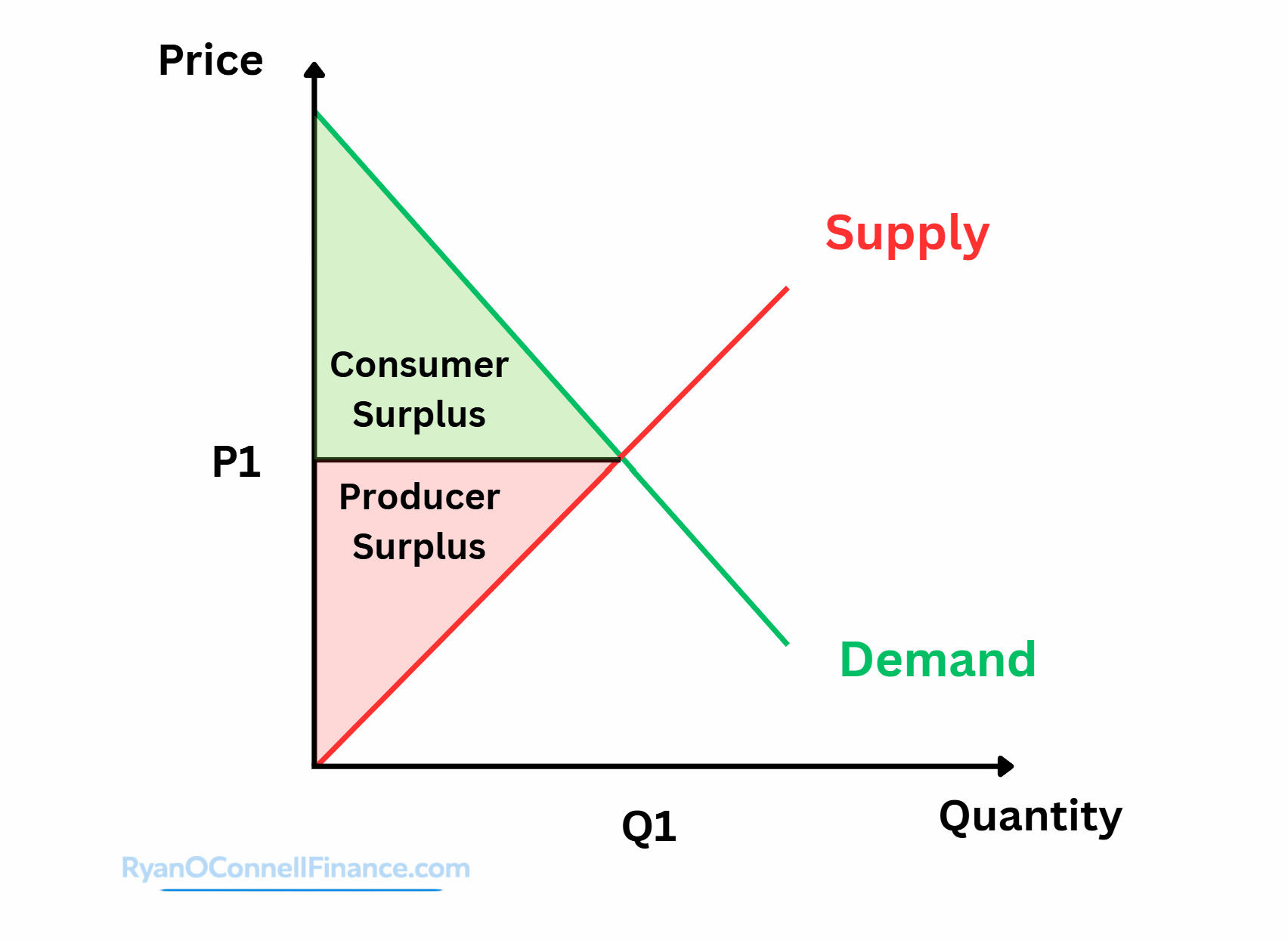
Consumer surplus is the difference between a buyer’s willingness to pay (the maximum amount they would pay) and the price they actually pay. For the entire market, consumer surplus is the area below the demand curve and above the market price, measured up to the equilibrium quantity.
Willingness to pay (WTP) is the maximum amount a buyer would hand over for one unit of a good. It reflects how much the buyer values that unit. The demand curve is really a schedule of willingness-to-pay values: the first unit is worth the most to the most eager buyer, and each additional unit is worth less, tracing out the familiar downward slope.
When the market price settles below a buyer’s WTP, that buyer captures consumer surplus equal to WTP − Price. When the market price is above a buyer’s WTP, that buyer simply does not purchase — and earns zero surplus (never negative, because the trade never happens).
Holding the demand curve constant, a lower market price increases consumer surplus in two ways: existing buyers pay less per unit, and new buyers whose WTP was between the old and new price now enter the market.
What is Producer Surplus?
Producer surplus is the difference between the market price a seller receives and the seller’s willingness to sell — the minimum price the seller would accept to part with the good. For the entire market, producer surplus is the area above the supply curve and below the market price, measured up to the equilibrium quantity.
Willingness to sell is the seller’s minimum acceptable price. It reflects the seller’s opportunity cost — the value of everything the seller must give up to produce and deliver that unit, including out-of-pocket expenses and forgone alternatives. The supply curve is a schedule of these minimum prices: the lowest-cost seller appears first, and each additional unit costs more to produce, tracing out the familiar upward slope.
When the market price exceeds a seller’s cost, that seller captures producer surplus equal to Price − Cost. Holding the supply curve constant, a higher market price increases producer surplus because existing sellers receive more per unit and new, higher-cost sellers now find it profitable to enter.
Consumer Surplus vs. Producer Surplus
Consumer Surplus
- Measures buyer benefit
- Based on willingness to pay (WTP)
- Formula: WTP − Price Paid
- Graphically: area below demand curve, above price
- Increases when the market price falls (curve held constant)
- Driven by diminishing marginal utility
Producer Surplus
- Measures seller benefit
- Based on willingness to sell (cost / opportunity cost)
- Formula: Price Received − Cost
- Graphically: area above supply curve, below price
- Increases when the market price rises (curve held constant)
- Driven by increasing marginal cost
Calculating Consumer and Producer Surplus on a Graph
On a standard supply-and-demand diagram, surplus areas are easy to identify. The method depends on whether the curves are smooth (continuous) or staircase-shaped (discrete buyers and sellers).
Continuous (Linear) Curves
When both the demand and supply curves are straight lines, each surplus area forms a triangle. The vertical side of the triangle spans the price difference (between the curve’s intercept and the equilibrium price), and the horizontal side spans the equilibrium quantity.
The ½ × base × height triangle formula only works when demand and supply are straight lines. If curves are nonlinear, use the area under/above the curve (integration in calculus, or add up the individual rectangles for discrete data). For stepwise demand, sum each buyer’s (WTP − Price) individually.
Step-by-Step: Reading Surplus From a Graph
- Find the equilibrium — the point where the demand and supply curves cross. Read off Peq and Qeq.
- Identify consumer surplus — shade the area below the demand curve and above the horizontal line at Peq, from Q = 0 out to Qeq.
- Identify producer surplus — shade the area above the supply curve and below the horizontal line at Peq, from Q = 0 out to Qeq.
- Calculate the areas — for triangles, use ½ × base × height. For discrete (staircase) curves, sum each individual buyer’s or seller’s surplus.
Total Surplus and Market Efficiency
Total surplus = Consumer Surplus + Producer Surplus. It measures the total gains from trade in a market — the combined benefit that all buyers and sellers receive from participating. At the competitive equilibrium, total surplus is maximized. This is the central result of welfare economics and the formal basis for the claim that free markets are efficient.
1. Free markets allocate goods to the buyers who value them most (highest WTP). 2. Free markets allocate production to the sellers with the lowest costs. 3. The equilibrium quantity — where supply meets demand — is the exact quantity that maximizes total surplus. Producing one more unit would cost more than it is worth; producing one fewer unit would forfeit a beneficial trade. This is Adam Smith’s “invisible hand” at work — no central planner is needed.
Efficiency does not mean fairness. A market can maximize total surplus while distributing it very unequally. Whether the distribution is acceptable is a question of equity, not efficiency — and it is one of the main reasons governments intervene in markets despite the efficiency costs.
Consumer and Producer Surplus Example: Concert Ticket Market
Taylor Swift’s Eras Tour (2023–2024) became the highest-grossing concert tour in history. Suppose five fans have the following willingness to pay for a general-admission ticket:
| Fan | Willingness to Pay | Buys at $250? | Consumer Surplus |
|---|---|---|---|
| Fan A (superfan) | $500 | Yes | $500 − $250 = $250 |
| Fan B | $400 | Yes | $400 − $250 = $150 |
| Fan C | $300 | Yes | $300 − $250 = $50 |
| Fan D | $200 | No | $0 |
| Fan E | $100 | No | $0 |
At a face-value price of $250, three fans purchase tickets. Total consumer surplus = $250 + $150 + $50 = $450.
On the supply side, suppose the venue’s production cost is $100 per seat (a flat cost, so the supply curve is horizontal at $100 for these quantities). Each ticket sold at $250 generates $250 − $100 = $150 in producer surplus. For 3 tickets: total producer surplus = 3 × $150 = $450. (Because cost is flat rather than upward-sloping, this is a rectangle, not a triangle.)
Total surplus = $450 + $450 = $900 — the combined benefit all market participants gain from these trades.
When Fan A resells her $250 ticket for $500, she converts her $250 of consumer surplus into cash. If the ticket reaches a buyer who values it at $600 (higher than Fan A’s $500), total surplus actually increases — the good moved to someone who values it more. However, resale platform fees reduce the surplus captured by participants. In general, secondary markets redistribute surplus and can improve efficiency, but transaction costs eat into the gains.
Surplus in the U.S. Housing Market
When the Federal Reserve cut interest rates to near zero during the pandemic, 30-year mortgage rates fell below 3% for the first time in history. For homebuyers, this dramatically reduced the effective price of housing (lower monthly payments for the same home). The result was a large increase in consumer surplus: new borrowers and refinancers secured historically low rates, and millions of additional buyers whose WTP had been below pre-pandemic prices were now able to purchase.
Producer surplus also rose — home sellers received higher prices as demand surged. But the gains were not evenly distributed. Buyers who locked in 2.5% rates captured enormous surplus; buyers who entered the market later (2022–2023) after rates rose above 7% saw that surplus evaporate. This illustrates how changes in market conditions redistribute surplus even when the underlying supply and demand framework stays the same.
How Taxes and Price Controls Affect Surplus
When governments impose taxes, price ceilings, or price floors, they prevent the market from reaching the competitive equilibrium — and total surplus falls. The lost surplus is called deadweight loss.
A tax drives a wedge between what buyers pay and what sellers receive. Consumer surplus shrinks (buyers face a higher effective price), producer surplus shrinks (sellers receive a lower effective price), and the government collects tax revenue. But the revenue does not fully replace the lost surplus — some trades that would have benefited both sides no longer happen, creating a deadweight loss triangle. For a full analysis, see Deadweight Loss and the Costs of Taxation.
Price ceilings (maximum legal prices) and price floors (minimum legal prices) also reduce total surplus by creating shortages or surpluses that prevent mutually beneficial trades. For details, see Price Ceilings and Price Floors.
Common Mistakes
Even experienced economics students make these errors when working with consumer surplus and producer surplus:
1. Confusing consumer surplus with the price paid. Consumer surplus is not the price — it is the difference between willingness to pay and the price. A fan who pays $250 for a ticket worth $500 to her has $250 in consumer surplus, not $250 in surplus because she paid $250.
2. Treating surplus as cash in the buyer’s pocket. Consumer surplus measures well-being, not money received. The concert-goer does not “have” an extra $250 in her bank account — she has $250 worth of satisfaction above what she paid. Surplus becomes cash only if the buyer resells the good.
3. Using the triangle formula when the data are discrete or curves are nonlinear. The ½ × base × height formula works only for straight-line demand and supply curves. For a staircase demand schedule (individual buyers with specific WTP values), you must sum each buyer’s surplus individually. For nonlinear curves, the surplus area requires integration or numerical approximation — not the triangle shortcut.
4. Forgetting that surplus is measured only up to the quantity actually traded. The area “below the demand curve” does not extend to infinity — it stops at the equilibrium quantity (or the actual quantity transacted). Units that are not produced and sold generate no surplus for anyone.
Limitations of Consumer and Producer Surplus
Consumer and producer surplus are powerful tools for comparing policies, but they rest on assumptions that do not always hold. Treat surplus calculations as useful approximations, not exact welfare measurements.
Assumes willingness to pay reflects true value. If buyers overestimate a good’s worth (speculative bubbles, impulse purchases) or underestimate it (preventive healthcare, education), measured consumer surplus may not reflect actual well-being. Behavioral economics has documented many situations where WTP diverges from true value.
Ignores equity and fairness. A dollar of surplus counts the same whether it goes to a billionaire or a minimum-wage worker. Two policies can produce identical total surplus but vastly different distributions. Surplus analysis tells you about efficiency — not about whether the outcome is fair.
Requires estimable demand and supply curves. Calculating surplus requires knowing (or estimating) the shapes of the demand and supply curves. In many real-world markets, this data is difficult to obtain, making precise surplus calculations impractical. How much surplus shifts between buyers and sellers when conditions change also depends on the relative price elasticity of demand and supply.
Does not account for externalities. The framework considers only private costs and benefits to market participants. When production or consumption generates external effects — pollution, congestion, public health impacts — market surplus may be maximized at a quantity that is not socially optimal. Externalities are one of the main justifications for government intervention despite the efficiency costs.
Frequently Asked Questions
Disclaimer
This article is for educational and informational purposes only and does not constitute investment advice. The examples cited use approximate figures and are intended to illustrate economic concepts, not to provide precise market data. Always conduct your own research and consult a qualified financial advisor before making investment decisions.