Minimum Wage: Economic Effects & Debate

Table of Contents
The minimum wage is one of the most debated policies in economics. At its core, it is a price floor in the labor market — a legal minimum that employers must pay workers. Standard supply-and-demand analysis predicts that a binding minimum wage will reduce employment, but the empirical evidence is mixed — the actual effects depend on labor market structure, the size of the increase, and local economic conditions. This guide covers the economic models, the empirical evidence, and the ongoing debate among economists.
What is the Minimum Wage?
The minimum wage is a government-mandated floor on the price of labor. Employers cannot legally pay workers below this rate. The United States established its first federal minimum wage through the Fair Labor Standards Act of 1938, and the federal rate has been $7.25 per hour since July 2009.
The minimum wage is a price floor in the labor market. Like all price floors, it only affects the market when it is binding — set above the equilibrium wage. For workers whose skills and experience command wages well above the minimum, the floor is non-binding and irrelevant. The minimum wage primarily affects low-wage labor markets, particularly entry-level and less-experienced workers.
As of 2024, 30 states plus the District of Columbia set minimum wages above the federal floor. Several cities — including Seattle, San Francisco, and New York City — have enacted local minimums of $15 or more per hour. The federal minimum also includes special provisions: a tipped minimum wage of $2.13 per hour (with tips expected to make up the difference) and a youth subminimum of $4.25 per hour for workers under 20 during their first 90 days of employment.
The minimum wage is distinct from a living wage, which refers to the hourly rate a worker needs to cover basic expenses (housing, food, transportation, healthcare) in a specific location. Living wage estimates vary widely by region and household size and are typically well above the federal minimum. Policymakers disagree not only on the level of the minimum wage but on whether it should exist at all — in the 2006 Whaples survey of economists, 47 percent favored eliminating it entirely, while 38 percent would increase it. The minimum wage can also contribute to structural unemployment when it holds wages above the market-clearing level for certain groups of workers.
The Competitive Model: Minimum Wage and Employment
In the standard competitive labor market model, wages are determined by the interaction of labor supply (workers offering their time) and labor demand (firms hiring workers based on their marginal revenue product). Without government intervention, the wage adjusts to an equilibrium where the quantity of labor supplied equals the quantity demanded.
When a minimum wage is set above this equilibrium, it becomes a binding price floor. At the higher mandated wage, firms want to hire fewer workers (quantity demanded falls) while more people want to work (quantity supplied rises). The result is an excess supply of labor — unemployment — in the affected low-wage labor market.
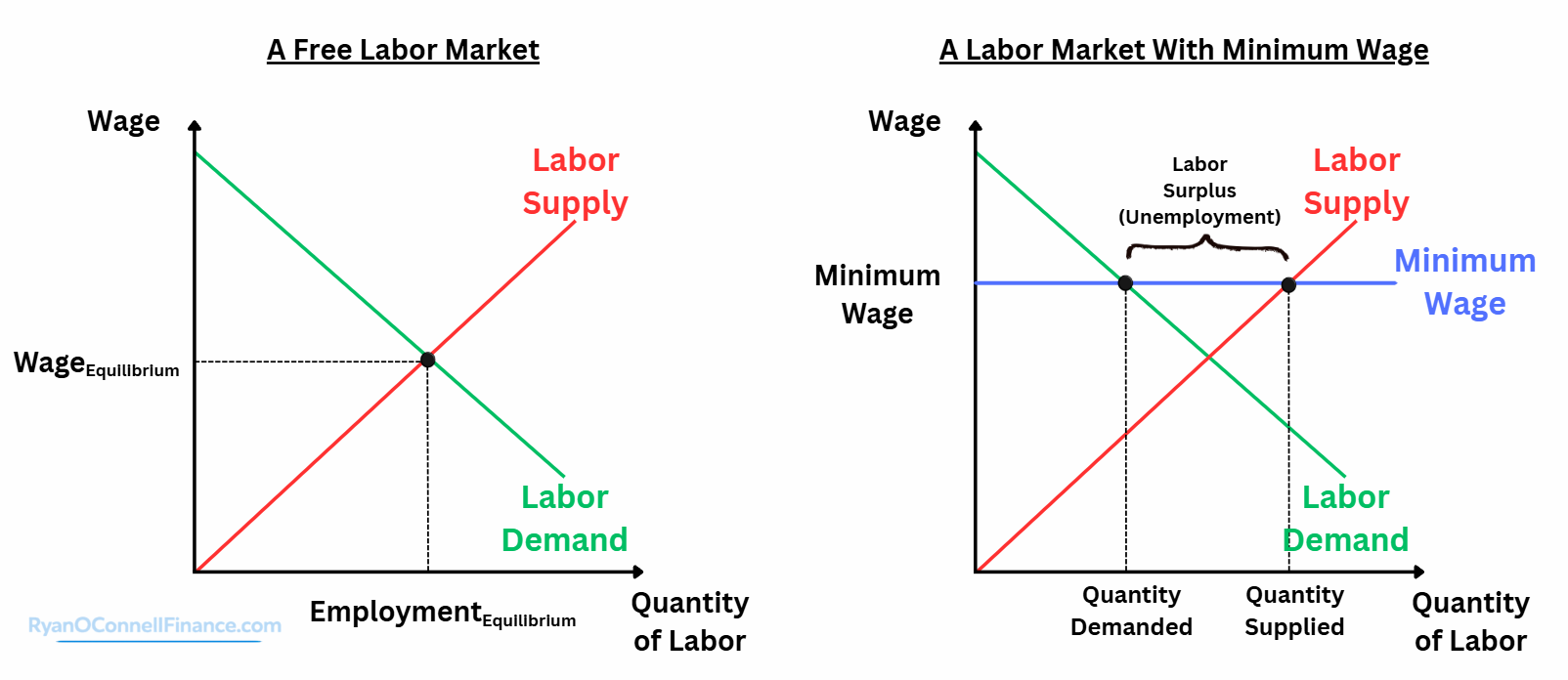
This model predicts that the minimum wage raises incomes for workers who keep their jobs at the higher wage, but reduces employment opportunities for workers whose productivity falls below the mandated rate. The workers most likely to be affected are those with the least skills and experience — particularly teenagers and entry-level workers. For the general framework of how price floors create surpluses, see our article on price ceilings and price floors.
The competitive model assumes that employers are price-takers in the labor market — no single firm has the power to influence the prevailing wage. If employers have wage-setting power (monopsony), the predictions change significantly. Real-world labor markets lie on a spectrum between perfect competition and pure monopsony, and where a particular market falls on that spectrum determines whether a minimum wage increase reduces employment, has no effect, or even increases it.
The Monopsony Model
The monopsony model describes a labor market where a single employer — or a small number of employers — has significant power to set wages. In this situation, the employer faces an upward-sloping labor supply curve: to attract additional workers, it must raise the wage for all employees, not just the marginal hire. This makes the marginal cost of labor higher than the wage itself, so the employer maximizes profit by hiring fewer workers at a wage below the competitive equilibrium.
In a monopsony labor market, a modest minimum wage set between the monopsony wage and the competitive wage can simultaneously raise wages and increase employment. The minimum wage effectively makes the labor supply curve perfectly elastic up to the mandated rate, eliminating the employer’s incentive to restrict hiring in order to suppress wages.
The competitive model and the monopsony model are benchmark extremes. Real labor markets typically fall somewhere between them due to search frictions, geographic mobility costs, and varying degrees of employer concentration. This is why the empirical effects of minimum wage increases vary across industries, regions, and time periods — and why the debate among economists has persisted for decades.
Monopsony-like conditions are most common in labor markets with limited employer options: rural hospitals for nurses, fast-food chains in small towns, meatpacking plants in isolated areas, and historically, company towns where a single firm dominated local employment. In these settings, workers have few outside options, which can give employers greater wage-setting power relative to competitive benchmark models.
What Does the Evidence Say About Minimum Wage and Employment?
The empirical literature on minimum wage effects is extensive and has evolved significantly since the 1990s. Early textbook estimates suggested that a 10 percent increase in the minimum wage would reduce teenage employment by 1 to 3 percent. However, more recent research using improved identification strategies has produced a wider range of findings.
| Study | Setting | Finding | Caveat |
|---|---|---|---|
| Card & Krueger (1994) | NJ fast-food restaurants after MW increase from $4.25 to $5.05, vs PA | No significant employment decrease | Single state, single industry; sparked decades of debate |
| Neumark & Wascher (2007, 2014) | Broad review of U.S. and international studies | Measurable disemployment effects, especially for teenagers and less-skilled workers | Literature review and reassessment; critics argue identification strategies vary in quality |
| Dube, Lester & Reich (2010) | U.S. county pairs straddling state borders with different MW levels | Small or zero employment effects | Border-comparison design controls for regional trends but may miss broader effects |
| Cengiz et al. (2019) | 138 state-level MW increases in the U.S., 1979–2016 | Number of low-wage jobs remained nearly unchanged; wages rose | Aggregate effects; does not rule out distributional effects within subgroups |
| Jardim et al. (2022) | Seattle’s MW increase to $13, using administrative payroll data | Significant reduction in hours worked; low-wage workers earned less total income despite higher hourly wage | Single city; large increase relative to local wages; results may not generalize to smaller increases |
| CBO (2021) | Projected effects of raising federal MW to $15 by 2025 | Median estimate: 1.4 million jobs lost, 17 million workers get raises, 900,000 lifted out of poverty | Projection with wide confidence intervals; actual effects would depend on implementation timeline |
Importantly, employment headcounts are not the only margin of adjustment. When minimum wages rise, firms may also reduce hours, cut non-wage benefits (such as employer-provided health insurance or meals), raise product prices, increase selectivity in hiring (demanding higher productivity from fewer workers), or accelerate automation of routine tasks. These margins mean that even studies finding small employment effects may understate the total adjustment burden on workers and firms.
Minimum Wage Example
Consider a competitive labor market for entry-level retail workers in a mid-sized city. The equilibrium wage is $9/hour with 10,000 workers employed.
The government imposes a minimum wage of $12/hour (binding — above equilibrium).
| Variable | At Equilibrium ($9/hr) | At Minimum Wage ($12/hr) |
|---|---|---|
| Wage | $9.00/hr | $12.00/hr |
| Workers Demanded (Hired) | 10,000 | 8,500 |
| Workers Supplied (Seeking Jobs) | 10,000 | 11,500 |
| Excess Supply (Unemployment) | None | 3,000 workers |
At the $12 minimum, 1,500 previously employed workers lose their jobs (firms reduce hiring), while 1,500 new workers enter the market attracted by the higher wage but find no positions. The 8,500 workers who keep their jobs earn $3/hour more, but 3,000 workers face unemployment in this market.
Now consider a rural county where one large meatpacking plant is the dominant employer for low-skilled workers. Without a minimum wage, the competitive equilibrium would be $10/hour with 9,000 workers employed. But the example assumes monopsony power, so the plant pays $7.50/hour and hires just 6,000 workers.
The government imposes a minimum wage of $9/hour — above the monopsony wage but below the competitive equilibrium.
| Variable | Monopsony (No MW) | With $9/hr Minimum Wage |
|---|---|---|
| Wage | $7.50/hr | $9.00/hr |
| Workers Employed | 6,000 | 8,000 |
| Competitive Equilibrium | $10.00/hr, 9,000 workers | |
The minimum wage eliminates the monopsonist’s incentive to suppress wages below $9, so it now costs the same to hire each additional worker up to 8,000. Both wages and employment rise — the opposite of the competitive model’s prediction. A minimum wage set exactly at the competitive wage of $10 would push employment all the way to 9,000, but setting it significantly above $10 would eventually begin reducing employment, just as in the competitive model.
Competitive Market vs Monopsony
Competitive Labor Market
- Many employers competing for workers
- Workers paid their marginal revenue product
- Minimum wage above equilibrium creates unemployment
- Higher minimum wage = larger excess supply of labor
- Most affected: workers whose productivity falls below the mandated wage
- Prediction: employment falls, wages rise for those who keep jobs
Monopsony Labor Market
- Few employers with wage-setting power
- Workers paid below their marginal revenue product
- Modest minimum wage can increase both wages and employment
- Effect depends on how far above monopsony wage the minimum is set
- Common in: rural areas, specialized occupations, concentrated industries
- Prediction: moderate increases improve outcomes; excessive increases reduce employment
These are benchmark models. Real labor markets typically sit between them due to search frictions, geographic mobility costs, and varying degrees of employer concentration. A market with many employers but high search costs for workers may behave more like a monopsony than a perfectly competitive market, which is one reason empirical results vary so widely across studies and settings.
Who Earns the Minimum Wage?
According to the Bureau of Labor Statistics (2024), approximately 870,000 U.S. workers earned at or below the federal minimum wage of $7.25 — about 1.0 percent of all hourly-paid workers. However, this statistic understates the number of workers directly affected by minimum wage policy, because it counts only those at or below the federal floor. Millions more workers earn between $7.25 and their state or local minimum, and would be affected by changes to those higher floors.
Young workers (ages 16-24) are disproportionately represented among minimum-wage earners, but the majority of low-wage workers are adults over 25. The food service and retail sectors have the highest concentrations of minimum-wage jobs. Workers without a high school diploma are also overrepresented. For how these labor market dynamics relate to the measurement of unemployment and the labor force, see our dedicated article.
The minimum wage is an imprecise tool for reducing poverty. Research suggests it may reduce poverty for some households, but targeting is imperfect — not all minimum-wage workers are in poor families, and not all poor families have workers who would benefit from a higher minimum wage. Researchers often compare the minimum wage with the Earned Income Tax Credit (EITC) as alternative or complementary tools aimed at raising after-tax income among low-income households.
Geographic variation also matters. The federal minimum of $7.25 is more likely to be binding in lower-cost states like Mississippi or West Virginia than in higher-cost states like California or Massachusetts, which have already enacted significantly higher minimums. This regional variation means that a single federal minimum wage has very different effects depending on local labor market conditions and cost of living.
Common Mistakes
1. Assuming the competitive model perfectly describes all labor markets. The textbook prediction of job losses from a minimum wage increase applies in perfectly competitive markets, but many low-wage labor markets have features of monopsony — limited employer options, high search costs, and geographic constraints. Ignoring these features can bias estimates upward for the employment effects of moderate minimum wage increases. The reverse mistake — assuming monopsony power is widespread — can bias estimates downward for the costs of large increases or increases in competitive labor markets.
2. Ignoring state and local minimum wages. The federal minimum of $7.25 is not the relevant rate for most workers. As of 2024, 30 states plus the District of Columbia have set higher minimums. Analyzing only the federal rate misses the policy landscape that actually affects the majority of low-wage workers.
3. Treating all minimum wage increases as identical. A modest increase from $7.25 to $9 in a low-wage labor market has very different effects than a jump to $15 in the same market. The size of the increase relative to the local median wage is critical — increases up to about 59 percent of the local median wage appear to have small employment effects, while larger increases carry greater risk.
4. Confusing correlation with causation in empirical studies. States that raise their minimum wages often have stronger economies, which can mask any negative employment effects. Careful identification strategies — like Card and Krueger’s border comparison — are needed to isolate the causal effect of the wage change from other economic trends.
5. Assuming the minimum wage only affects workers earning exactly the minimum. Minimum wage increases create spillover effects that push up wages for workers slightly above the new minimum, as employers maintain internal pay hierarchies. A $12 minimum wage often raises wages for workers previously earning $12-14 per hour as well.
6. Focusing only on employment headcounts. Firms adjust to higher minimum wages through multiple channels beyond hiring and firing. Reduced hours, fewer benefits, higher prices, increased productivity expectations, and accelerated automation all represent real costs that employment-focused studies may not fully capture.
Limitations of Minimum Wage Analysis
The economic analysis of minimum wages faces several important limitations that should temper the confidence of both advocates and opponents:
Evidence is context-dependent. Findings from moderate increases in U.S. states may not apply to large increases, to different countries with different labor market institutions, or to different time periods. A study of fast-food restaurants in New Jersey does not necessarily predict what would happen to agricultural workers in Mississippi or technology workers in Seattle.
Long-run effects may differ from short-run. Most empirical studies focus on effects within one to three years of a minimum wage increase. Over longer time horizons, firms may automate tasks, restructure operations, or relocate — effects that short-run studies cannot capture.
Difficult to isolate minimum wage effects. Many economic conditions change simultaneously — tax policy, macroeconomic cycles, industry trends, and other regulations. Even well-designed studies cannot perfectly isolate the minimum wage’s contribution from everything else happening in the economy.
The minimum wage vs. EITC debate. Some economists regard the EITC as a more targeted anti-poverty tool because it directly targets low-income families, subsidizes work rather than directly raising employer wage costs, and does not create the same modeled employment trade-offs. However, the EITC requires government funding, may partially subsidize low-wage employers, and does not help workers who are outside the tax system. Many economists view the two policies as complements rather than substitutes.
The minimum wage debate is as much about values as about evidence. Reasonable economists disagree about optimal policy because they weigh employment effects, poverty reduction, labor market efficiency, and the distribution of gains and losses differently. The empirical evidence can narrow the range of plausible outcomes but cannot resolve a fundamentally normative question about how society should balance these competing goals.
Frequently Asked Questions
Disclaimer
This article is for educational and informational purposes only and does not constitute investment, legal, or policy advice. The examples, data, and study citations are for illustrative purposes and may not reflect the most current research or regulations. Always consult primary sources and qualified professionals for policy analysis and investment decisions.