The Market for Loanable Funds

Table of Contents
The loanable funds market is the fundamental model economists use to explain how interest rates are determined in the long run. Whether you are analyzing why mortgage rates rise after a government spending increase, evaluating how tax policy affects business investment, or studying for an economics exam, the loanable funds framework connects saving, investment, and interest rate movements in a single intuitive model. This guide covers the complete model: the saving-investment identity, what drives supply and demand for funds, how the equilibrium interest rate is determined, and how government policy shifts the market.
What Is the Loanable Funds Market?
The loanable funds market is a simplified model of the financial system that shows how saving (the supply of funds) and investment (the demand for funds) interact to determine the real interest rate. In this model, all saving flows into a single market where borrowers compete for those funds.
In a closed economy, every dollar saved by households or the government becomes a dollar available for firms and households to borrow for investment. The real interest rate adjusts to balance the quantity of loanable funds supplied (national saving) with the quantity demanded (investment). When saving equals investment, the market is in equilibrium.
The model treats the entire financial system — banks, bond markets, stock markets, and other intermediaries — as a single market where savers supply funds and borrowers demand them. While this is a simplification, it captures the essential mechanism: interest rates coordinate the economy’s saving and investment decisions.
The Loanable Funds Formula
The loanable funds model rests on a fundamental identity from national income accounting. In a closed economy (one without international trade or capital flows), every dollar of output is either consumed, invested, or purchased by the government:
National saving has two components — what households save and what the government saves:
Where Y = national income (GDP), T = taxes, C = consumption, and G = government purchases. When T > G, the government runs a budget surplus and adds to the supply of loanable funds. When G > T, the government runs a budget deficit and reduces the supply of loanable funds — it is borrowing rather than saving.
Supply and Demand for Loanable Funds
The loanable funds market has a supply curve and a demand curve, just like any other market. However, in this market the “price” is the real interest rate — the inflation-adjusted return on saving and the inflation-adjusted cost of borrowing.
Supply of Loanable Funds
The supply of loanable funds comes from national saving — both private saving by households and public saving by the government. The supply curve slopes upward because higher real interest rates make saving more attractive. When the return on saving increases, households are willing to forgo more current consumption in exchange for greater future purchasing power.
Demand for Loanable Funds
The demand for loanable funds comes from firms and households that want to borrow to invest. Firms borrow to purchase capital equipment, build factories, and fund research. Households borrow to buy homes. The demand curve slopes downward because higher real interest rates make borrowing more expensive, causing fewer investment projects to be profitable. At lower rates, more projects clear the hurdle rate and firms borrow more.
The loanable funds model uses the real interest rate (adjusted for inflation), not the nominal rate. Both savers and borrowers care about the real return on their funds. If the nominal rate is 7% but inflation is 3%, the real interest rate is approximately 4% — that is the true cost of borrowing and the true reward for saving.
Equilibrium in the Loanable Funds Market
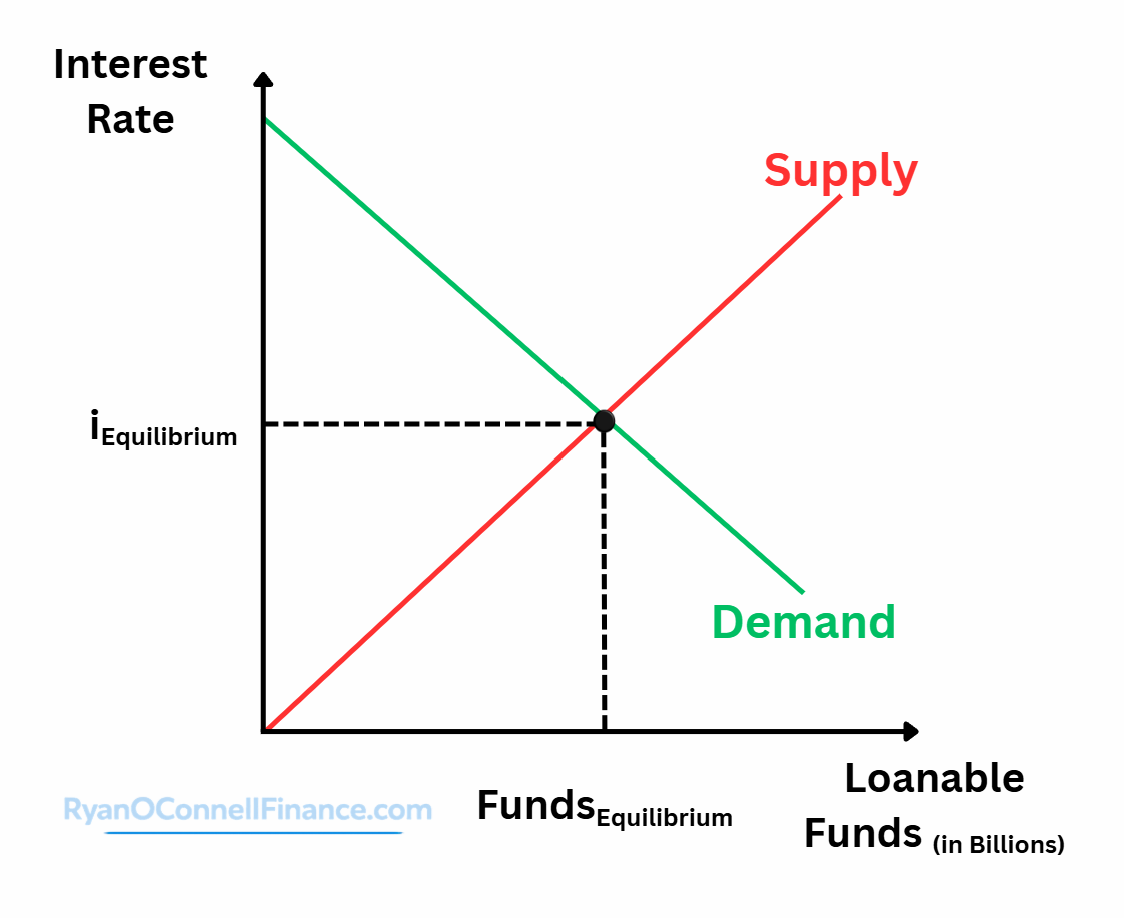
As the diagram above shows, the real interest rate adjusts until the quantity of loanable funds supplied equals the quantity demanded. At the equilibrium interest rate, national saving equals investment (S = I), and the economy’s saving is fully channeled into productive investment.
If the real interest rate is above equilibrium, the quantity of saving exceeds the quantity of investment — there is a surplus of loanable funds. Lenders compete for borrowers by accepting lower rates, pushing the interest rate down. If the real interest rate is below equilibrium, investment demand exceeds available saving — there is a shortage. Borrowers compete for funds by offering higher rates, pushing the interest rate up.
This equilibrating process ensures that the economy’s scarce saving is allocated to the investment projects that offer the highest returns. The interest rate serves as the price signal that coordinates millions of individual saving and investment decisions across the economy. This capital accumulation — the conversion of saving into productive investment — is a key driver of long-run economic growth.
Loanable Funds Market Example
The Economic Recovery Tax Act of 1981 (ERTA) introduced the Accelerated Cost Recovery System (ACRS), which allowed businesses to depreciate capital assets much faster — effectively subsidizing investment spending. This is a textbook demand-side shift in the loanable funds market.
The faster depreciation made capital purchases cheaper for firms, increasing the quantity of investment demanded at every interest rate. In the loanable funds framework, the demand curve shifts to the right. The predicted result: higher real interest rates and higher quantities of saving and investment.
| Before ERTA (1980) | After ERTA (1984) | |
|---|---|---|
| Real Interest Rate (10-Year Treasury minus CPI) | ~2-3% | ~5-6% |
| Gross Private Domestic Investment | ~$480 billion | ~$735 billion |
| Loanable Funds Effect | — | Demand shifted right |
Real interest rates rose sharply as investment demand increased, drawing out more saving from households — a movement along the supply curve. The economy invested more, but at a significantly higher cost of borrowing. (Note: real rates in this period also reflected other factors, including Federal Reserve policy and large budget deficits — see below.)
The same logic works in reverse for saving incentives. If the government offers tax-advantaged retirement accounts (such as expanding IRA contribution limits), households save more at every interest rate, shifting the supply curve to the right. The result: lower interest rates and higher investment — a win for long-run capital accumulation.
Budget Deficits and the Loanable Funds Market
When the government runs a budget deficit (G > T), public saving turns negative. This reduces national saving and shifts the supply of loanable funds to the left. With less saving available, the real interest rate rises and private investment falls.
This mechanism is called crowding out — government borrowing absorbs funds that would otherwise finance private investment, raising borrowing costs for firms and households.
The combination of the 1981 tax cuts and increased defense spending pushed the U.S. federal budget deficit from approximately $79 billion in 1981 to $221 billion by 1986. The loanable funds model predicts that this reduction in public saving should shift the supply curve to the left and raise real interest rates.
Consistent with the model’s prediction, the real interest rate on 10-year Treasury securities (nominal yield minus CPI inflation) rose from roughly 2-3% in 1980 to approximately 5-6% by 1984. Higher real borrowing costs contributed to reduced private investment in interest-sensitive sectors such as housing. This episode is one of the most frequently cited examples of the crowding out mechanism in practice.
For a full analysis of the crowding out mechanism, including partial crowding out and the Ricardian equivalence debate, see our guide on the crowding out effect. For a broader discussion of long-run fiscal sustainability, see national debt economics.
Loanable Funds Market vs Money Market
The loanable funds market and the money market are two distinct models that explain interest rate determination over different time horizons. Understanding which model applies in which context is essential for macroeconomic analysis.
Loanable Funds Market
- Determines the real interest rate
- Supply comes from national saving (private + public)
- Demand comes from investment borrowing (firms + households)
- Long-run equilibrium model
- Shifted primarily by fiscal policy (taxes, spending, deficits)
- Equilibrates the flow of saving and investment over time
Money Market
- Determines the nominal interest rate
- Supply set by the central bank (money supply)
- Demand comes from liquidity preference (transactions, precautionary, speculative)
- Short-run equilibrium model
- Shifted primarily by monetary policy (open market operations, Fed funds rate)
- Equilibrates the stock of money held at a point in time
The key distinction is time horizon. The loanable funds market explains long-run interest rate determination through saving and investment flows. The money market explains short-run interest rate determination through the supply and demand for money. Fiscal policy (taxes and government spending) primarily affects the loanable funds market, while monetary policy (central bank actions) primarily affects the money market. For a deeper look at the money market model, see our guide on money supply and demand.
Common Mistakes
1. Confusing the loanable funds market with the money market. These are two different models that determine two different interest rates. The loanable funds market determines the real interest rate through saving and investment. The money market determines the nominal interest rate through money supply and demand. They answer different questions about different time horizons.
2. Using nominal instead of real interest rates. The vertical axis of the loanable funds diagram is the real interest rate, not the nominal rate. Savers and borrowers make decisions based on inflation-adjusted returns. Plotting the nominal rate confuses the analysis because it conflates changes in inflation with changes in the real cost of borrowing.
3. Treating budget deficits as an increase in demand rather than a decrease in supply. A common error is to say the government “demands” more loanable funds when it runs a deficit. In this model, the budget deficit reduces national saving — the supply side. Public saving (T − G) becomes negative, shifting the supply curve to the left and raising the interest rate.
4. Applying the closed-economy S = I identity to open economies. The identity S = I holds only in a closed economy. In an open economy with international capital flows, the correct identity is S = I + NCO, where NCO is net capital outflow — the net flow of domestic funds invested abroad. By the balance of payments identity, NCO equals net exports (NX). Foreign capital inflows can supplement domestic saving, which is why the United States has been able to sustain large budget deficits while still funding substantial investment — foreign savers help fill the gap.
Limitations of the Loanable Funds Model
The loanable funds model is a useful framework for understanding long-run interest rate determination, but it relies on several simplifying assumptions that limit its direct applicability to real-world financial markets.
1. Closed-economy assumption. The basic model assumes no international capital flows. In reality, most economies are open, and foreign capital can offset domestic saving shortfalls. The United States has run persistent current account deficits financed by foreign saving for decades — a pattern the closed-economy model cannot explain without modification.
2. Single interest rate. The model assumes a single interest rate equilibrates the market. In practice, there are many interest rates that vary by maturity, credit risk, liquidity, and tax treatment. The yield on a 10-year Treasury bond differs substantially from a 30-year mortgage rate or a corporate bond yield. The model abstracts from this term structure complexity.
3. Assumes flexible interest rates. The model assumes the real interest rate adjusts freely to clear the market. In practice, central banks set short-term nominal interest rates, and various institutional frictions — such as interest rate floors, credit rationing, and regulatory constraints — can prevent real rates from adjusting smoothly to their equilibrium level.
Frequently Asked Questions
Disclaimer
This article is for educational and informational purposes only and does not constitute financial or investment advice. The loanable funds model is a simplified framework based on standard macroeconomic theory; real-world financial markets are more complex. Historical data cited (budget deficits, interest rates, investment figures) are approximate values from publicly available government and economic sources. Always consult primary sources and qualified professionals for policy analysis and investment decisions.