Costs of Production in Economics: Fixed, Variable, Marginal & Average Cost Curves

Table of Contents
The costs of production are the foundation of every business decision a firm makes — what to produce, how much to charge, and whether to stay in business at all. From a neighborhood bakery deciding how many loaves to bake each morning to an airline determining how many flights to schedule, understanding cost structures is essential. This guide covers the key cost concepts in economics: fixed and variable costs, marginal cost, average cost curves, economies of scale, and the long-run cost envelope.
What Are Costs of Production?
In economics, the costs of production include all the resources a firm uses to create goods and services. Economists define cost more broadly than accountants do: economic cost includes both explicit costs (direct payments like wages, rent, and materials) and implicit costs (the value of foregone alternatives, such as the owner’s time or capital deployed elsewhere). For a deeper exploration of implicit costs and foregone alternatives, see our guide on opportunity cost.
Economic profit equals total revenue minus total economic cost (both explicit and implicit costs). A firm can earn positive accounting profit while earning negative economic profit — meaning the owner’s resources would generate more value in their next-best alternative use.
This distinction matters for understanding firm behavior. When economists say a firm earns “zero economic profit,” the firm is still covering all its explicit costs and earning a normal return for the owner — it simply is not earning above-normal returns. A firm’s cost structure directly determines its profit margins and long-term viability.
Fixed Costs vs Variable Costs
A firm’s total cost splits into two categories based on how they respond to changes in output:
- Fixed costs (FC) — Costs that do not change with the quantity of output produced. Examples include rent, insurance premiums, equipment leases, and salaried managers. A bakery pays its monthly rent whether it produces 100 loaves or 1,000.
- Variable costs (VC) — Costs that change directly with output. Raw materials, hourly labor, utilities tied to production volume, and shipping costs all rise as a firm produces more.
| Cost Type | Bakery Example | Airline Example |
|---|---|---|
| Fixed Costs | Monthly rent, oven lease, insurance | Aircraft leases, gate fees, salaried pilots |
| Variable Costs | Flour, butter, eggs, hourly bakers | Jet fuel, in-flight meals, baggage handling |
Fixed costs are only “fixed” in the short run — the period during which at least one input cannot be adjusted. In the long run, a firm can renegotiate its lease, sell equipment, or relocate entirely. Every cost becomes variable given enough time.
Marginal Cost
Marginal cost (MC) is the increase in total cost from producing one additional unit of output. It is one of the most important concepts in microeconomics because firms use it to make production decisions at the margin.
Marginal cost is intimately connected to the production function. As a firm adds more of a variable input (like labor) while holding other inputs fixed (like factory size), each additional worker eventually produces less additional output — a principle called diminishing marginal product. Because each additional unit of output requires progressively more input, the cost of each additional unit rises. This is why the marginal cost curve eventually slopes upward.
At very low output levels, marginal cost may initially decline as workers specialize and coordinate more efficiently. But once the fixed inputs become a constraint — the kitchen gets crowded, the machines run at capacity — diminishing returns take over and marginal cost rises. During Tesla’s early Model 3 ramp-up, pushing production beyond the Fremont factory’s designed capacity led to sharply rising costs per additional vehicle as bottlenecks emerged on the assembly line.
Average Total Cost, Average Fixed Cost, and Average Variable Cost
While marginal cost measures the cost of the next unit, average costs measure cost per unit across all output produced:
These three measures are linked: ATC = AFC + AVC. Average fixed cost falls continuously as output increases — each additional unit spreads the fixed cost over a larger base. Average variable cost eventually rises due to diminishing marginal product. The combined result is a U-shaped average total cost curve: ATC falls at first (as declining AFC dominates), reaches a minimum, then rises (as increasing AVC overtakes the declining AFC).
The output level where ATC reaches its minimum is called the efficient scale — the quantity that minimizes the firm’s per-unit cost of production.
A firm’s average fixed cost falls continuously as output increases. This is why high-fixed-cost industries like airlines, software companies, and semiconductor manufacturers aggressively pursue volume — each additional unit sold dilutes fixed costs across a larger base, improving margins even if variable cost per unit stays constant.
The Relationship Between Marginal Cost and Average Total Cost
One of the most important relationships in cost theory is how marginal cost interacts with average total cost:
- When MC < ATC, average total cost is falling
- When MC > ATC, average total cost is rising
- MC crosses ATC at ATC’s minimum point
Marginal cost intersects average total cost at its minimum point — the firm’s efficient scale. This is not a coincidence but a mathematical necessity: whenever the marginal value is below the average, it pulls the average down; whenever it is above, it pulls the average up.
The intuition is straightforward. Think of it like a grade point average: if the grade on your next exam (the marginal) is below your cumulative GPA (the average), your GPA falls. If the next grade is above your GPA, it rises. The marginal always pulls the average toward itself, and they must intersect where the average changes direction — at its minimum. The same logic applies to marginal cost crossing average variable cost at AVC’s minimum.
Short-Run Cost Curves
In the short run, at least one input is fixed — typically capital like factory size, equipment, or store space. This constraint gives rise to the characteristic shapes of the short-run cost curves:
- MC curve — Eventually upward-sloping due to diminishing marginal product of the variable input
- ATC curve — U-shaped, with its minimum at the efficient scale
- AVC curve — Also U-shaped, reaching its minimum at a lower output level than ATC (because ATC = AVC + AFC, and AFC is still declining when AVC begins to rise)
- AFC curve — Continuously declining as fixed costs are spread over more units
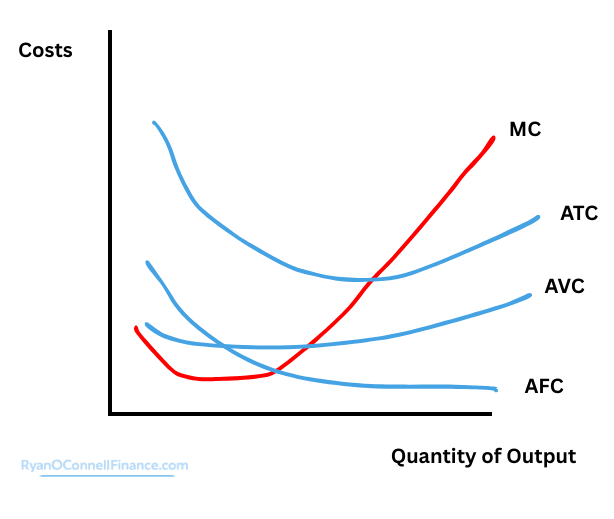
MC crosses both AVC and ATC at their respective minimums. These relationships are driven by diminishing marginal returns to the variable input — not by any change in input prices or worker quality, but simply because workers have less capital to work with as more are hired into a fixed facility.
Consider a coffee shop with a fixed lease and three espresso machines. The first two baristas are highly productive — each has dedicated equipment and workspace. A third barista can still contribute meaningfully. But a fourth and fifth must share machines and crowd the counter, producing progressively less additional output per worker. Costs per additional cup served rise accordingly.
Long-Run Average Total Cost and Economies of Scale
In the long run, all inputs are variable. A firm can change its factory size, technology, number of locations, and workforce composition. There are no fixed costs by assumption — every input can be adjusted to the optimal level for a given output target.
The long-run average total cost (LRATC) curve is the “envelope” of all possible short-run ATC curves. For each output level, the firm chooses the plant size that minimizes average total cost. The LRATC curve has three distinct regions:
| Region | LRATC Behavior | Cause | Real-World Example |
|---|---|---|---|
| Economies of Scale | Declining | Specialization of labor, bulk purchasing, spreading R&D costs | Amazon’s warehouse network uses automation and worker specialization to reduce per-unit fulfillment costs as volume grows |
| Constant Returns to Scale | Flat | Specialization gains exhausted, coordination costs not yet severe | Mid-sized regional manufacturers operating at efficient scale |
| Diseconomies of Scale | Rising | Coordination problems, bureaucracy, communication breakdowns | Large conglomerates adding management layers that slow decisions and increase overhead |
The minimum efficient scale is the smallest output level at which a firm achieves the lowest possible long-run average total cost. Below this level, the firm has not fully captured available economies of scale. Industries with high minimum efficient scales (like automobile manufacturing or semiconductor fabrication) tend to have fewer, larger firms.
Adam Smith observed specialization’s power in an 18th-century pin factory: ten workers each performing a specialized task could produce 48,000 pins per day, while each working alone might produce only 10. This division of labor is the core mechanism behind economies of scale — but it has limits. As organizations grow very large, the cost of coordinating thousands of specialized workers across departments, divisions, and geographies eventually outweighs the benefits of further specialization. This is also why a firm’s cost efficiency is a key component of return on equity, as analyzed through the DuPont analysis framework.
Natural monopolies arise when economies of scale are so large that a single firm can serve the entire market at lower average cost than two or more firms could. Utility companies providing water or electricity through local networks are a common example. For more on how market power affects pricing when scale advantages are extreme, see our guide on monopoly and market power.
Costs of Production Example: Bakery Cost Table
To bring these concepts together, consider a bakery with fixed costs of $100 per day (rent on the shop) and variable costs that increase with each additional loaf produced:
| Quantity (loaves) | FC ($) | VC ($) | TC ($) | MC ($) | AFC ($) | AVC ($) | ATC ($) |
|---|---|---|---|---|---|---|---|
| 0 | 100 | 0 | 100 | — | — | — | — |
| 1 | 100 | 30 | 130 | 30 | 100.00 | 30.00 | 130.00 |
| 2 | 100 | 50 | 150 | 20 | 50.00 | 25.00 | 75.00 |
| 3 | 100 | 80 | 180 | 30 | 33.33 | 26.67 | 60.00 |
| 4 | 100 | 120 | 220 | 40 | 25.00 | 30.00 | 55.00 |
| 5 | 100 | 180 | 280 | 60 | 20.00 | 36.00 | 56.00 |
| 6 | 100 | 260 | 360 | 80 | 16.67 | 43.33 | 60.00 |
| 7 | 100 | 370 | 470 | 110 | 14.29 | 52.86 | 67.14 |
Key observations:
- MC initially falls from $30 to $20 (between Q = 1 and Q = 2) as the first workers specialize, then rises continuously as diminishing marginal product sets in
- Efficient scale is at Q = 4, where ATC reaches its minimum of $55.00 per loaf
- MC crosses ATC between Q = 4 and Q = 5 — at Q = 4, MC ($40) is still below ATC ($55), but at Q = 5, MC ($60) exceeds ATC ($56). With discrete data, the crossing occurs between output levels rather than on an exact row
- AFC declines continuously from $100 to $14.29, illustrating the “spreading effect” of fixed costs
- AVC reaches its minimum at Q = 2 ($25.00), earlier than ATC’s minimum — exactly as theory predicts
How to Calculate Cost Curves
Calculating a firm’s cost curves requires data on total costs at different output levels. The process is conceptually straightforward:
- Identify fixed and variable costs: Separate costs that remain constant regardless of output (rent, insurance) from those that change with production volume (materials, hourly labor)
- Compute total cost: TC = FC + VC at each output level
- Calculate marginal cost: MC = ΔTC / ΔQ — the change in total cost when output increases by one unit
- Calculate average costs: ATC = TC / Q, AFC = FC / Q, AVC = VC / Q at each positive output level
- Identify efficient scale: Find the output level where ATC is minimized — this is where MC crosses ATC
Understanding cost curves is essential for analyzing how firms make production and pricing decisions. For more on how firms use these curves to determine output and supply behavior, see our guide on firms in competitive markets.
Short-Run vs Long-Run Costs
Short-Run Costs
- At least one input is fixed (factory, equipment)
- Both fixed and variable costs exist
- U-shaped ATC driven by diminishing marginal returns
- Firm operates on one specific SRATC curve
- Example: airline with a fixed fleet size
Long-Run Costs
- All inputs are variable (no inputs are fixed by assumption)
- No fixed costs — everything can be adjusted
- LRATC shaped by economies and diseconomies of scale
- Firm can choose the optimal plant size for any output level
- Example: airline can buy or sell aircraft, open or close routes
The terms “short run” and “long run” are not defined by calendar time — they are analytical horizons that depend on the industry. For a food truck, the long run might be a few weeks (time to buy a second truck). For a semiconductor fabrication plant, the long run could be five years or more (time to design and build a new facility). The key distinction is whether the firm can adjust all of its inputs or is constrained by at least one fixed factor. Cost curves underpin the supply curve that firms use to determine how much to produce at each price.
Common Mistakes
1. Confusing economic cost with accounting cost — Economic cost includes implicit costs (foregone opportunities), not just explicit cash outlays. A business showing $50,000 in accounting profit may have negative economic profit if the owner could earn $80,000 in salary elsewhere. Always account for what you give up. Learn more in our opportunity cost guide.
2. Thinking fixed costs are always fixed — Fixed costs are only fixed in the short run, when at least one input cannot be adjusted. In the long run, a firm can renegotiate its lease, sell its factory, or exit the industry entirely. Every cost becomes variable given enough time.
3. Forgetting that marginal cost crosses average total cost at ATC’s minimum — This is a mathematical necessity, not a coincidence. When the cost of the next unit (MC) is below the current average (ATC), it pulls the average down. When it is above the average, it pulls the average up. They must intersect at the turning point.
4. Assuming economies of scale last forever — Economies of scale are powerful, but they have limits. Eventually, growing larger creates coordination problems, bureaucratic overhead, and communication breakdowns that push long-run average total cost back up. Bigger is not always cheaper.
Limitations of Cost Curve Analysis
Cost curves are simplified models of firm behavior. Real-world costs are messier than the smooth, continuous curves in textbook diagrams — but the core relationships they illustrate remain powerful tools for understanding firm decisions.
1. Smooth curves vs lumpy real-world costs — Textbook cost curves are continuous, but real firms face stepped or lumpy costs. Adding a second production shift, leasing a new warehouse, or buying another machine creates discrete cost jumps rather than smooth changes.
2. Diminishing marginal product may not always hold — The assumption that adding workers to a fixed facility eventually yields less additional output per worker is reasonable for physical production, but may not apply uniformly in knowledge-based industries where collaboration can increase rather than decrease marginal productivity.
3. The short run vs long run boundary is context-dependent — There is no universal timeline. Remodeling a coffee shop takes weeks; building a nuclear power plant takes a decade. The “long run” is defined by the industry’s adjustment speed, not by a fixed number of months or years.
4. Cost curves reflect current technology — Innovation can shift entire cost curves downward. Cloud computing dramatically reduced IT infrastructure costs for startups. Advances in robotics continue to reshape manufacturing cost structures. Historical cost data may not predict future costs when technology is changing rapidly.
Frequently Asked Questions
Disclaimer
This article is for educational and informational purposes only and does not constitute financial or investment advice. Cost data and examples are illustrative and may not reflect current market conditions. The economic models presented are simplified representations of firm behavior. Always conduct your own analysis and consult qualified professionals before making business or investment decisions.