Enter Values

$
Costs that remain constant regardless of output
$/unit
Base variable cost per unit (MC starts at this value)
$/unit²
Drives rising MC from diminishing returns (b = 0 for constant MC)
units
Calculate cost data from Q = 0 to this value
$
Total fixed cost at all output levels
Quantity Variable Cost ($)
Cost Function Formulas
TC = FC + aQ + bQ²
MC = a + 2bQ | ATC = FC/Q + a + bQ | AVC = a + bQ | AFC = FC/Q | Q* = √(FC/b)
Ryan O'Connell, CFA
Calculator by Ryan O'Connell, CFA

Cost Curves

Efficient Scale

Efficient Scale (Q*) --
ATC at Q* --
MC at Q* --

Cost Data Table

Q TC FC VC MC ATC AFC AVC
Model Assumptions
  • Quadratic mode assumes TC = FC + aQ + bQ² (MC rises linearly, ATC is U-shaped)
  • Diminishing marginal returns drive the upward-sloping portion of MC
  • Short-run analysis — at least one input (e.g., capital or factory size) is fixed
  • Manual mode makes no functional form assumption — uses discrete differences
  • All costs are measured in the same currency unit
  • For educational purposes. Not financial advice. Market conventions simplified.

Understanding Cost Curves

What Are Cost Curves?

Cost curves show how a firm's costs change as it produces more output. The four main cost curves — marginal cost (MC), average total cost (ATC), average variable cost (AVC), and average fixed cost (AFC) — are fundamental tools in microeconomics for understanding firm behavior, pricing, and market structure.

Quadratic Cost Function
TC = FC + aQ + bQ²
MC = a + 2bQ (rises linearly with output)
ATC = FC/Q + a + bQ (U-shaped)
Q* = √(FC/b) (efficient scale)

Why Does Marginal Cost Rise?

In the quadratic cost model, MC = a + 2bQ rises linearly when b > 0. This reflects diminishing marginal product: as more workers share fixed equipment, each additional unit of output becomes progressively costlier to produce. At low output, workers and equipment are underutilized. At high output, crowding and resource constraints push costs up.
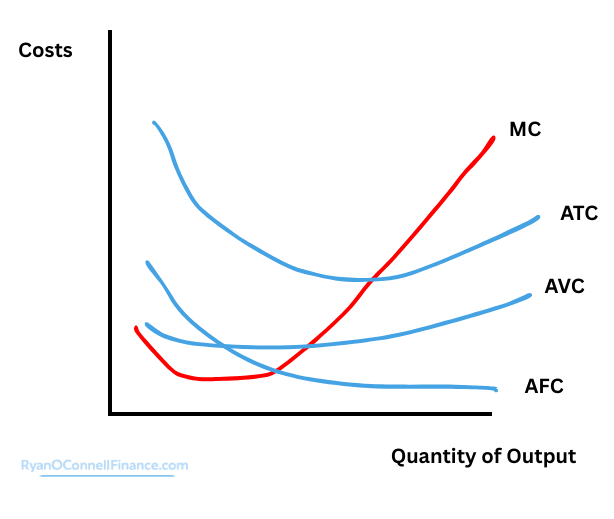
Cost curves for a typical firm showing marginal cost (MC) as a red U-shaped curve crossing through the minimum points of both the blue average variable cost (AVC) and average total cost (ATC) curves, with average fixed cost (AFC) declining continuously toward zero as quantity of output increases
Cost curves for a typical firm: MC crosses AVC at its minimum and ATC at its minimum (the efficient scale). AFC declines continuously as fixed costs spread over more units.

The MC-ATC Relationship

MC and ATC have a crucial relationship: MC crosses ATC at ATC's minimum point (the efficient scale). When MC < ATC, each additional unit costs less than the current average, pulling ATC down. When MC > ATC, each additional unit costs more, pushing ATC up. Think of it like your GPA — a course grade above your GPA raises it, and below your GPA lowers it.

Key Assumptions

  • Short-run analysis: at least one input (e.g., factory size) is fixed
  • Quadratic cost function produces rising MC and U-shaped ATC
  • Efficient scale (Q*) minimizes average total cost
  • MC intersects ATC at the efficient scale in quadratic mode
  • Manual mode uses discrete differences without assuming a functional form
Short-Run vs. Long-Run: This calculator analyzes short-run costs where at least one input is fixed. In the long run, all inputs are variable and firms choose the optimal scale of production. The long-run ATC curve is the envelope of all short-run ATC curves.
Download This Calculator as an Excel Template Interactive model with editable formulas — customize, save, and share.
Get Excel Template

Frequently Asked Questions

Marginal cost (MC) is the additional cost of producing one more unit of output, calculated as ΔTC/ΔQ. In the quadratic cost model TC = FC + aQ + bQ², marginal cost equals a + 2bQ, which rises linearly with output when b > 0. This increase reflects diminishing marginal product — as more workers share fixed equipment, each additional unit becomes costlier to produce. Real-world MC curves can be U-shaped with more complex cost functions, but the quadratic model captures the key insight that MC eventually rises.

MC and ATC have a crucial relationship: MC intersects ATC at ATC's minimum point, known as the efficient scale. When MC is below ATC, each additional unit costs less than the current average, pulling ATC down. When MC exceeds ATC, each additional unit costs more than the average, pushing ATC up. This is why MC always crosses ATC at its lowest point — similar to how your GPA rises when a course grade exceeds it and falls when it is below it.

The efficient scale is the quantity of output that minimizes average total cost (ATC). At this point, MC equals ATC. For a quadratic cost function TC = FC + aQ + bQ², the efficient scale is Q* = √(FC/b). Producing at the efficient scale means the firm achieves the lowest possible cost per unit. In perfectly competitive markets, long-run equilibrium pushes firms toward producing at their efficient scale.

The short-run ATC curve has two distinct regions separated by the efficient scale (Q*). For output below Q*, ATC is declining because the effect of spreading fixed costs over more units dominates. For output above Q*, ATC is rising because increasing variable costs per unit dominate. While economies and diseconomies of scale are technically long-run concepts involving all inputs being variable, the short-run ATC curve exhibits analogous behavior driven by fixed cost spreading and diminishing marginal returns.

Fixed costs (FC) remain constant regardless of output level — examples include rent, insurance, and equipment leases. They must be paid even when producing zero units. Variable costs (VC) change with the quantity produced — examples include raw materials, hourly wages, and electricity for machinery. Total cost is always TC = FC + VC. In the short run, at least one input is fixed (like factory size), which creates the distinction between fixed and variable costs.

In a competitive market, a firm's short-run supply curve is the portion of its MC curve that lies above the AVC curve. If the market price is below AVC at every output level, the firm shuts down (produces zero). If price is between AVC and ATC, the firm operates at a loss but covers its variable costs. If price is above ATC, the firm earns a profit. The firm produces where P = MC (as long as P ≥ AVC). This calculator visualizes cost curves but does not directly solve for the supply curve — that relationship is a short-run conceptual extension for competitive firms.
Disclaimer

This calculator is for educational purposes only. It uses simplified cost function models to illustrate microeconomic concepts from introductory economics courses. Real-world cost structures may be more complex than the quadratic model presented here. This tool should not be used for business or financial decisions.