
Green Bonds & ESG Fixed Income: How Sustainable Bonds Work

Table of Contents
Green bonds are fixed income instruments whose proceeds are designated for projects with environmental objectives. With annual green bond issuance exceeding $650 billion in 2025 and cumulative issuance surpassing $4 trillion according to the Climate Bonds Initiative, this market segment has attracted significant institutional capital. Understanding how green bonds work — including their structure, pricing dynamics, and limitations — is essential for fixed income investors evaluating this asset class.
What Are Green Bonds?
A green bond is a fixed income instrument whose proceeds are designated for projects classified as environmentally beneficial by the issuer. The issuer commits to allocating funds to eligible green project categories such as renewable energy, clean transportation, sustainable water management, or energy-efficient buildings. Whether these projects achieve meaningful environmental outcomes is a separate question from whether the bond qualifies as “green” under market conventions.
Standard green bonds (the most common type) are structurally identical to conventional bonds — same credit quality, same legal recourse, same payment mechanics. The difference is in the use of proceeds: green bond funds must be earmarked for projects designated as environmentally beneficial, and issuers typically provide impact reporting. Other green bond structures (revenue, project, secured) may have different risk profiles.
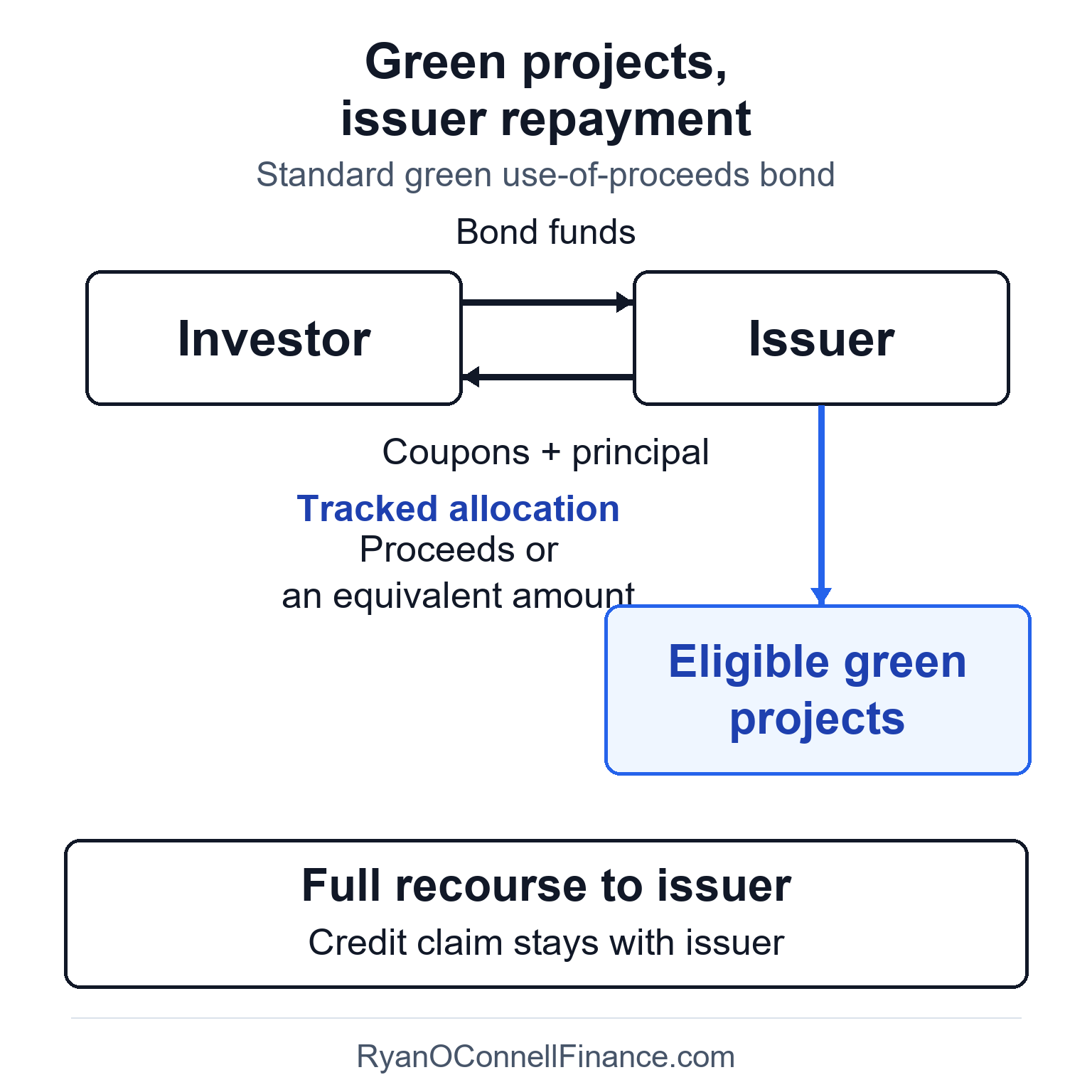
Credit analysis therefore follows the issuer and the bond’s contractual ranking.
The green bond market originated in 2007 when the European Investment Bank (EIB) issued the first “Climate Awareness Bond.” The World Bank followed in 2008, and corporate issuers like Apple, Verizon, and Toyota have since entered the market. Today, green bonds are issued by sovereigns (France, Germany), supranationals (EIB, World Bank), corporates, and municipalities.
The market has grown rapidly: from under $50 billion in annual issuance in 2015 to over $650 billion by 2025. This growth reflects increasing investor demand for sustainable fixed income and regulatory support like the EU Green Bond Regulation (effective December 2024).
The Green Bond Principles
The Green Bond Principles (GBP), established by the International Capital Market Association (ICMA), provide voluntary guidelines that promote transparency and integrity in the green bond market. The principles define four core components:
| Principle | Description |
|---|---|
| 1. Use of Proceeds | Proceeds must be used for projects in eligible green categories. Categories include renewable energy, energy efficiency, clean transportation, sustainable water, and green buildings. |
| 2. Project Evaluation & Selection | Issuers must clearly communicate their environmental objectives, the process for determining project eligibility, and any exclusion criteria. |
| 3. Management of Proceeds | Net proceeds must be tracked and credited to a sub-account or otherwise segregated. Unallocated proceeds should be invested in cash, cash equivalents, or other liquid instruments. |
| 4. Reporting | Issuers should provide annual reports on proceeds allocation and, where feasible, expected environmental impact (e.g., tonnes of CO2 avoided). |
Most green bond issuers obtain a Second Party Opinion (SPO) from an external reviewer (such as Sustainalytics, Vigeo Eiris, or CICERO) to verify alignment with the Green Bond Principles. However, the GBP are voluntary — there is no legal enforcement mechanism, which creates the potential for “greenwashing.”
When evaluating green bonds, check for a Second Party Opinion and review the issuer’s annual impact report. Look for quantified environmental metrics, not just qualitative statements.
Types of Sustainable Bonds
The sustainable bond market includes several distinct structures. Understanding the differences helps investors evaluate how each instrument type restricts issuer behavior or use of proceeds.
Green Bond Structures (ICMA Classification)
ICMA’s Green Bond Principles recognize four structural types, all with proceeds earmarked for green projects:
| Type (ICMA Terminology) | Recourse | Description |
|---|---|---|
| Standard Green Use of Proceeds Bond | Full recourse to issuer | Senior unsecured bond with green use of proceeds. Most common structure — credit risk equals the issuer’s general creditworthiness. |
| Green Revenue Bond | Pledged revenue streams | Non-recourse to issuer; credit exposure is to pledged cash flows (e.g., utility revenues, toll receipts). Proceeds may fund projects beyond the revenue source. |
| Green Project Bond | Project only (may have partial issuer recourse) | Investor bears exposure to underlying project risk. May be with or without recourse to the issuer depending on structure. |
| Secured Green Bond | Collateral-backed | Similar to covered bonds or ABS; backed by a pool of green assets as collateral. Credit quality depends on collateral, not just issuer. |
Other Sustainable Bond Labels
Beyond green bonds, the market includes related instruments with different objectives:
- Social Bonds — Proceeds finance projects in social categories (affordable housing, healthcare access, education, employment programs).
- Sustainability Bonds — Proceeds finance a combination of green and social projects.
- Sustainability-Linked Bonds (SLBs) — SLBs typically allow general-purpose use of proceeds. Instead, the bond’s financial characteristics (typically the coupon rate) are tied to the issuer achieving predefined sustainability targets (e.g., reducing carbon emissions by 25% by 2030). A missed target can trigger a coupon step-up under the bond’s terms.
Green, social, and sustainability bonds earmark proceeds for eligible projects. Sustainability-linked bonds tie financial terms to key performance indicator (KPI) outcomes, such as measured emissions, and typically allow general-purpose funding; a hybrid can combine both features.
Consider a hypothetical five-year bond paying a 3% annual coupon. Its terms test a sustainability target at the end of year three and add 25 basis points to the remaining coupons if the target is missed. Compare the two outcomes on $10,000 face value.
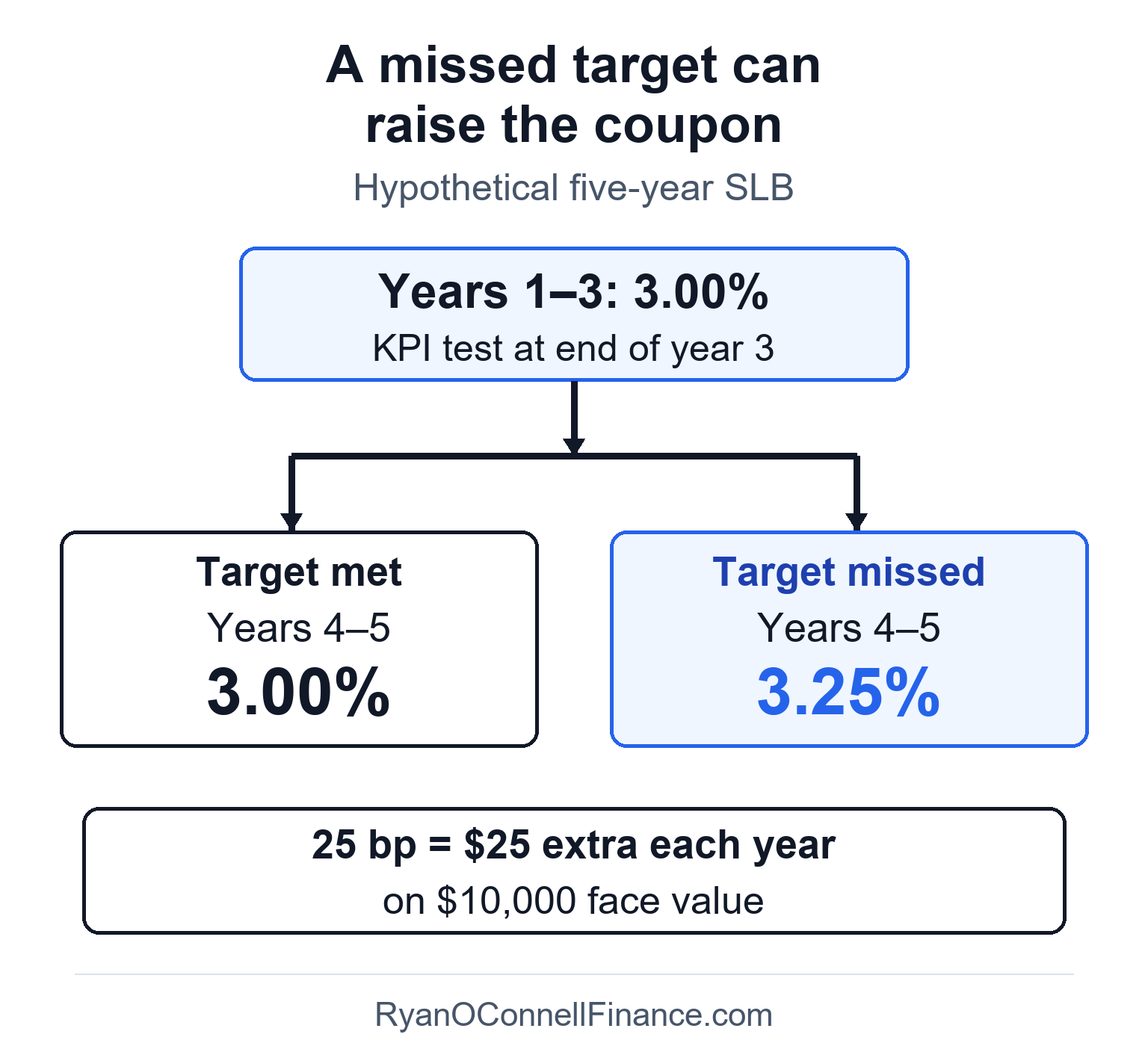
The target affects the last two annual coupons in this example; the bond terms determine the timing and size of any adjustment.
Use of Proceeds and Impact Reporting
The defining feature of green bonds is the commitment to allocate proceeds to eligible environmental projects. Common eligible project categories include:
- Renewable energy (solar, wind, hydroelectric)
- Energy efficiency (building retrofits, smart grids)
- Clean transportation (electric vehicles, rail infrastructure)
- Sustainable water management
- Pollution prevention and control
- Green buildings (LEED-certified construction)
Issuers typically publish an annual Allocation and Impact Report detailing how proceeds were deployed and the expected or achieved environmental benefits. Metrics may include megawatts of renewable capacity installed, tonnes of CO2 emissions avoided, or gallons of water conserved.
However, impact measurement remains imprecise. Different issuers use different methodologies, making cross-issuer comparisons difficult. Some projects (like refinancing existing green assets) may have less incremental impact than new construction.
| Check | Question and evidence |
|---|---|
| Allocation | Where did proceeds go? Look for project allocations and amounts. |
| Impact | What is expected or achieved? Look for environmental metrics, assumptions and the measurement period. |
| Additionality | What changes because of this financing? Look for evidence against a credible alternative without the bond. |
A proceeds ledger can establish allocation while reported impact still rests on estimates. Showing additional benefits caused by the financing requires a separate case.
Sources: ICMA impact-reporting framework, June 2026, and IPCC AR6, Working Group III, Chapter 15 (2022).
Because the Green Bond Principles are voluntary, some bonds may carry the “green” label without delivering meaningful environmental impact. Academic research (Lyon & Maxwell) documents adverse selection: issuers can enjoy reputational benefits without rigorous verification. Always review the SPO and impact reports before assuming genuine environmental benefit.
The Greenium Debate: Do Green Bonds Pay Lower Yields?
A central question for investors is whether green bonds trade at a “greenium” — a price premium and corresponding lower yield compared to otherwise comparable conventional bonds from the same issuer.
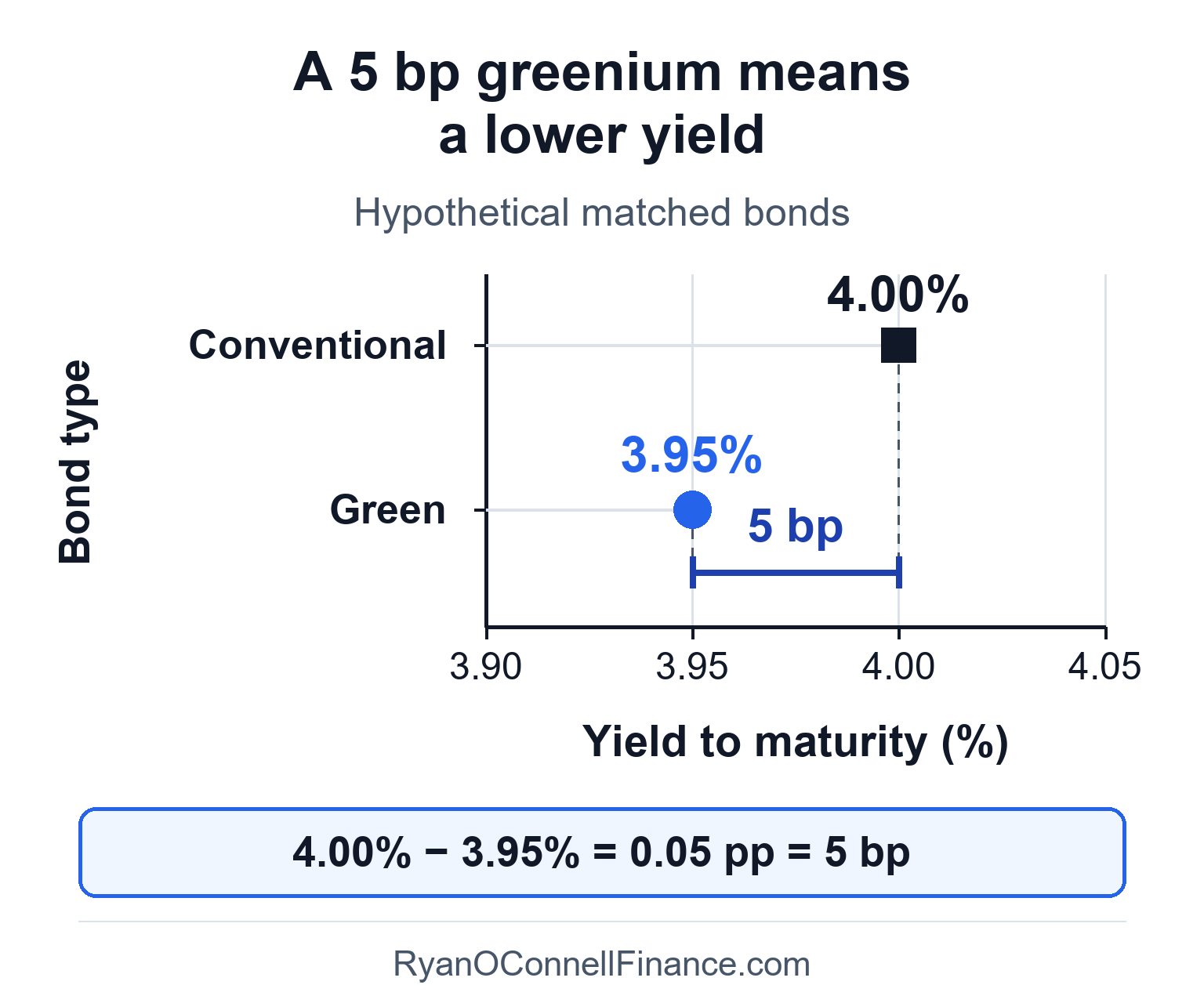
The green bond yields 5 basis points less in this hypothetical matched pair, a difference of 0.05 percentage points. This comparison concerns yield to maturity; the SLB example above changes the contractual coupon.
The academic evidence is mixed:
| Evidence FOR Greenium | Evidence AGAINST or Mixed |
|---|---|
| Partridge & Medda (2020): Documented greenium in U.S. municipal bond market | Hachenberg & Schiereck (2018): Found only a very small greenium (~1-2 bp) in corporate bonds |
| Zerbib (2019): Slight yield compression in primary market for green bonds | Fatica, Panzica & Rancan (2021): Greenium varies significantly by issuer type and market conditions |
| Wulandari et al. (2018): Significant premium in secondary market | Baker et al. (2018): Municipal green bonds show modest premium, but effect is not universal |
Several factors may explain the inconsistent findings:
- Market asymmetry: Retail investors cannot access primary market issuance, so secondary market demand may exceed supply, creating a premium that doesn’t exist at issuance.
- Risk characteristics: Meziani (2020) found green bonds have lower beta coefficients than conventional bonds and outperform during market turmoil — suggesting risk reduction, not just impact preference.
- Supply constraints: Limited green bond supply relative to ESG-mandated demand may create pricing distortions.
Evidence is mixed. Some studies find green bonds trade 2-6 basis points tighter than conventional equivalents; others find no difference. Don’t assume green bonds will automatically cost you yield — but don’t expect premium returns either. Focus on credit quality and liquidity, not the green label alone.
How to Invest in Green Bonds
Individual green bonds can be difficult for retail investors to access — issue sizes are often large, liquidity can be thin, and the primary market is dominated by institutional buyers. Most investors gain exposure through funds:
- Green Bond ETFs: Examples include the iShares USD Green Bond ETF (BGRN), which tracks the Bloomberg MSCI Green Bond Index, and the VanEck Green Bond ETF.
- ESG Bond Mutual Funds: Many fixed income funds now integrate ESG criteria, though not all focus specifically on green bonds.
- Sovereign and Supranational Bonds: Individual investors can sometimes purchase sovereign green bonds (like France’s OAT Verte) through brokers offering international fixed income.
When evaluating green bond funds, examine the methodology: Does the fund require third-party verification? Does it include sustainability-linked bonds (which have different structures)? What’s the credit quality distribution?
Green bond ETFs provide diversified exposure and daily liquidity, but check the fund’s index methodology. Some indices include any bond labeled “green” without verifying impact quality.
Green Bonds vs Conventional Bonds
When comparing green bonds to conventional bonds from the same issuer, here’s what investors should consider:
Green Bonds
- Yield: May trade slightly tighter (greenium)
- Credit Quality: Same as issuer’s conventional debt
- Liquidity: Often lower; fewer issues outstanding
- Use of Proceeds: Earmarked, often externally reviewed
- Investor Base: ESG-mandated + traditional buyers
- Reporting: Annual impact reports typically required
Conventional Bonds
- Yield: Market rate for issuer’s credit
- Credit Quality: Issuer’s standard rating
- Liquidity: Generally higher; deeper secondary market
- Use of Proceeds: General corporate purposes
- Investor Base: Traditional fixed income buyers
- Reporting: Standard financial disclosures only
For standard recourse green bonds, credit risk is identical to conventional bonds — you have the same legal claim on the issuer. The key differences are use of proceeds transparency and (potentially) a small yield differential.
Limitations
Despite the growth of the green bond market, investors should be aware of several limitations:
1. Standards Are Voluntary — The Green Bond Principles provide guidelines, not legal requirements. There is no single global standard, though the EU Green Bond Standard (effective 2024) creates a more rigorous framework for bonds issued under that label.
2. Greenwashing Risk — Without mandatory third-party verification, some bonds may carry a green label without delivering meaningful environmental impact. A Second Party Opinion helps, but SPO quality varies.
3. Impact Measurement Is Imprecise — Comparing environmental impact across issuers is difficult due to inconsistent methodologies. Refinancing existing green assets has different additionality than funding new projects.
4. Limited Supply Constrains Portfolio Construction — Green bonds remain a small fraction of the overall fixed income market, limiting diversification options for investors seeking pure green exposure.
5. No Global Official Register — There is no authoritative database of all green bonds (Gyura). Investors must rely on commercial data providers and index methodologies to identify eligible securities.
6. Additionality Is Debated — Critics argue that many green bond projects would have been funded through conventional financing regardless (Shishlov, Morel & Cochran). If green bonds merely relabel existing capital flows rather than directing incremental capital to environmental projects, their real-world impact may be limited. This remains an active academic debate with no consensus.
Common Mistakes
Investors new to green bonds often make these errors:
1. Assuming “Green” Means Lower Risk — The green label says nothing about credit quality. A green bond from a BB-rated issuer carries the same default risk as their conventional debt. Credit analysis still applies.
2. Ignoring Credit Fundamentals for ESG Labels — Chasing impact without analyzing the issuer’s financial health can lead to unexpected losses. Always evaluate the underlying credit before buying.
3. Expecting Premium Returns — The greenium, if it exists, actually compresses yields. Green bonds may slightly underperform conventional bonds on a pure yield basis, though risk-adjusted returns may differ.
4. Confusing Sustainability-Linked Bonds with Green Bonds — SLBs generally allow general-purpose funding and tie financial terms to sustainability targets. A coupon step-up is one possible adjustment. Check the terms before treating an SLB as a use-of-proceeds green bond.
5. Assuming a Green Label Guarantees Impact — A Second Party Opinion or green label does not automatically mean the projects will deliver meaningful environmental benefits. Review the actual impact reports.
Frequently Asked Questions
Disclaimer
This article is for educational and informational purposes only and does not constitute investment advice. Green bond characteristics, yields, and market conditions change over time. Always conduct your own research and consult a qualified financial advisor before making investment decisions.
Keep reading
Next in this series
Part 9 of 12 in Bond Analysis & Portfolio Strategy
Bond Market Liquidity: OTC Trading, Bid-Ask Spreads & RiskMore in Fixed Income
-
Bond Pricing & Yield to Maturity: Complete Guide
Learn how to calculate bond prices and yield to maturity (YTM) with step-by-step formulas and examples for annual and semi-annual coupon bonds.
-
Interest Rate Risk: Duration, Convexity & Hedging
Comprehensive guide to interest rate risk — how duration, convexity, and key rate duration measure bond price sensitivity, with hedging strategies including…
-
Spot Rates and Forward Rates: Complete Guide
Learn the difference between spot rates and forward rates, how to calculate forward rates from spot rates, and how bootstrapping extracts zero-coupon yields…

