Aggregate Demand & Aggregate Supply: The AD-AS Model Explained

Aggregate demand and aggregate supply form the central framework economists use to explain why economies experience recessions, booms, and inflation. The AD-AS model shows how the overall price level and total output are determined — and how shocks to spending or production costs can push an economy into a downturn or trigger rising prices. From the 2008 financial crisis to the 1970s oil shocks, the AD-AS model provides a structured way to analyze what went wrong and what policy responses are available. This guide covers the complete model: what the curves represent, why they slope the way they do, what shifts them, and how the economy adjusts in the short run and the long run.
What is the AD-AS Model?
The AD-AS model is the primary framework for analyzing short-run economic fluctuations — periods when the economy’s output deviates from its long-run potential. It consists of two sides: aggregate demand (the total quantity of goods and services demanded at each price level) and aggregate supply (the total quantity produced and sold at each price level).
The AD-AS model plots the overall price level on the vertical axis and real GDP (total output) on the horizontal axis. Where the aggregate demand curve intersects the aggregate supply curve determines the economy’s equilibrium output and price level. Aggregate supply has two versions: a short-run aggregate supply (SRAS) curve that slopes upward, and a long-run aggregate supply (LRAS) curve that is vertical.
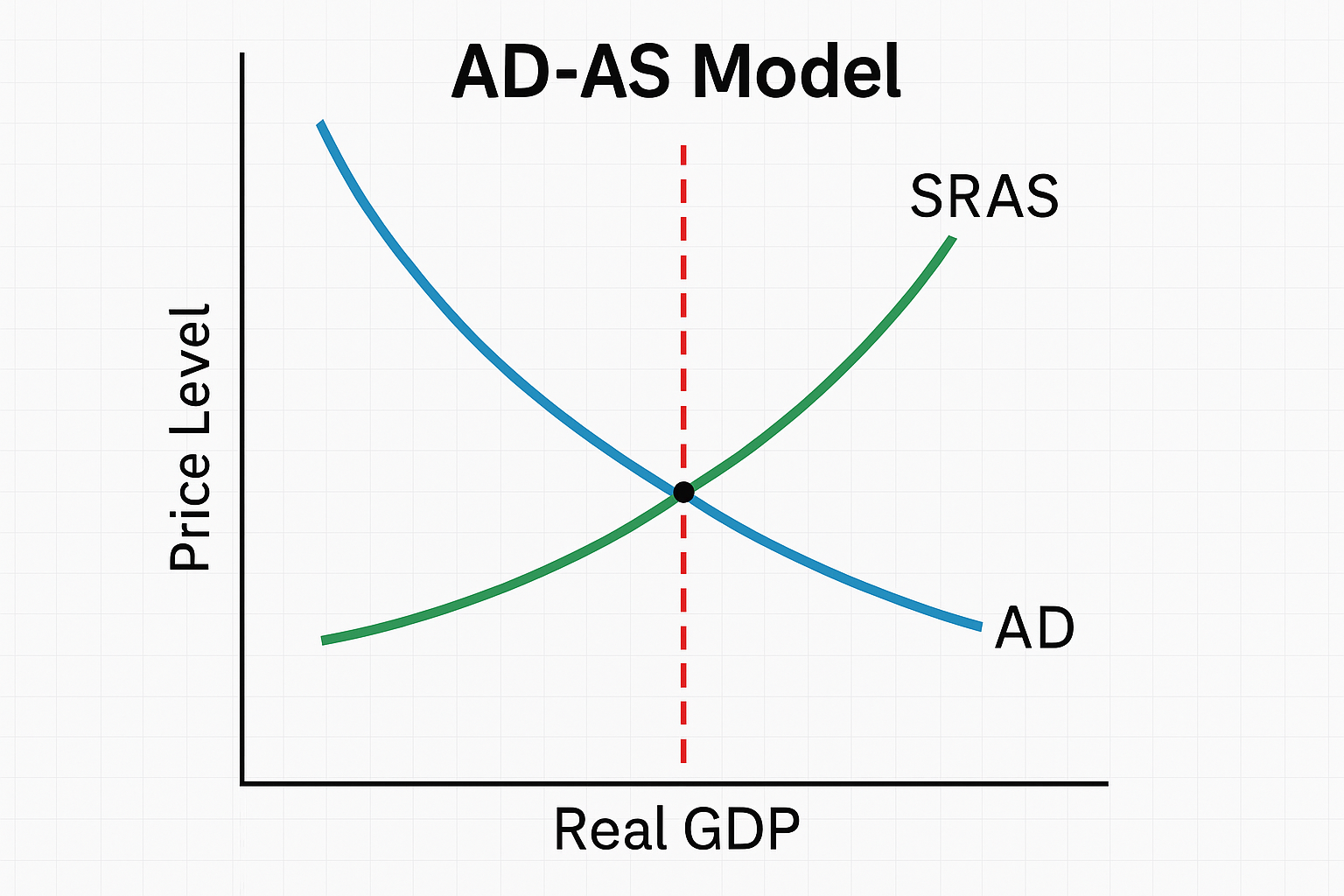
Unlike microeconomic supply and demand for a single good, the AD-AS model describes the entire economy. The reasons the curves slope the way they do are fundamentally different from micro demand and supply. In micro, demand slopes down because of the substitution effect — consumers switch to cheaper alternatives. In macro, there are no alternatives to “all goods and services,” so entirely different mechanisms drive the relationship.
Total spending in the economy is defined by the GDP identity: Y = C + I + G + NX (consumption + investment + government purchases + net exports). This identity tells us what aggregate demand measures — the sum of all spending — but it does not explain why the AD curve slopes downward. That requires understanding three distinct effects.
Why Does the Aggregate Demand Curve Slope Downward?
The aggregate demand curve slopes downward because a lower overall price level increases the total quantity of goods and services demanded through three reinforcing channels. Each operates through a different component of GDP.
The Wealth Effect (Consumption)
When the overall price level falls, the real value of money holdings increases. Consumers’ existing cash and savings can now buy more goods and services, making them effectively wealthier. This increase in real wealth encourages higher consumption spending. Conversely, a rising price level erodes real wealth and reduces consumption.
The Interest Rate Effect (Investment)
A lower price level means households need less money to purchase their usual goods and services. They deposit the excess in banks or buy bonds, which increases the supply of loanable funds and drives down interest rates. Lower interest rates encourage firms to borrow for capital investment and households to finance homes and durable goods, increasing investment spending. A higher price level has the opposite effect — more money is needed for transactions, interest rates rise, and investment falls.
The Exchange Rate Effect (Net Exports)
Lower domestic interest rates (triggered by a lower price level) cause some investors to seek higher returns abroad. Capital flows out of the country, increasing the supply of domestic currency in foreign exchange markets and causing the currency to depreciate. A weaker currency makes domestic goods cheaper for foreign buyers and foreign goods more expensive for domestic consumers, boosting net exports. A higher price level strengthens the currency and reduces net exports.
All three effects point in the same direction: a lower price level increases quantity demanded, and a higher price level decreases it. The wealth effect works through consumption (C), the interest rate effect through investment (I), and the exchange rate effect through net exports (NX). Together, they explain the downward slope of the AD curve.
What Shifts Aggregate Demand?
Any change that alters total spending at a given price level shifts the entire AD curve. A rightward shift means more output is demanded at every price level; a leftward shift means less. The table below summarizes the major shift factors.
| Component | Rightward Shift (AD Increases) | Leftward Shift (AD Decreases) |
|---|---|---|
| Consumption (C) | Tax cuts, stock market boom, rising confidence | Tax hikes, stock market crash, pessimism |
| Investment (I) | Business optimism, lower interest rates, investment tax credits | Pessimism, higher interest rates, tighter credit |
| Government (G) | Increased government spending | Government spending cuts (austerity) |
| Net Exports (NX) | Foreign economic boom, currency depreciation | Foreign recession, currency appreciation |
| Monetary Policy | Expansionary policy (Fed increases money supply, lowers rates) | Contractionary policy (Fed reduces money supply, raises rates) |
Notice that monetary and fiscal policy are among the most powerful AD shifters. In macroeconomic models, central banks and governments are often analyzed as using these tools for demand management during recessions and overheating periods.
It is important to distinguish between movements along the AD curve and shifts of the AD curve. A change in the price level causes a movement along the existing AD curve (through the wealth, interest rate, and exchange rate effects). A change in any of the factors listed in the table above shifts the entire AD curve to a new position at every price level.
Why Is Long-Run Aggregate Supply Vertical?
In the long run, the economy’s ability to produce goods and services depends on its real resources — labor, capital, natural resources, and technology — not the overall price level. This is why the long-run aggregate supply (LRAS) curve is vertical.
The LRAS curve is vertical at the natural rate of output (also called potential output or full-employment output). This is the level of real GDP the economy produces when all prices and wages have fully adjusted and unemployment is at its natural rate. Changes in the price level do not affect long-run output — they only affect nominal values like wages and prices, not real production capacity.
The LRAS curve shifts when the economy’s productive capacity changes:
- Labor force growth (immigration, population growth) shifts LRAS right
- Capital accumulation (more factories, machines, infrastructure) shifts LRAS right
- Technological advances (computers, automation, better production methods) shifts LRAS right
- Natural resource discoveries shift LRAS right; resource depletion shifts it left
This vertical LRAS reflects the principle of monetary neutrality in the long run: changes in the money supply or aggregate demand affect prices but not real output. The economy gravitates toward the natural rate of output over time, regardless of the price level.
Consider an example: if a country doubles its money supply, eventually all prices and wages will double, but the economy will still produce the same amount of real goods and services. Factories don’t produce more cars just because prices and wages are higher — their capacity depends on physical capital, workers, and technology, not on nominal price levels.
The natural rate of output is not fixed over time. As economies accumulate capital, develop new technologies, and grow their labor force, the LRAS curve shifts rightward — this is the process of long-run economic growth. But within the AD-AS framework, the focus is on short-run fluctuations around this gradually shifting long-run trend.
Why Does Short-Run Aggregate Supply Slope Upward?
Unlike the vertical LRAS, the short-run aggregate supply (SRAS) curve slopes upward. When the overall price level rises above what firms and workers expected, output temporarily exceeds the natural rate. Three theories explain why.
1. Sticky-Wage Theory. Nominal wages are slow to adjust because of long-term contracts and social norms around pay. If the price level rises unexpectedly while wages remain fixed, the real cost of labor falls. Firms find it profitable to hire more workers and expand production. Conversely, if prices fall while wages are stuck, real labor costs rise and firms cut back.
2. Sticky-Price Theory. Some firms are slow to adjust their prices due to menu costs — the expense of reprinting catalogs, updating systems, and renegotiating contracts. When the overall price level rises, firms that haven’t yet raised their prices find themselves with relatively low prices, attracting more customers and increasing their output.
3. Misperceptions Theory. Suppliers sometimes confuse changes in the overall price level with changes in their own relative prices. When all prices rise, a wheat farmer may initially think only wheat prices rose, perceive an increase in the relative value of wheat, and produce more. The misperception temporarily boosts output.
All three theories share a common prediction: when the actual price level exceeds the expected price level, output rises above the natural rate. When the actual price level falls short of expectations, output falls below it.
The SRAS curve shifts when any of the following change: the expected price level (Pe), input costs such as oil and raw materials, or the same real factors that shift LRAS (labor, capital, technology, resources). A rise in the expected price level shifts SRAS to the left (workers demand higher wages before prices actually change), while a fall in input costs shifts SRAS to the right (production becomes cheaper at every output level).
The SRAS curve slopes upward because wages, prices, and expectations have not yet fully adjusted to changes in the price level. The LRAS curve is vertical because, given enough time, they do fully adjust. As the expected price level catches up to the actual price level, the SRAS curve shifts and the economy converges toward the LRAS — the natural rate of output.
AD-AS Equilibrium
The AD-AS model distinguishes between two types of equilibrium:
Short-run equilibrium occurs where the AD curve intersects the SRAS curve. At this point, the quantity of goods demanded equals the quantity supplied in the short run. However, output may be above or below the natural rate.
Long-run equilibrium occurs where all three curves intersect — AD, SRAS, and LRAS. Here, output equals the natural rate, the actual price level equals the expected price level, and there is no pressure for wages or prices to adjust further.
When the economy is not in long-run equilibrium, two types of gaps can emerge. These gaps describe the relationship between actual output and the natural rate:
- Recessionary gap: Short-run output is below the natural rate. Unemployment exceeds the natural rate, and the economy is operating below its potential.
- Inflationary gap: Short-run output is above the natural rate. The economy is overheating, with unemployment below the natural rate and upward pressure on prices.
The economy has a built-in self-correction mechanism. In a recessionary gap, high unemployment puts downward pressure on wages. As workers and firms revise their expected price level (Pe) downward, real labor costs fall and the SRAS curve shifts to the right, gradually restoring output to the natural rate. In an inflationary gap, the reverse occurs — tight labor markets push wages up, Pe rises, SRAS shifts left, and output returns to potential.
Self-correction can be slow. During the Great Depression of the 1930s, the U.S. economy took years to return to potential output despite falling wages and prices. This is a key reason policymakers often use monetary and fiscal policy to shift aggregate demand rather than relying solely on self-correction — though economists debate whether intervention speeds recovery or introduces new distortions.
How to Analyze AD-AS Shifts
One of the most valuable skills the AD-AS model teaches is a systematic way to reason through any macroeconomic event. When a major economic shock occurs — a pandemic, a financial crisis, a commodity price spike, a change in government policy — you can use a four-step process to trace its effects:
- Identify the shock. Is the event a change in spending or confidence (demand-side) or a change in production costs or capacity (supply-side)?
- Determine which curve shifts. A demand shock shifts the AD curve. A supply shock shifts the SRAS curve. Some events (like a major technological breakthrough) can shift LRAS as well.
- Trace the short-run effect. Find the new intersection of AD and SRAS. Note the direction of change in both output and the price level.
- Trace the long-run adjustment. Over time, the expected price level (Pe) adjusts toward the actual price level, shifting SRAS. The economy moves toward a new long-run equilibrium on the LRAS curve at the natural rate of output.
Quick example: Suppose consumer confidence collapses after a stock market crash. Step 1: This is a change in spending (demand-side). Step 2: AD shifts to the left. Step 3: The new AD-SRAS intersection shows lower output and a lower price level — a recessionary gap. Step 4: Over time, Pe adjusts downward, SRAS shifts right, and output returns to the natural rate at a lower price level.
Here is the key diagnostic: if output and the price level move in the same direction (both up or both down), the shock is on the demand side. If they move in opposite directions (output falls while prices rise, or vice versa), the shock is on the supply side. This distinction is critical because the correct policy response differs fundamentally between the two.
Aggregate Demand vs Aggregate Supply in Action
The AD-AS model becomes most powerful when applied to real economic events. The following two examples illustrate how demand shocks and supply shocks produce very different outcomes.
The collapse of the U.S. housing market and the ensuing financial panic caused a severe negative demand shock. As household wealth evaporated and credit markets froze, both consumption (C) and investment (I) plummeted, shifting the AD curve sharply to the left.
Short-run effect: U.S. real GDP contracted about 4% from the fourth quarter of 2007 to the second quarter of 2009. Unemployment rose from 5.0% in December 2007 to 10.0% in October 2009 — a deep recessionary gap.
Policy response: In AD-AS terms, the Fed’s rate cuts and asset purchases, together with ARRA, were intended to shift AD back to the right. Economists differ on the size and durability of these effects relative to wage adjustment, balance-sheet repair, and other recovery forces. For more on monetary and fiscal policy responses, see monetary and fiscal policy.
In October 1973, OPEC imposed an oil embargo that roughly quadrupled crude oil prices from about $3 to about $12 per barrel over 1973-1974. This massive increase in a critical input cost shifted the SRAS curve sharply to the left.
Short-run effect: The economy experienced stagflation — the combination of stagnation (falling output) and inflation (rising prices). U.S. inflation rose to about 11% in 1974 while real GDP declined. Output and prices moved in opposite directions, the hallmark of a supply shock.
Policy dilemma: Unlike a demand shock, a supply shock creates an impossible trade-off. Expansionary policy to restore output would worsen inflation. Contractionary policy to fight inflation would deepen the recession. This is why supply shocks are considered more difficult for policymakers to address than demand shocks.
The table below summarizes how each curve in the AD-AS model responds to different types of economic changes:
| Factor | AD | SRAS | LRAS |
|---|---|---|---|
| Consumer/business confidence | Shifts | No direct effect | No effect |
| Demand-management policy (monetary/fiscal) | Shifts | No direct effect | No effect |
| Input costs (oil, materials) | No direct effect | Shifts | No effect |
| Expected price level (Pe) | No effect | Shifts | No effect |
| Labor, capital, technology | No direct effect | Shifts | Shifts |
These examples illustrate how the AD-AS model connects to the broader pattern of business cycle phases. Demand and supply shocks are the primary drivers of the expansions and contractions that define the business cycle. When automatic stabilizers like unemployment insurance and progressive taxation are in place, they partially offset demand shocks by reducing cyclical swings in disposable income and spending.
Demand Shock vs Supply Shock
Demand Shock
- Which curve shifts: Aggregate Demand (AD)
- Output & prices: Move in the same direction
- Negative shock: Both output and prices fall (recession)
- Positive shock: Both output and prices rise (expansion)
- Policy response: Can offset — shift AD back
- Gap type: Recessionary or inflationary
- Example: 2008 financial crisis
Supply Shock
- Which curve shifts: Short-Run Aggregate Supply (SRAS)
- Output & prices: Move in opposite directions
- Adverse shock: Output falls while prices rise (stagflation)
- Favorable shock: Output rises while prices fall
- Policy response: Faces trade-off — can’t fix both
- Gap type: Stagflation (adverse) or higher output with lower inflation (favorable)
- Example: 1973 OPEC oil embargo
Common Mistakes
1. Confusing aggregate demand with microeconomic demand. The AD curve slopes downward for entirely different reasons than a single good’s demand curve. Micro demand slopes down due to the substitution effect — consumers switch to cheaper alternatives. There is no substitute for “all goods and services.” AD slopes down because of the wealth effect, interest rate effect, and exchange rate effect.
2. Confusing a movement along the curve with a shift of the curve. A change in the price level causes a movement along the AD or SRAS curve. A change in any other factor — consumer confidence, government spending, input costs, expected prices — causes the curve itself to shift. This distinction is fundamental to correctly analyzing any economic event.
3. Assuming the SRAS curve has a constant slope. The SRAS curve becomes steeper as the economy approaches full capacity. When most resources are already employed, additional output requires bidding workers away from other firms at disproportionately higher wages. Near full employment, a given increase in AD produces mostly higher prices rather than more output.
4. Ignoring long-run self-correction. After a demand shock causes a recession, many analyses stop at the short-run result. But over time, the expected price level adjusts and the SRAS curve shifts, gradually restoring output to the natural rate. The economy does return to long-run equilibrium — though the adjustment process may take years.
5. Misunderstanding how self-correction works. Self-correction is not automatic or instantaneous. It works through a specific mechanism: when actual prices diverge from expected prices, workers and firms eventually revise their expectations (Pe). This adjustment shifts the SRAS curve until output returns to the natural rate. Output does not “snap back” on its own — it is the revision of price expectations that drives the adjustment.
6. Using the AD-AS model as a long-run model. The AD-AS framework is designed to analyze short-run fluctuations — temporary deviations from the natural rate. In the long run, output is determined by the real factors behind the LRAS curve (labor, capital, technology), and shifts in aggregate demand affect only the price level, not output.
Limitations of the AD-AS Model
The AD-AS model is a powerful organizing framework for thinking about short-run economic fluctuations, but it is a significant simplification of real-world macroeconomic dynamics.
1. Static framework. The AD-AS model shows comparative statics — it compares the economy before and after a shock — but does not specify the dynamic path of adjustment. How quickly wages adjust, how fast expectations update, and whether the transition is smooth or turbulent are all outside the model’s scope.
2. Ad hoc SRAS theories. The three explanations for why SRAS slopes upward (sticky wages, sticky prices, misperceptions) each have empirical support but lack a unified micro-foundation. Modern macroeconomics has developed more rigorous dynamic stochastic general equilibrium (DSGE) models that address some of these shortcomings.
3. Shock identification problem. In real time, it is often difficult to determine whether a downturn is caused by a demand shock or a supply shock. The correct policy response differs fundamentally — demand shocks can be offset with monetary or fiscal policy, while supply shocks present a trade-off. Misidentifying the shock can lead to policy errors.
4. Unobservable natural rate of output. The position of the LRAS curve — the natural rate of output — is estimated, not directly measured. If policymakers overestimate natural output, they may stimulate the economy too aggressively, causing inflation. If they underestimate it, they may keep policy too tight, sacrificing output and employment unnecessarily.
Frequently Asked Questions
Disclaimer
This article is for educational and informational purposes only and does not constitute financial or investment advice. Economic data cited (GDP contraction, unemployment rates, oil prices) are approximate figures commonly reported in academic and government sources. The AD-AS model is a simplified framework; real-world economic dynamics are more complex. Always consult primary sources and qualified professionals for policy analysis and investment decisions.


