Stages of the Business Cycle: Expansion, Peak, Contraction & Trough Explained

Every economy moves through recurring phases of growth and contraction. Understanding the stages of the business cycle helps investors anticipate turning points, businesses plan hiring and capital spending, and policymakers calibrate stimulus or restraint. This guide explains each phase in detail, how the National Bureau of Economic Research (NBER) officially dates cycles, and what the 2007–2009 Great Recession looked like from start to finish.
What is the Business Cycle?
The business cycle describes the recurring pattern of expansion and contraction in economic activity, most commonly measured by real GDP. Economies rarely grow in a straight line — they fluctuate as consumer demand, business investment, credit conditions, and external shocks interact over time.
A business cycle is one complete sequence from trough to expansion to peak to contraction and back to trough. Despite the name, cycles are not regular like clock cycles — their duration and depth vary considerably from one cycle to the next.
The term “cycle” can be misleading because it implies predictable timing. In reality, post-World War II U.S. expansions have ranged from 12 months (1980–1981) to 128 months (2009–2020), and contractions have ranged from 2 months (2020 COVID recession) to 18 months (2007–2009). The NBER’s postwar averages are 64.2 months for expansions, 10.3 months for contractions, and roughly 74.5 months from trough to trough — but those averages mask the enormous variability. There is no reliable formula for timing individual cycles. What investors and analysts can do is recognize the characteristics of each phase and monitor indicators for early warning signals.
The Four Stages of the Business Cycle
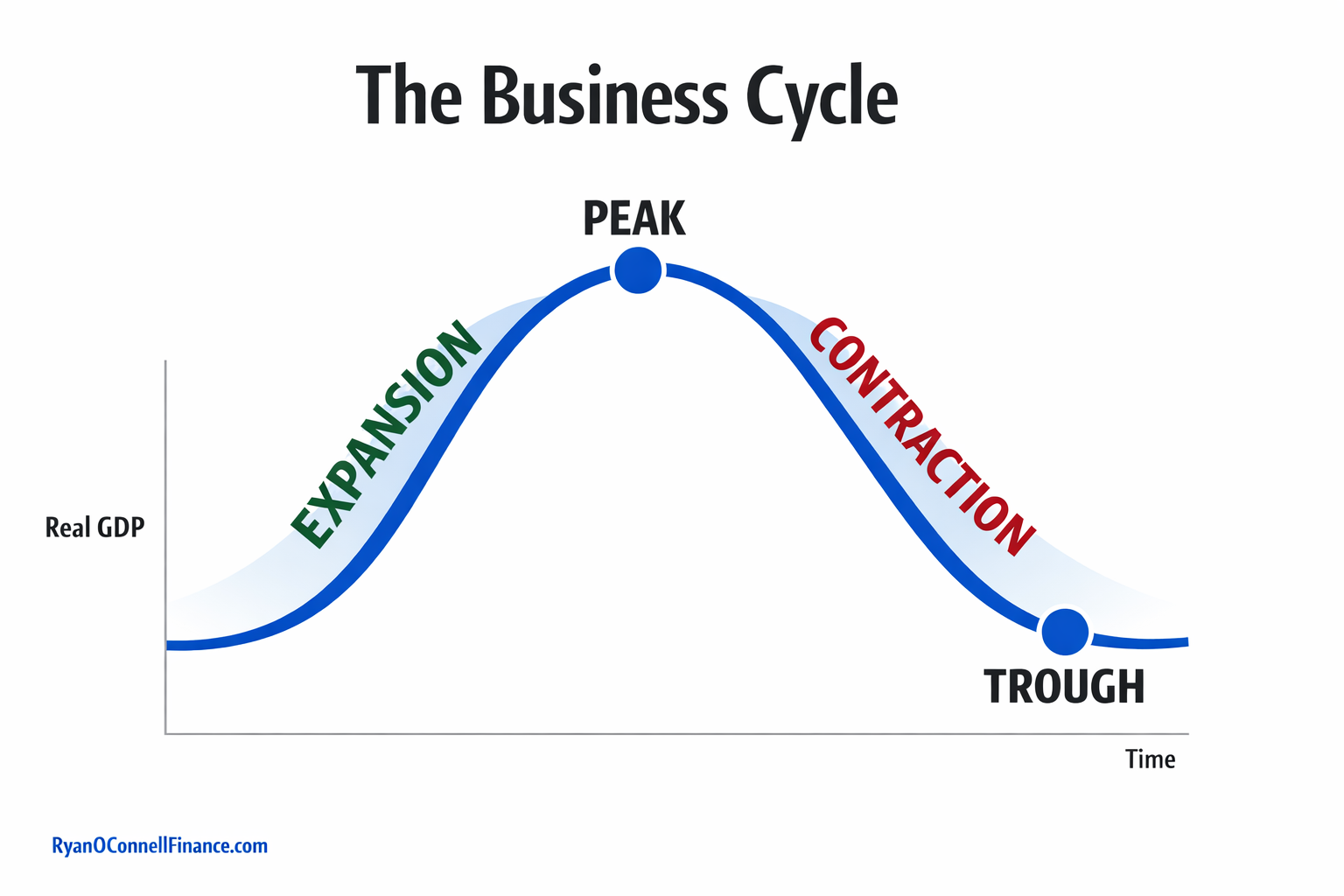
Economists identify four distinct stages, each with recognizable characteristics across output, employment, corporate profits, and credit conditions. In the NBER’s official framework, the economy is always in either an expansion or a recession; peak and trough are the turning points that separate them, not long phases in their own right. The four-stage model is a practical teaching tool that maps well to how conditions feel in real time.
1. Expansion
During an expansion, real GDP is rising, unemployment is falling, consumer confidence is high, and business investment is accelerating. Credit is available and relatively inexpensive. Corporate profits grow as revenue outpaces costs. Equity markets tend to perform well. The expansion continues until the economy reaches its cyclical peak.
2. Peak
The peak is the turning point where economic activity reaches its cyclical high before contraction begins. Broad output and employment are at their strongest; inflationary pressures often build as capacity constraints tighten. Equity markets typically begin declining in advance of the peak because markets are forward-looking. The NBER identifies the peak date retrospectively, sometimes well after it occurs.
3. Contraction (Recession)
A contraction — also called a recession in NBER terminology — is the period from peak to trough: a decline in broad economic activity that is significant in depth, widespread in breadth, and lasting in duration. GDP falls, unemployment rises, consumer spending softens, and business investment slows. Credit conditions tighten and corporate profits decline. See the section below on exactly how the NBER determines whether a peak-to-trough episode qualifies as a recession.
4. Trough
The trough is the turning point where broad economic activity reaches its cyclical low before recovery begins. While overall output has bottomed, employment and other lagging indicators may continue deteriorating for some time afterward — unemployment, for example, is a lagging indicator that often keeps rising well after the NBER has dated the trough. The trough marks the end of the recession and the beginning of the next expansion. Like the peak, the NBER identifies the trough retrospectively.
How Long Does a Business Cycle Last?
Based on NBER data for U.S. cycles since 1945, the average expansion has lasted 64.2 months and the average contraction 10.3 months, giving an average full cycle of roughly 74.5 months trough-to-trough. But individual cycles vary enormously: expansions have lasted as few as 12 months and as long as 128 months. Because of this variability, average duration is a poor guide for timing any specific cycle. The economy does not “know” it is overdue for a recession simply because the current expansion has run longer than average.
What actually ends one phase and starts another is rarely a single cause. Transitions are typically triggered by combinations of factors: a collapse in consumer or business demand (demand shock), a sudden increase in production costs like an oil price spike (supply shock), a tightening of credit conditions as lenders pull back, or deliberate policy action such as the Federal Reserve raising interest rates to cool inflation. Understanding these transition mechanisms is as important as identifying which phase the economy is currently in.
Investors who understand which phase the economy is likely entering can position portfolios accordingly — overweighting cyclicals during early expansion, defensives during late-cycle and contraction phases. See Sector Rotation for a deeper look at how sector allocations shift through the business cycle.
How Economists Define a Recession
The popular definition of a recession — “two consecutive quarters of negative GDP growth” — is a useful rule of thumb but is not the official U.S. definition. The NBER Business Cycle Dating Committee uses a broader, multi-factor approach.
The “two quarters of negative GDP growth” definition is widely cited in the media but is not how the NBER officially determines recessions. GDP data is revised frequently, and many recessions involve declining economic activity that does not cleanly show two consecutive negative GDP quarters. Always defer to the NBER’s official announcement.
The NBER defines a recession as “a significant decline in economic activity that is spread across the economy and lasts more than a few months.” The Committee examines a range of monthly and quarterly indicators with no fixed weighting — it exercises judgment rather than applying a mechanical formula. Key series it considers include:
- Nonfarm payroll employment — the broadest labor market measure
- Household employment (CPS survey) — a second employment measure from a different source
- Real personal income less transfer payments — removes government stimulus effects
- Real personal consumption expenditures (PCE) — tracks consumer spending breadth
- Industrial production — measures factory and mining output
- Real manufacturing and trade sales — tracks business activity broadly
- Real GDP and real GDI — quarterly measures that are especially important for overall cycle dating
By requiring a decline to be significant (depth), widespread across sectors (breadth), and lasting (duration), the NBER avoids mislabeling brief statistical blips as recessions. The 2020 COVID recession lasted only two months — the shortest on record — yet qualified due to the unprecedented depth of the decline. For models and indicators used to estimate the probability of a recession in real time, see Probability of Recession.
The 2007–2009 Great Recession: A Complete Cycle Example
| Phase | Dates | Key Indicators |
|---|---|---|
| Expansion | Nov 2001 – Dec 2007 | 73-month expansion; unemployment fell from ~6% to 4.4%; S&P 500 roughly doubled from 2003 trough |
| Peak | December 2007 | Real GDP at cycle high; unemployment at 5.0%; housing market already declining since 2006 |
| Contraction | Dec 2007 – Jun 2009 | 18 months (longest since 1945); real GDP fell 4.3% peak-to-trough; S&P 500 fell ~57% from Oct 2007 to Mar 2009 |
| Trough | June 2009 | GDP bottomed; unemployment peaked at 10.2% in October 2009 (lagging indicator); recovery began slowly |
Note that the S&P 500 peaked in October 2007 — two months before the NBER-dated cycle peak of December 2007. Equity markets often lead the business cycle by several months, illustrating why stock prices are classified as a leading indicator. Similarly, unemployment did not peak until October 2009, four months after the trough, confirming its status as a lagging indicator. For a deeper look at how drawdowns during contractions are measured, see Maximum Drawdown.
The Great Recession also illustrates how fiscal policy responds to contraction. Congress passed the American Recovery and Reinvestment Act (ARRA) in February 2009, injecting $787 billion in stimulus. For how these fiscal tools work, see Fiscal Multiplier Effect and Automatic Stabilizers.
How Economists Identify Which Phase the Economy Is In
Because business cycle turning points are not visible in real time, economists classify indicators by whether they move before, during, or after changes in economic activity. Coincident indicators are the most useful for confirming the current phase; leading and lagging indicators serve as forward and backward checks.
Leading Indicators
- Move before the economy turns
- Useful for anticipating future phases
- Examples: stock prices, building permits, average weekly manufacturing hours
- Provide early signals but must be interpreted with caution
Coincident Indicators
- Move with the economy in real time
- Best measure of the current phase
- Examples: nonfarm payroll employment, industrial production, personal income (less transfers), real manufacturing and trade sales
- Form the core of NBER’s recession-dating process
Lagging Indicators
- Move after the economy turns
- Useful for confirming a phase change has occurred
- Examples: average duration of unemployment, unit labor costs, commercial and industrial loan volume, inventories-to-sales ratio
- Unemployment often continues rising for months after a trough — sometimes well beyond
This classification is a tool for understanding which phase the economy is currently in. For a comprehensive treatment of how these indicators are used to estimate recession probability in real time, see Probability of Recession.
Common Mistakes When Analyzing Business Cycles
1. Assuming cycles are regular and predictable. Post-WWII U.S. expansions have ranged from 12 to 128 months. There is no fixed length. Models and pundits who call for a recession “right on schedule” after a certain number of months are relying on intuition, not evidence. Each cycle reflects a unique combination of monetary policy, fiscal policy, credit conditions, and external shocks.
2. Equating “two quarters of negative GDP” with the official recession definition. The NBER uses a multi-indicator approach covering breadth, depth, and duration. GDP data is also revised significantly — what looks like two negative quarters may later be revised to one, or vice versa. The 2001 recession involved only one quarter of mildly negative GDP growth.
3. Treating all contractions as severe. Most post-WWII recessions were mild and brief. The average contraction since 1945 lasted approximately 10 months. The Great Recession (18 months) and the Great Depression were outliers. Investors who assume every recession will mirror 2008–2009 may overreact to normal cyclical slowdowns.
4. Declaring the business cycle obsolete. Before both the 2001 and 2007 recessions, commentators argued that the modern economy had outgrown the business cycle. Technology, globalization, and improved monetary policy were said to have eliminated major downturns. This claim reappears at late-cycle peaks and has always been wrong. The AD-AS model explains the macroeconomic forces that drive these fluctuations; see Aggregate Demand and Aggregate Supply.
5. Confusing a slowdown with a recession. A deceleration in growth — GDP expanding at 1% rather than 3% — is not a recession. The NBER requires an actual decline in broad economic activity, not merely slower growth. Financial media frequently uses “recession fears” language during growth slowdowns, which can cause investors to misread the cycle phase. A slowdown that does not turn into an outright contraction may be a late-cycle normalization, not the start of a downturn.
Limitations of Business Cycle Analysis
Business cycle dating is inherently retrospective. The NBER often announces a recession’s start many months after it has begun — sometimes more than a year. By the time a recession is officially declared, markets have usually already priced in the downturn and begun recovering.
1. Cycles are irregular. Because cycle duration varies enormously, there is no reliable timing model. Attempting to call the exact peak or trough based on cycle length alone is not supported by evidence.
2. Leading indicators generate ambiguous and false signals. The yield curve inverted in 2019, and a recession did begin in February 2020 — but that recession was caused by an external pandemic shock rather than the credit and demand dynamics the yield curve typically signals, making the 2019 case a disputed forecasting example. For a genuinely clean false positive, the yield curve briefly inverted in 1998 during the Russia/LTCM crisis without any U.S. recession following. Stock markets have, famously, “predicted nine of the last five recessions.” No single leading indicator is definitive or mechanically reliable.
3. Global interconnection limits domestic policy. An economy can be fundamentally sound yet tip into recession due to an external shock — an oil embargo, a global financial crisis, or a pandemic. Domestic monetary and fiscal policy cannot fully offset internationally transmitted downturns.
4. The cycle framework simplifies a continuous process. The four-stage framework is a conceptual tool. In practice, economies transition gradually; there is no clean line between “late expansion” and “peak.” Real-time analysis requires interpreting noisy, frequently revised data.
Frequently Asked Questions
Disclaimer
This article is for educational and informational purposes only and does not constitute investment advice. Economic data cited (GDP, unemployment, index levels) are based on publicly available historical sources including the NBER, Bureau of Economic Analysis, and Bureau of Labor Statistics. Past cycle patterns do not predict future cycle timing or severity. Always consult qualified financial and economic advisors before making investment decisions.