Enter Values
Multiplier Formulas

Calculation Result
Formula Breakdown
Spending Rounds
| Round | New Spending | Cumulative |
|---|
Balanced-Budget Multiplier = 1
The spending increase and tax increase have opposing multiplier effects that largely cancel. The net result is that GDP rises by exactly the amount of the policy change, with no additional multiplier amplification. The spending rounds table does not apply in this mode.
Model Assumptions
- Simple Keynesian cross model (fixed price level, no supply constraints)
- MPC is constant across all income levels and spending rounds
- Closed economy — no import leakage (open-economy multipliers are smaller)
- Crowding out modeled as a simplified percentage reduction, not derived from IS-LM
- Tax multiplier assumes lump-sum taxes (not marginal rate changes or endogenous taxes)
- Balanced-budget multiplier = 1 assumes simultaneous equal changes in G and lump-sum T
- Does not account for Ricardian equivalence, implementation lags, or supply-side effects
For educational purposes. Not financial advice. Market conventions simplified.
Understanding the Fiscal Multiplier
What is the Fiscal Multiplier?
The fiscal multiplier measures how much total GDP changes in response to a change in government spending or taxes. In the simple Keynesian cross model, when the government spends $1, that dollar becomes income for someone — a worker, a supplier, or a business owner. That person then spends a fraction of that new income (determined by their MPC), which becomes income for someone else, creating a cascading chain of spending.
With an MPC of 0.75, each $1 of government spending eventually generates $4 of total GDP through this multiplier process. The formula is straightforward: Multiplier = 1 / (1 − MPC) = 1 / MPS.
Tax: −MPC / (1 − MPC) = −MPC / MPS
Balanced Budget: Always = 1
Based on Mankiw, Chapter 21 (Sections 21.2–21.3)
Spending Multiplier vs. Tax Multiplier
Spending Multiplier
1 / MPS
Government purchases enter demand dollar-for-dollar in Round 1. The full $1 becomes new spending immediately, maximizing the cascade effect.
Tax Multiplier
−MPC / MPS
A tax cut increases disposable income, but households save (1 − MPC) of it. Only MPC × $1 enters spending in Round 1, making the absolute effect smaller.
The Crowding-Out Effect
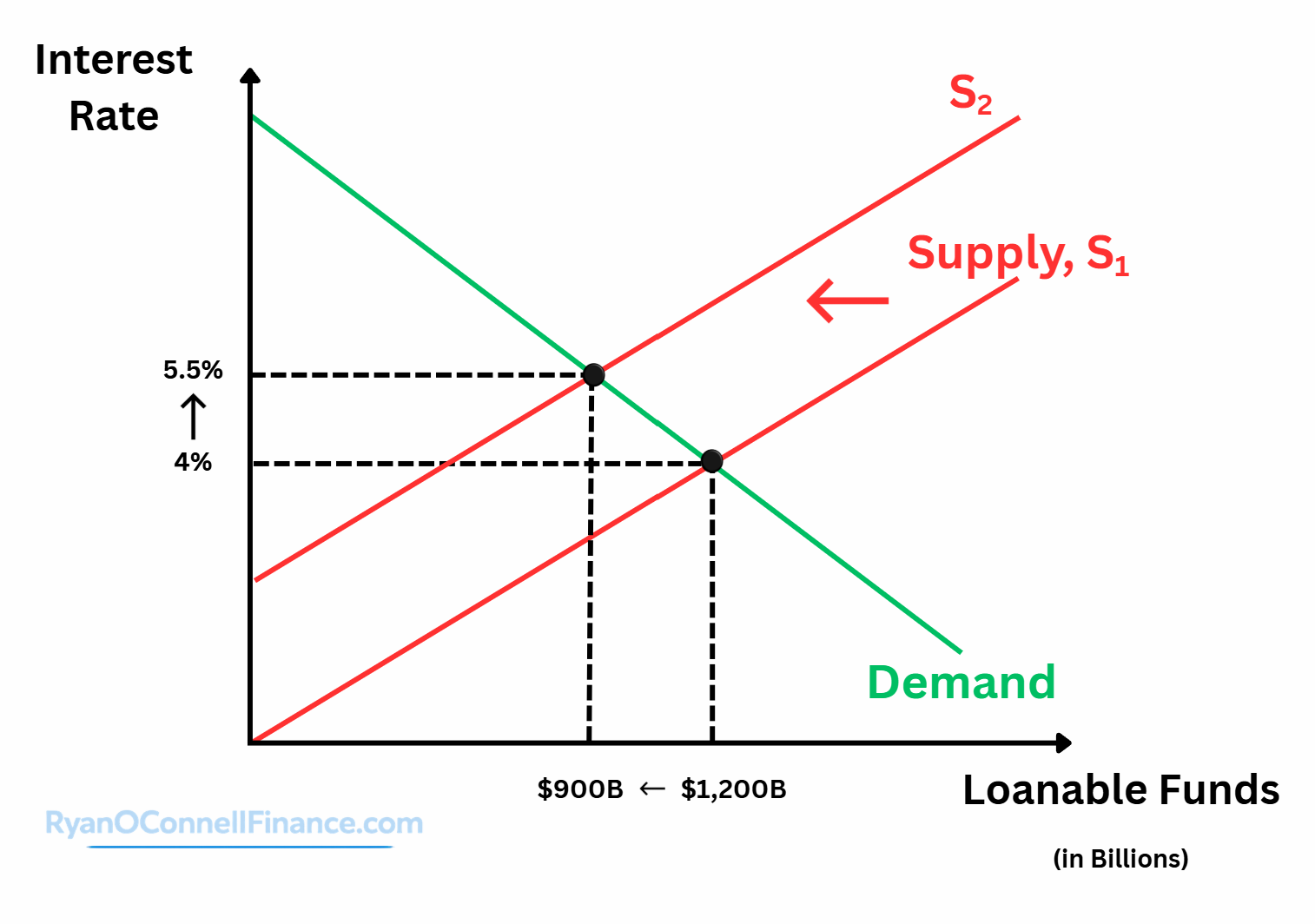
When the government increases spending financed by borrowing, it increases demand for loanable funds, which pushes up interest rates. Higher interest rates make borrowing more expensive for businesses and households, reducing private investment spending. This crowding-out effect partially offsets the multiplier’s stimulus.
This calculator models crowding out as a simple percentage reduction — a heuristic approximation. In practice, the magnitude depends on monetary policy response, the state of the economy, and financial market conditions.
Key Model Limitations
- Fixed price level — no inflation response to demand changes
- Closed economy — no import leakage (open-economy multipliers are smaller)
- Constant MPC across income levels and rounds
- Tax multiplier uses lump-sum taxes only (not marginal rate changes)
- No Ricardian equivalence — consumers don’t offset government borrowing
- No implementation lags or supply-side constraints
Frequently Asked Questions
Disclaimer
This calculator is for educational purposes only and uses the simple Keynesian cross model with fixed prices, constant MPC, and a closed economy. Real-world fiscal multipliers depend on monetary policy, economic conditions, trade openness, and consumer expectations. This tool should not be used for policy recommendations.


