Its primary goal is to maximize shareholder value through strategic planning and management of investments, capital budgeting, and funding. Corporate finance professionals analyze a company’s financial needs and develop strategies for raising and allocating funds, which may include issuing stocks or bonds, taking on debt, or reinvesting earnings. They also make decisions about dividend policies, mergers and acquisitions, and risk management. This discipline is crucial in guiding companies through financial challenges and opportunities, ensuring sustainable growth and profitability.
Start here
3 articles · 38 min
-
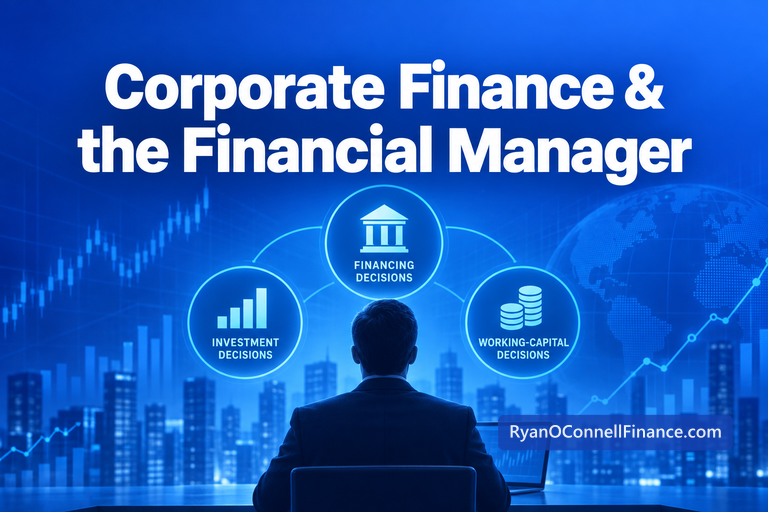
What is Corporate Finance? Types of Firms & the Financial Manager
Corporate finance is the study of how firms make three core financial decisions — capital budgeting, capital structure, and working capital management…
-

Time Value of Money: Present Value and Future Value Explained
The time value of money is the foundational principle that a dollar today is worth more than a dollar in the future.
-
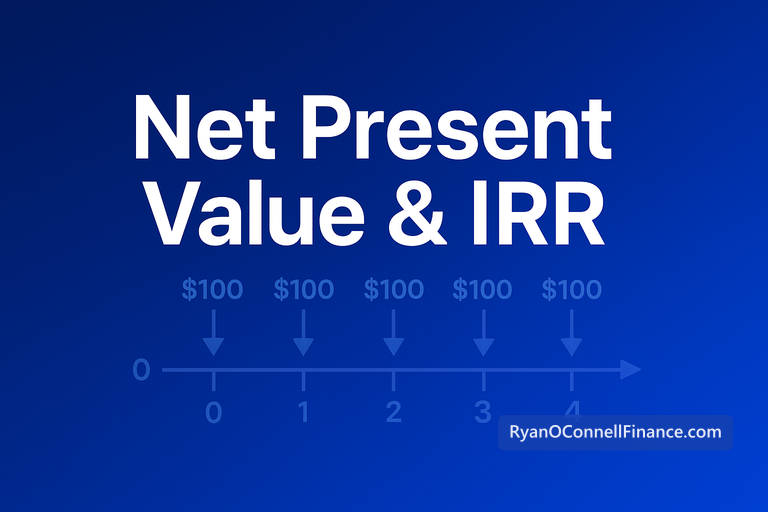
Net Present Value & IRR: Formulas, Examples, and When They Disagree
Net present value (NPV) and internal rate of return (IRR) are the two most widely used capital budgeting tools.
Corporate Finance Fundamentals
12 parts · 3 hours
Financial Ratio Analysis: A Complete Guide to Liquidity, Profitability, Leverage & Market Ratios
Learn how to use financial ratio analysis to evaluate company liquidity, profitability, leverage, efficiency, and market valuation with real-world examples…
Annuities, Perpetuities & Growing Cash Flows: The Annuity Formula Explained
Learn the annuity formula for present and future value of ordinary annuities, annuity due, perpetuities, and growing cash flows with real-world mortgage…
Interest Rates: EAR, APR & the Yield Curve
Learn how to convert between APR and EAR, understand compounding frequencies, apply the Fisher equation for real interest rates, and interpret yield curve…
Capital Budgeting & Free Cash Flow Estimation: Formula, Components, and Examples
Learn the free cash flow formula (FCF = NOPAT + Depreciation – CapEx – Change in NWC), how to identify incremental cash flows, and techniques for sensitivity…
DCF Valuation & Comparable Company Analysis: A Practitioner Guide From Financial Modeling
How investment bankers and analysts value companies using discounted cash flow analysis, comparable company analysis (trading comps), and precedent…
Learn how companies raise equity capital through IPOs, seasoned equity offerings, and modern alternatives. Covers the IPO process from the issuer perspective…
Corporate Debt Financing: Bonds, Covenants & Credit
Learn about corporate bonds, debt covenants, credit ratings, and repayment provisions. Understand the types of corporate debt, how credit spreads work…
Capital Structure: Modigliani-Miller Theorem, Tradeoff Theory & Optimal Leverage
The Modigliani-Miller theorem shows that in perfect capital markets, firm value is independent of capital structure.
Dividend Policy: Payout vs Retention & Share Repurchases
Learn how companies choose between paying dividends, repurchasing shares, and retaining earnings — including MM irrelevance, signaling theory, and tax…
Pro Forma Financial Statements: Percent-of-Sales Method, EFN & Growth Rate Formulas From Financial Modeling
Learn how to build pro forma financial statements using the percent-of-sales method, calculate external financing needed (EFN), and determine sustainable…
Working Capital Management & the Cash Conversion Cycle
Working capital management ensures firms have enough liquidity to meet short-term obligations while minimizing idle asset costs.
Mergers and Acquisitions: Synergies, Takeover Defenses & LBOs
Comprehensive guide to mergers and acquisitions covering merger types, synergy analysis, acquisition NPV, hostile vs friendly takeovers, takeover defenses…
Capital Budgeting & Valuation Metrics
5 parts · 57 min
Payback Period & Discounted Payback Period: Formula and Examples
Learn what the payback period and discounted payback period measure, how to calculate them, and how they compare to NPV for capital budgeting decisions.
Profitability Index Explained: Formula, Examples & Capital Rationing
The profitability index (PI) measures the value a project creates per dollar invested, making it essential for capital rationing decisions.
WACC: Weighted Average Cost of Capital Explained
The weighted average cost of capital (WACC) is the blended cost of equity and after-tax debt that serves as the hurdle rate for corporate investment decisions…
Dividend Discount Model & Gordon Growth Model Explained
The dividend discount model (DDM) values a stock by discounting all expected future dividends to present value.
DuPont Analysis Explained: 3-Factor & 5-Factor ROE Decomposition
DuPont analysis decomposes Return on Equity into profitability, efficiency, and leverage components. Learn the 3-factor and 5-factor DuPont formulas…
Startup & Venture Capital Finance
8 parts · 1½ hours
Introduction to Entrepreneurial Finance: 8 Key Differences from Corporate Finance
Entrepreneurial finance differs from corporate finance in 8 fundamental ways. Learn how uncertainty, staged financing, and active investors change everything…
VC Term Sheet Explained: Key Provisions Every Founder Must Know
Learn every provision in a VC term sheet — valuation, liquidation preference, antidilution, board composition, protective provisions, and more.
Startup Cap Tables: How to Build, Read & Manage Ownership
Learn how to build, read, and manage a startup cap table. Understand share classes, dilution mechanics, and ownership tracking through funding rounds.
Antidilution Provisions: Full Ratchet vs Weighted Average Explained
Learn how antidilution provisions protect investors in down rounds. Compare full ratchet vs weighted average mechanisms, understand pay-to-play clauses…
SAFE Notes vs Convertible Notes: Which Is Better for Your Startup?
SAFEs and convertible notes are the most common instruments for early-stage startup financing. This guide explains how each works, how valuation caps…
The VC Method of Valuation: How Investors Value Startups
Learn the Venture Capital Method for startup valuation. Master the formulas for post-money, pre-money, and required ownership, plus hurdle rates and dilution…
First Chicago Method: Scenario-Based Startup Valuation
The First Chicago Method values startups using probability-weighted scenarios for more realistic expected values.
Staged Financing & Real Options: How Milestones Affect Startup Valuation
Staged venture capital financing invests capital in sequential rounds tied to milestones. Learn the reverse induction method for calculating ownership across…
More articles
40 articles · 10 hours
Absorption vs Variable Costing From Accounting
Learn absorption vs variable costing with two-period income statements, fixed-overhead inventory reconciliation, reporting rules and practical managerial uses.
Accounting Cycle and Trial Balances From Accounting
Follow the accounting cycle through adjustments, financial statements, closing entries, and three trial balances with a fully reconciled hypothetical example.
Activity-Based Costing Explained From Accounting
Learn activity-based costing with cost pools, drivers, rates, and a two-product example showing how overhead allocation changes product margins and decisions.
Audit Opinions: Four Types Explained From Accounting
Understand the four audit opinions, report wording, going-concern warnings, critical audit matters, and why financial-statement and ICFR opinions can differ.
Bank Reconciliation: Worked Example From Accounting
Learn bank reconciliation with a complete cash-book example, deposits in transit, outstanding checks, bank errors and balanced adjusting journal entries.
Learn break even analysis with unit and revenue formulas, a worked example, price-cut effects, target operating profit, and the margin of safety for sales.
Cash Management Models Explained From Accounting
Learn cash management models with Baumol transfer sizes, Miller-Orr control limits, worked examples, daily rates and variance, and practical treasury limits.
Compare CFROI and CROCI with accounting ROIC. Learn how investment, inflation, asset life and capital recovery shape cash-based returns through an example.
Common-Size Financial Statements From Accounting
Learn common-size financial statements with examples of income statements, balance sheets, horizontal changes, indexes and percentage-point differences.
Consolidated Financial Statements From Accounting
Learn consolidated financial statements with a reconciled 80% subsidiary worksheet, goodwill, intercompany eliminations, and noncontrolling interest in equity.
Corporate Zero-Based Budgeting From Accounting
Learn corporate zero-based budgeting through decision packages, service levels, a reconciled cash budget, implementation costs, and practical control checks.
Death Spiral Financing Explained
Death spiral financing resets conversion prices to market references. Learn how dilution compounds, what floors and caps limit, and which filings to inspect.
Discount for Lack of Marketability
Understand the discount for lack of marketability, separate control from liquidity, and evaluate restricted-stock studies, pre-IPO evidence and option models.
Double-Entry Accounting Explained From Accounting
Learn double-entry accounting with debit and credit rules, journal entries, and eight worked transactions that reconcile T-accounts and the accounting equation.
EBITDA Explained: Formula and Examples
Learn what EBITDA measures, calculate it from net income or EBIT, and understand adjusted EBITDA, margins, and why earnings differ from operating cash flow.
Economic Order Quantity: EOQ Guide
Learn economic order quantity, ordering and holding costs, feasible batch sizes, reorder points, quantity discounts, and effects on inventory cash investment.
Equivalent Annual Cost and Annuity
Learn equivalent annual cost and annuity with unequal-life machine examples, replacement-chain checks, clear cash-flow timing, and practical limits for use.
GMROI: Formula and Retail Examples From Accounting
Learn GMROI with a retail category example, correct margin and turnover formulas, seasonal inventory averages, and practical limits of gross-profit returns.
Intercorporate Investments: Fair Value, Equity Method and Consolidation From Accounting
Classify intercorporate investments under U.S. GAAP and follow a fully reconciled equity-method example covering purchase basis, income, OCI, dividends…
Managerial Accounting: Cost Basics From Accounting
Learn managerial accounting with cost classifications, fixed and variable behavior, and prime and conversion examples that avoid double-counting direct labor.
Medium-Term Notes: Programs & Risks From Fixed Income
Learn how medium-term notes use issuance programs, pricing supplements and dealer arrangements, then compare plain and structured payoffs and investor risks.
Net Advantage to Leasing: NAL Example
Calculate net advantage to leasing with an after-tax lease-vs-buy example, matched cash-flow timing, residual risk, and a break-even annual lease payment.
Onerous Contracts: Loss Provisions From Accounting
Learn how onerous contracts create IAS 37 provisions, compare fulfillment with exit costs, follow journal entries, and distinguish specific U.S. GAAP rules.
Overhead Allocation: Rates & Entries From Accounting
Learn overhead allocation through predetermined rates, job costing, journal entries, and year-end adjustments for underapplied or overapplied factory overhead.
Prepaid Expenses: Entries & Cash Flow From Accounting
Learn prepaid expenses with insurance journal entries, monthly adjustments, statement effects and a cash-flow reconciliation that avoids double counting cash.
Real Options: Valuation, Types, and Examples From Options & Derivatives
Real options apply option pricing theory to capital investment decisions, recognizing that management flexibility to expand, abandon, or defer projects has…
Return on Incremental Invested Capital From Equities
Understand return on incremental invested capital, its timing, growth link and limits, with an example separating accounting ROIIC from project value.
Revenue-Based Financing: Costs & Risks
Learn how revenue based financing payments, repayment caps and fees affect cash flow, payoff timing and effective financing cost under different revenue paths.
Reverse DCF: Implied Growth From Financial Modeling
Use reverse DCF to find revenue growth and operating margins implied by a share price, with a full valuation example, sensitivity grid, and practical checks.
Scenario Analysis: Base, Bull and Bear From Equities
Learn scenario analysis with base, bull and bear cases. Follow revenue, margins, EPS and P/E through a stock valuation example and interpret the results.
Segment Reporting: Rules & Analysis From Accounting
Learn segment reporting under ASC 280, including CODM, 10% tests, 75% revenue coverage, expense disclosures and reconciliations before valuing business units.
Seller and Vendor Financing Explained
Understand seller and vendor financing, seller-note payments, balloon risk and below-market note value, with a worked small-business acquisition example.
Sensitivity Analysis Explained From Financial Modeling
Learn sensitivity analysis with a complete profit example, tornado rankings, realistic input ranges, and decision thresholds that show which assumptions matter.
Supply Chain Finance Explained From Accounting
Learn supply chain finance and reverse factoring: invoice costs, payment timelines, DPO, accounting disclosures and liquidity risk when funding is withdrawn.
The Enron Scandal Explained From Accounting
The Enron scandal explained: how accounting estimates, conflicted partnerships, and failing hedges led to bankruptcy, and what investors can learn from it.
Trade Date vs Settlement Date Accounting From Accounting
Trade date vs settlement date accounting explained with IFRS entries, period-end balances, U.S. GAAP limits, T+1 cash settlement and GIPS performance records.
Transfer Pricing: Management and Tax From Accounting
Learn transfer pricing for managerial decisions and tax rules, with capacity examples, divisional profit reconciliation, arm’s-length methods and documentation.
Variance Analysis: Budget vs Actual
Learn variance analysis with a budget vs actual profit bridge. Separate sales volume, price, variable spending, and fixed costs using a complete worked example.
VBA Financial Modeling and Controls From Financial Modeling
Learn VBA financial modeling with a reproducible scenario loop, worksheet setup, benchmarks, error handling, state restoration and practical model controls.
Work in Progress Inventory: Cost Flows From Accounting
Understand work in progress inventory with linked manufacturing ledgers, COGM and COGS schedules, journal entries, and a fully reconciled factory example.
Tools for this topic
- NPV CalculatorFree online calculator
- Annuity & Perpetuity CalculatorFree online calculator Excel model: Annuity & Perpetuity Calculator
- WACC CalculatorFree online calculator
- Cap Table & Dilution CalculatorFree online calculator Excel model: Cap Table & Dilution Calculator
- Cash Conversion Cycle CalculatorFree online calculator Excel model: Cash Conversion Cycle Calculator
- Interest Rate ConverterFree online calculator Excel model: Interest Rate Converter
Browse other topics
Videos on Corporate Finance
All 24 Corporate Finance videos →
Professional certificates
Explore Top Finance Certificates
Access official certificates from Wharton Online & Columbia Business School Executive Education, powered by Wall Street Prep. Save up to $500 with my exclusive discount code:
Affiliate disclosure: I may earn a commission if you enroll through my certificate program links.