Externalities in economics represent one of the most important reasons markets fail to allocate resources efficiently. When a transaction imposes costs or benefits on bystanders who are not party to the exchange, the invisible hand breaks down — markets produce too much of some goods and too little of others. Understanding externalities is essential for evaluating environmental policy, public health interventions, and the role of government in correcting market outcomes.
This guide covers negative and positive externalities, how they distort supply and demand, and the major policy tools economists have developed to address them — including Pigouvian taxes, cap-and-trade systems, corrective subsidies, and the Coase theorem’s insight that private bargaining can sometimes resolve externalities without government action.
What Are Externalities?
An externality arises when a person or firm engages in an activity that affects the well-being of a bystander, yet neither pays nor receives compensation for that effect. Externalities can be negative (imposing costs on others) or positive (conferring benefits on others). When externalities are present, markets produce outcomes that deviate from what would maximize total welfare — a condition economists call market failure.
An externality is an uncompensated cost or benefit imposed on a third party who is not involved in the transaction. Negative externalities (like pollution) cause overproduction, while positive externalities (like education) cause underproduction relative to what would maximize total surplus.
The core issue is a divergence between private and social costs or benefits. When a factory produces steel, its private cost includes raw materials, labor, and equipment. But if the factory emits pollution that harms the health of nearby residents, the social cost exceeds the private cost. Because the factory does not bear these external costs, it produces more steel than is socially efficient.
Conversely, when a person gets vaccinated, their private benefit is personal immunity. But vaccination also reduces disease transmission to others — a positive externality. Because the individual does not capture this broader social benefit, the market produces fewer vaccinations than would be socially optimal.
Externalities can arise from either production or consumption. A factory emitting pollution is a production externality — the external cost occurs during manufacturing. A driver creating congestion is a consumption externality — the external cost occurs during use of the good. The analytical framework (social cost vs. private cost) applies equally to both, but the appropriate policy instrument may differ depending on whether the externality is best targeted at the point of production or consumption.
Externalities are distinct from another type of market failure — public goods and common resources. While externalities involve uncompensated side effects of private transactions, public goods involve goods that are non-excludable and non-rivalrous (like national defense or street lighting). Both cause markets to produce inefficient outcomes, but through different mechanisms and requiring different policy responses.
Negative Externalities: When Social Cost Exceeds Private Cost
A negative externality occurs when the social cost of an activity exceeds the private cost borne by the decision-maker. The external cost — borne by bystanders who have no say in the production decision — drives a wedge between what producers pay and what society actually bears. Common examples include air and water pollution from industrial production, noise from construction or transportation, and congestion on public roads. In each case, the producer or consumer making the decision does not bear the full cost their activity imposes on others.
Because producers base their output decisions on private costs alone — ignoring the external costs they impose on others — the market equilibrium quantity exceeds the socially optimal quantity. The supply curve (reflecting private cost) lies below the social cost curve, and the market overproduces relative to the point where demand intersects the social cost curve.
Before the 1990 Clean Air Act Amendments, U.S. power plants emitted approximately 15.7 million tons of sulfur dioxide (SO2) annually. The external costs were substantial: acid rain damaged forests, lakes, crops, and buildings across the eastern United States. The EPA estimated acid rain caused billions of dollars in annual damage to ecosystems and infrastructure. Because power plants did not bear these external costs, they burned high-sulfur coal at levels far above the social optimum.
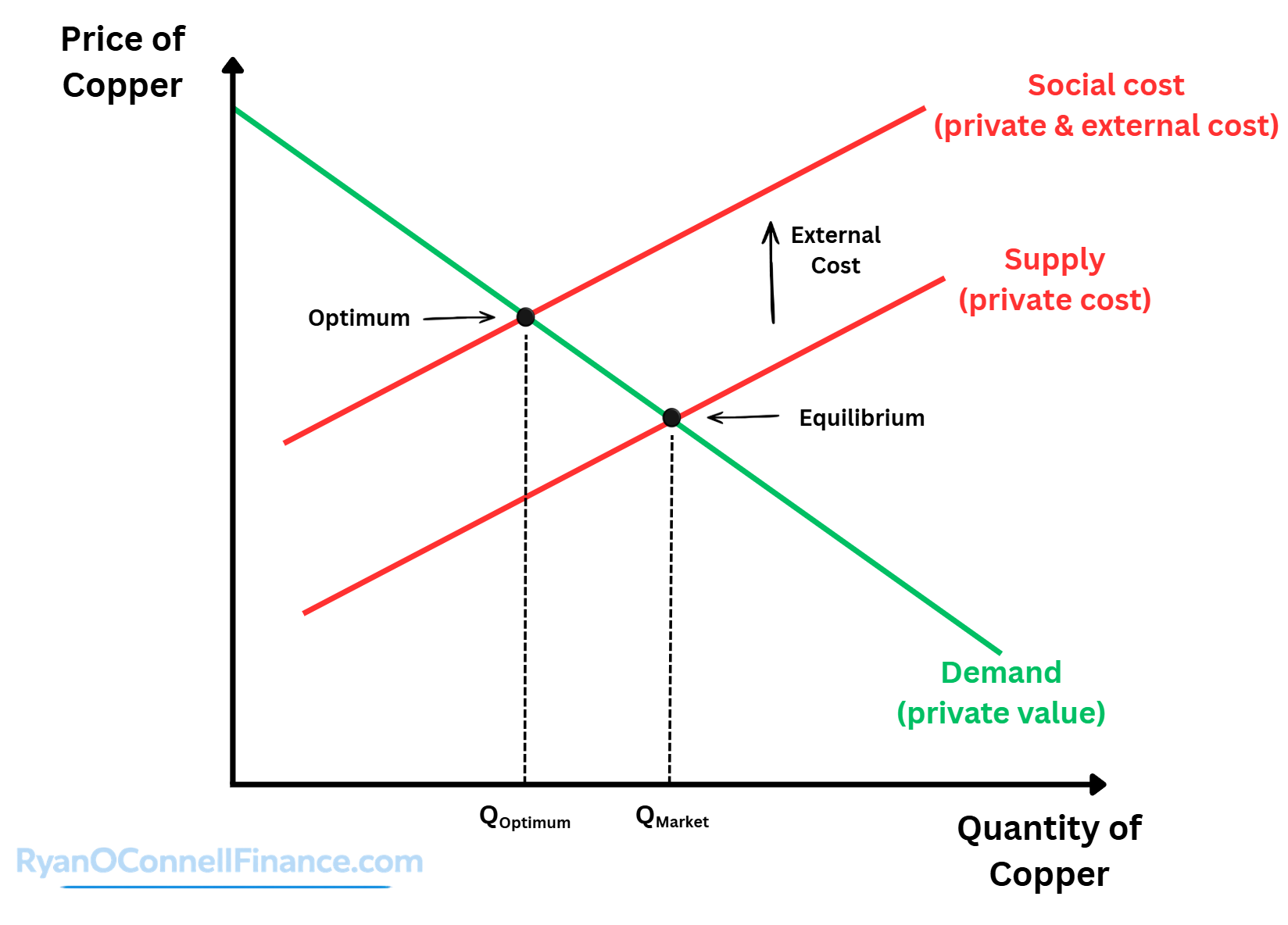
Graphically, the social cost curve lies above the private supply curve by exactly the amount of the external cost per unit. The market equilibrium occurs where demand intersects private supply (at QMARKET), but the socially optimal quantity is where demand intersects the social cost curve (at QOPTIMUM). The deadweight loss from the externality is the triangular area between these two quantities — it represents the units where the social cost of production exceeds the value consumers place on the good, yet the market produces them anyway because producers only consider private costs.
The deadweight loss from a negative externality differs from the deadweight loss created by ordinary taxes. With an externality, the DWL exists because the market is already producing an inefficient quantity — too much output relative to the social optimum. Corrective policies aim to reduce this overproduction, not create a new distortion.
Positive Externalities: When Social Benefit Exceeds Private Benefit
A positive externality occurs when the social benefit of an activity exceeds the private benefit captured by the decision-maker. In contrast to negative externalities, which cause overproduction, positive externalities cause underproduction — the market produces less than the socially optimal quantity because buyers do not account for the benefits their actions confer on others.
Education is a classic example. The private benefit of attending college includes higher lifetime earnings and expanded career opportunities. But educated citizens also generate substantial external benefits that they do not personally capture: better-informed voters strengthen democratic institutions, lower crime rates reduce costs for the justice system and potential victims, faster technological progress raises productivity across the economy, and greater civic participation improves community outcomes. Because the social value of education exceeds the private value, the market — left alone — would produce less education than is socially optimal.
This analysis provides the economic rationale for public schooling, education subsidies, and student loan programs. Governments worldwide invest heavily in education not only to benefit individual students but to capture the positive externalities that spill over to the rest of society. The same logic applies to compulsory schooling laws — by mandating a minimum level of education, governments push consumption closer to the socially optimal quantity.
COVID-19 vaccination illustrates the positive externality concept clearly. The private benefit is individual immunity, but each vaccinated person also reduces community transmission — protecting those who cannot be vaccinated and slowing the emergence of new variants. A Lancet study estimated that COVID-19 vaccines prevented approximately 14.4 million deaths globally in their first year. Because individuals do not capture the full social benefit of herd immunity, governments worldwide subsidized vaccination — a textbook response to a positive externality.
Research and development is another important source of positive externalities. When a technology company invests in innovation, the resulting knowledge often spills over to competitors and other industries. Economists estimate that the social rate of return on R&D investment substantially exceeds the private rate of return — innovators capture only a fraction of the total value their discoveries create. This is why most countries use a combination of policy tools to address the R&D externality: the patent system grants inventors temporary exclusive rights (increasing private returns), R&D tax credits reduce the private cost of innovation, and government-funded research through agencies and universities directly produces knowledge with broad social benefits.
Other positive externalities include historic building restoration (aesthetic and cultural value to the community beyond what the owner captures) and basic scientific research (advances in fundamental knowledge that enable applied innovations decades later). In each case, the market alone would produce less than the socially optimal amount.
Pigouvian Taxes and Subsidies
When markets fail due to externalities, policymakers can use corrective taxes and subsidies to realign private incentives with social costs and benefits. These tools, first proposed by British economist Arthur Pigou in the 1920s, remain central to how economists think about externality policy.
A Pigouvian tax is a corrective tax designed to make private decision-makers internalize external costs. By taxing the activity that produces the negative externality, the government shifts the supply curve upward to coincide with the social cost curve, moving the market toward the socially optimal quantity.
For positive externalities, the mirror image is a corrective subsidy equal to the marginal external benefit at the socially optimal quantity. The mechanism depends on where the externality arises. For consumption externalities (e.g., vaccination), a subsidy to consumers shifts the demand curve upward toward the social value curve — increasing the quantity demanded. For production externalities (e.g., R&D), a subsidy to producers shifts the supply curve downward toward the social cost curve — increasing the quantity supplied. In both cases, the subsidy moves output toward the socially optimal level. Examples include public health vaccination programs (consumption subsidy), R&D tax credits (production subsidy), and education grants (which can target either side of the market).
Driving produces multiple negative externalities: congestion, accident risk, and air pollution. Parry & Small (2005, American Economic Review) estimated the total external costs of driving per gallon of gasoline consumed:
| External Cost Category | Estimated Cost per Gallon |
|---|---|
| Congestion | $0.85 |
| Accident externalities | $0.63 |
| Local air pollution | $0.42 |
| Greenhouse gas emissions | $0.20 |
| Total External Costs | $2.10 |
However, the optimal gasoline tax is substantially lower than the total external cost — Parry & Small estimated it at approximately $1.01 per gallon. The reason is that a gasoline tax is an imperfect proxy for the externalities it targets. Congestion and accident costs depend on miles driven, not gallons consumed, so a fuel tax only partially addresses these mileage-related externalities. A more fuel-efficient vehicle causes the same congestion per mile but consumes less fuel per mile — meaning a gasoline tax undertargets the externality for efficient cars and overtargets it for inefficient ones. This illustrates an important practical point: the optimal corrective tax depends not just on the size of the external cost, but on how well the taxed activity maps onto the externality itself.
Pigouvian taxes differ fundamentally from ordinary taxes. Regular taxes on efficient markets create deadweight loss by distorting behavior away from the efficient outcome. Corrective taxes fix a pre-existing distortion — they move the market toward the social optimum, actually reducing deadweight loss. Economists note this distinction when comparing corrective taxes to other policy tools for addressing externalities. The choice between approaches depends on factors including measurement difficulty, enforcement costs, and the specific externality involved.
A key advantage of Pigouvian taxes is that they generate government revenue while simultaneously correcting the market failure. This “double dividend” means that revenue from corrective taxes can be used to reduce other distortionary taxes (like income taxes), potentially improving economic efficiency on two margins at once. However, the size of this double dividend is debated among economists, and the revenue benefit should not be the primary justification for the tax — the corrective function is what distinguishes it from ordinary taxation.
Cap-and-Trade and Tradable Permits
An alternative to corrective taxes is the cap-and-trade system, also known as a tradable permit program. Under this approach, the government sets a total cap on the quantity of pollution allowed, then issues tradable permits that firms can buy and sell. Each permit grants the right to emit a specified amount of the pollutant.
The key efficiency property of cap-and-trade is that firms with low abatement costs reduce their emissions below their permit allocation and sell the excess permits for profit. Firms with high abatement costs find it cheaper to buy permits than to reduce emissions. The market for permits ensures that pollution reduction occurs where it is cheapest — achieving the environmental target at the lowest total cost to the economy.
Economists note an important equivalence between Pigouvian taxes and tradable permits. A corrective tax sets the price of pollution (and the quantity adjusts via market forces), while tradable permits set the quantity (and the price adjusts in the permit market). On a given demand curve for pollution rights, both approaches can achieve the same outcome.
The practical difference matters when policymakers face uncertainty. If the government is uncertain about firms’ abatement costs (i.e., the demand curve for pollution rights), a quantity cap guarantees the environmental outcome but allows the compliance cost to vary. A price-based tax guarantees the cost per unit of pollution but allows the total quantity to vary. Which instrument is preferable depends on whether the environmental or the economic outcome is more important to control with certainty — a question that depends on the specific externality and its damage function.
The 1990 Clean Air Act Amendments created a cap-and-trade system for SO2 emissions from power plants. The results were striking:
- SO2 emissions fell from 15.7 million tons (1990) to approximately 2.2 million tons by 2015 — over an 85% reduction
- Compliance costs were roughly 75% lower than EPA projections under command-and-control regulation
- The program achieved its environmental targets ahead of schedule
The SO2 program is frequently cited as evidence that tradable permits can achieve environmental targets cost-effectively. Proponents highlight the flexibility it gave firms to find the cheapest abatement methods, while analysts note that the program’s success also depended on strong enforcement, a clearly measurable pollutant, and a limited number of large emitters — conditions that may not hold for all externalities.
Carbon markets have expanded this approach globally. The EU Emissions Trading System (EU ETS), launched in 2005, is the world’s largest cap-and-trade program, covering approximately 40% of EU greenhouse gas emissions. The effectiveness of any cap-and-trade system depends on the stringency of the cap, the strength of enforcement mechanisms, and whether the number of permits declines over time to tighten the environmental target.
The Coase Theorem
The policy tools discussed above — Pigouvian taxes, subsidies, and tradable permits — all involve government action. But not all externality solutions require government intervention. The Coase theorem, formulated by economist Ronald Coase in 1960, shows that private bargaining can sometimes achieve efficient outcomes on its own.
The Coase theorem states that if property rights are well-defined and transaction costs are sufficiently low, private parties can bargain to reach the economically efficient outcome regardless of how property rights are initially allocated.
Consider a classic example from Mankiw’s textbook: Dick owns a dog whose barking disturbs his neighbor Jane. Dick values having the dog at $500, while the barking imposes a cost on Jane of $800 in lost peace and quiet. If Jane has the legal right to quiet, Dick cannot afford to compensate her (since $500 < $800), so the dog goes — the efficient outcome. If Dick has the right to keep the dog, Jane pays Dick between $500 and $800 to give up the dog — and again, the efficient outcome is reached. The initial allocation of rights affects who pays whom (the distribution of wealth), but not the efficiency of the result.
The same logic applies in business contexts. If a noisy manufacturing operation reduces the productivity of an adjacent office, the two firms can negotiate — the office might pay the manufacturer to install soundproofing, or the manufacturer might compensate the office for the disturbance. As long as the two parties can identify each other and negotiate cheaply, they will reach an efficient arrangement without government involvement.
However, the Coase theorem has important practical limitations that explain why government intervention is often necessary for large-scale externalities:
- High transaction costs — Legal fees, negotiation time, and enforcement costs can make bargaining prohibitively expensive
- Many affected parties — Air pollution affects millions of people; coordinating bargaining among them is impractical
- Unclear property rights — For many environmental resources, it is not obvious who owns the right to clean air or clean water
- Strategic behavior — Parties may hold out for a better deal, preventing efficient agreements from being reached
These limitations mean that Coasian bargaining works well for small-scale, two-party externalities (neighbor disputes, localized nuisances) but is generally insufficient for large-scale problems like air pollution or climate change, where millions of affected parties would need to coordinate simultaneously.
Policy Tools for Correcting Externalities
When externalities are too widespread for private bargaining to solve, governments have three main public policy tools. Each involves distinct trade-offs — the best choice depends on the specific externality, available information, and practical constraints. (Private solutions through Coasian bargaining, discussed above, complement these public approaches when transaction costs are low.)
Command-and-Control Regulation
- How it works: Government sets specific standards — emission limits, technology mandates, or outright bans
- Strengths: Certainty of environmental outcome; simple to enforce and communicate; no need to estimate external costs precisely
- Weaknesses: Inflexible — treats all firms the same regardless of abatement cost; no incentive to innovate beyond the required standard; can be costly when firms have very different reduction costs
- Examples: EPA emission limits, CAFE fuel efficiency standards
Pigouvian Taxes
- How it works: Tax per unit of pollution equal to the estimated marginal external cost
- Strengths: Efficient allocation (lowest-cost firms reduce most); continuous incentive to innovate and develop cleaner technology; generates government revenue
- Weaknesses: Requires accurately estimating the correct tax rate; creates cost uncertainty for firms; can be regressive (disproportionate burden on lower-income households)
- Examples: Gasoline taxes, landfill taxes, carbon taxes
Tradable Permits (Cap-and-Trade)
- How it works: Government sets total pollution cap and lets firms buy and sell permits
- Strengths: Quantity certainty (total emissions are fixed); efficient allocation through market trading; proven track record (U.S. SO2 program)
- Weaknesses: Initial permit allocation can be politically contentious; permit price volatility creates cost uncertainty; monitoring and enforcement can be complex
- Examples: U.S. SO2 program, EU Emissions Trading System
In the standard textbook framework, Pigouvian taxes and tradable permits are economically equivalent — both put a price on pollution and achieve efficient abatement. The practical difference is that a tax fixes the price of pollution (and the quantity adjusts), while cap-and-trade fixes the quantity (and the price adjusts). Which is preferable depends on whether environmental certainty or cost certainty matters more for the specific externality. In practice, most countries use a combination of all three approaches — regulation sets minimum safety standards while market mechanisms handle the margin of adjustment.
Common Mistakes When Analyzing Externalities
Externalities are widely discussed in both academic economics and public policy debates, but several misconceptions persist. These errors can lead to flawed policy reasoning, so understanding the corrections is important for anyone studying or applying externality analysis.
1. Assuming all externalities require government intervention. The Coase theorem demonstrates that when transaction costs are low and property rights are clear, private bargaining can resolve externalities efficiently without any government involvement. Government action is most justified when many parties are affected (air pollution affecting millions), transaction costs are prohibitively high, or property rights are difficult to assign. Small-scale externalities — like disputes between neighbors over noise, landscaping, or property boundaries — can often be resolved through direct private negotiation.
2. Believing the optimal level of pollution is zero. The socially optimal level of pollution is where the marginal social cost of the pollution equals the marginal social benefit of the activity that produces it. This is almost always greater than zero. Consider a simple example: if eliminating the last ton of a pollutant costs a firm $1 million in abatement equipment, but the damage that ton causes to society is only $100, elimination is not efficient — society is worse off by $999,900. The efficient policy reduces pollution to the point where the marginal cost of further reduction equals the marginal damage avoided. Eliminating all pollution would require shutting down virtually all production and transportation — a cost that far exceeds the benefit. The goal of externality policy is to find the right balance, not to eliminate the activity entirely.
3. Treating Pigouvian taxes the same as ordinary taxes. Ordinary taxes distort decisions in otherwise efficient markets and create deadweight loss. Pigouvian taxes correct a pre-existing market failure — the externality — by aligning private costs with social costs. Rather than moving the market away from efficiency, corrective taxes move it toward the social optimum and reduce deadweight loss. This fundamental distinction is central to the economic analysis of taxation.
Limitations of Externalities Analysis
Externality analysis assumes we can accurately measure external costs and benefits in dollar terms. In practice, quantifying the cost of pollution-related health effects, the social benefit of education, or the value of technological spillovers is extremely difficult. Policy recommendations depend heavily on these estimates, and reasonable people can disagree substantially on the correct values.
1. Multiple overlapping externalities — Most economic activities produce several externalities simultaneously. Driving generates congestion, pollution, accident risk, and road wear. Analyzing each in isolation may miss important interactions, and addressing one externality without considering others can lead to unintended consequences.
2. Dynamic effects — Static externality analysis does not account for technological change, behavioral adaptation, or feedback loops over time. A carbon tax today may spur clean energy innovation that fundamentally changes the externality landscape decades from now. Similarly, firms and consumers adapt their behavior in response to regulation in ways that are difficult to predict in advance.
3. Political implementation — The theoretically optimal Pigouvian tax may differ substantially from what is politically feasible. Lobbying by affected industries, rent-seeking behavior, and grandfathering of pollution permits to existing firms can distort policy outcomes away from the economic ideal. The gap between textbook prescriptions and real-world policy is often significant.
4. International externalities — Cross-border externalities like carbon emissions require coordination among sovereign nations, which is far more difficult than domestic policy. One country’s corrective tax can be significantly weakened if production relocates to a jurisdiction without such a tax — a problem known as carbon leakage. Differences in environmental regulation across countries also affect international competitiveness and investment decisions.
For the related concept of goods that are non-excludable and non-rivalrous — another important category of market failure — see public goods and common resources.
Frequently Asked Questions
Understanding externalities provides a powerful lens for analyzing why markets sometimes fail and what tools are available to improve outcomes. The framework applies far beyond textbook examples — from evaluating environmental policy to understanding public health spending, technology regulation, and international trade agreements. The key insight is that when private costs or benefits diverge from social costs or benefits, the unregulated market outcome is not efficient, and carefully designed interventions can improve welfare.
Disclaimer
This article is for educational and informational purposes only and does not constitute investment, legal, or policy advice. The examples and data cited are for illustrative purposes and may not reflect current conditions. Economic models simplify complex real-world dynamics. Always consult primary sources and qualified professionals for policy analysis or decision-making.