Monopolistic Competition: Product Differentiation, Excess Capacity & Advertising

Monopolistic competition is the market structure that describes most real-world industries — restaurants, clothing brands, craft breweries, and countless others. The name sounds like an oxymoron, but it captures an important reality: firms sell differentiated products that give each some pricing power (like a monopolist), yet free entry and exit drive economic profit to zero in the long run (like perfect competition). Understanding monopolistic competition explains why so many industries feature product variety, thin margins, and constant competitive churn — and why investors analyzing competitive moats must distinguish between industries where pricing power is durable and those where free entry erodes it. (For the foundational market model, see supply and demand.)
What Is Monopolistic Competition?
Monopolistic competition is a market structure defined by three key attributes:
- Many sellers — numerous firms compete for the same group of customers
- Product differentiation — each firm’s product is slightly different from competitors’, giving the firm some degree of market power
- Free entry and exit — firms can enter or leave the industry without significant barriers
Monopolistic competition is a market structure with many firms selling differentiated products with free entry and exit. Each firm has some market power due to product differentiation, but competition from close substitutes limits that power and drives economic profit to zero in the long run.
Real-world examples are everywhere. Restaurants in a city each have their own menu, ambiance, and location — yet dozens compete for the same diners. Athletic shoe companies like Nike, Adidas, and New Balance sell differentiated products, but consumers can easily switch between brands. Craft breweries each develop a distinct identity through unique recipes, taproom atmosphere, and local branding — yet thousands compete nationwide, and new breweries can open with relatively modest capital.
Monopolistic competition differs from oligopoly in a critical way: because there are many small firms, each firm’s decisions have a negligible effect on any single rival. There is no strategic interdependence — a restaurant does not need to anticipate how one specific competitor will react to its menu changes. This independence makes monopolistic competition much simpler to analyze than oligopoly.
The Short Run: Monopoly-Like Behavior
Because each firm sells a differentiated product, it faces a downward-sloping demand curve — unlike a perfectly competitive firm, which faces a horizontal demand curve at the market price. This means the firm can raise its price without losing all of its customers, because some buyers prefer its particular product.
In the short run, a monopolistically competitive firm maximizes profit exactly like a monopolist: it produces the quantity where marginal revenue equals marginal cost (MR = MC), then charges the price consumers are willing to pay at that quantity.
Suppose a specialty coffee shop in a busy neighborhood faces demand that allows it to sell 200 cups per day at $5.50 each when producing at the MR = MC quantity. Its average total cost at this output level is $4.00 per cup.
Daily Economic Profit = ($5.50 − $4.00) × 200 = $300
The shop earns $300 per day in economic profit above all costs, including the opportunity cost of the owner’s time and capital. This profit will attract new coffee shops to the neighborhood — which is exactly what drives the long-run adjustment.
In the short run, a monopolistically competitive firm behaves exactly like a monopolist — downward-sloping demand, MR < P, and profit maximization at MR = MC. The difference emerges in the long run, when free entry erodes that profit. For a full analysis of monopoly pricing and deadweight loss, see Monopoly & Market Power.
The Long Run: Zero Economic Profit
The key difference between monopolistic competition and monopoly is free entry and exit. When existing firms earn positive economic profit in the short run, new firms enter the market — attracted by those above-normal returns. Each new entrant takes some customers from incumbents, shifting each existing firm’s demand curve to the left. Entry continues until economic profit is driven to zero.
Conversely, if firms are suffering losses in the short run, some exit. As competitors leave, the remaining firms pick up their customers, shifting demand to the right. Exit continues until losses are eliminated.
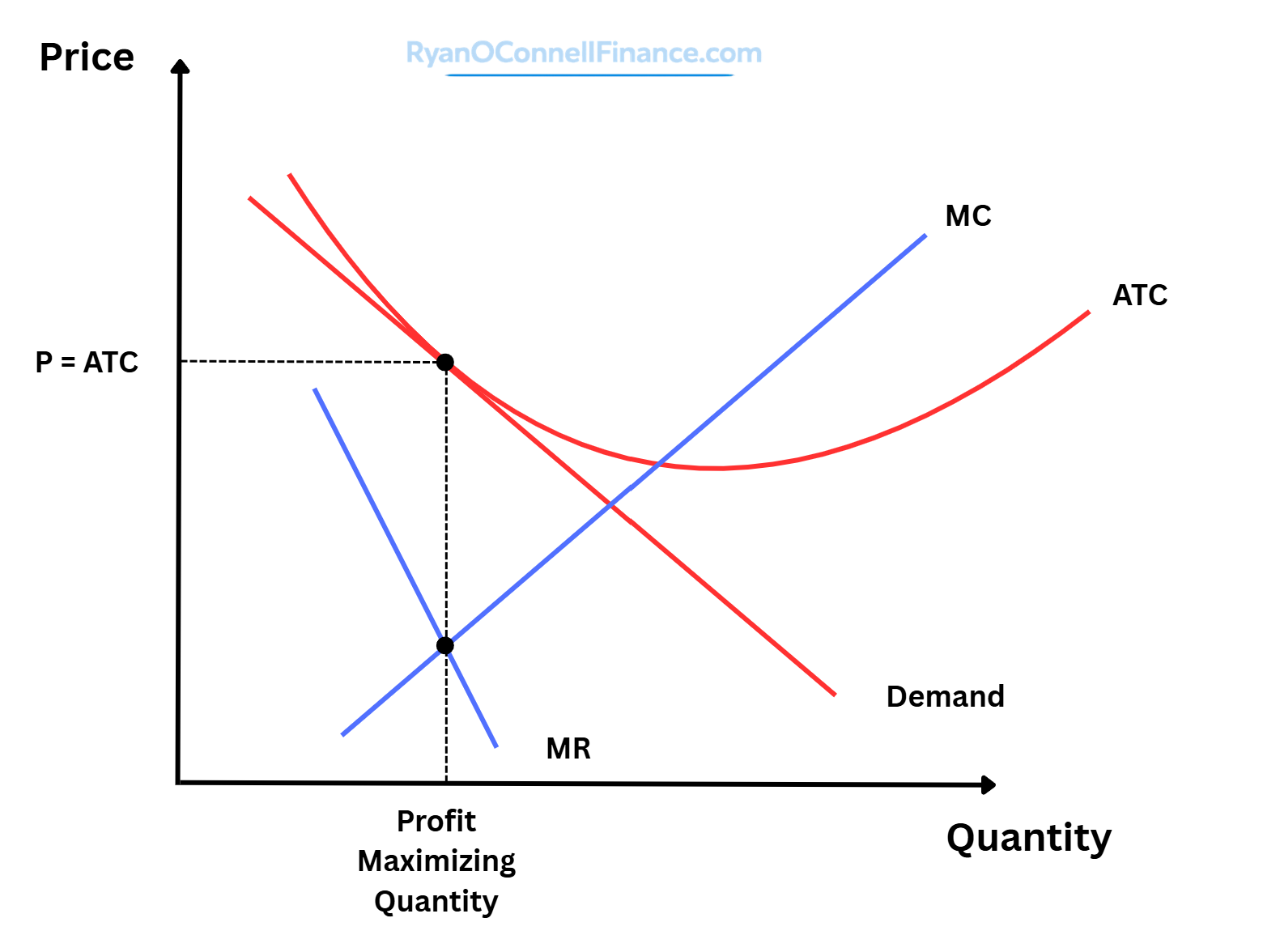
In the long-run equilibrium, the demand curve is tangent to the average total cost curve at the profit-maximizing quantity. This tangency means P = ATC (zero economic profit) while simultaneously P > MC (the firm retains some market power). This dual condition — zero profit with markup — is the defining feature of monopolistic competition.
The diagram below illustrates this long-run equilibrium. The demand curve is tangent to the ATC curve — just barely touching it at the profit-maximizing quantity. At any other quantity, ATC lies above the demand curve, so the firm cannot earn positive profit. Meanwhile, MR = MC at that same quantity confirms the firm is maximizing profit. The result: the best the firm can do is break even.
The restaurant industry illustrates this dynamic clearly. When a neighborhood becomes profitable for dining, new restaurants open rapidly. As the market becomes saturated, demand per restaurant falls and margins thin out. Weaker restaurants close, and the surviving firms earn approximately zero economic profit — enough to cover all costs and keep the owners from pursuing other opportunities, but no more. The high rate of restaurant turnover — with new concepts constantly opening and underperforming ones closing — is consistent with an industry where entry is easy but long-run profits are elusive.
This process mirrors perfect competition in outcome (zero economic profit) but differs in mechanism. Under perfect competition, P = MC at the zero-profit point. Under monopolistic competition, P > MC — the firm retains pricing power even as profit is eliminated.
Excess Capacity and Markup
The long-run equilibrium of monopolistic competition produces two important differences compared to perfect competition:
Excess capacity means monopolistically competitive firms could serve more customers at lower average cost — but doing so would require cutting prices below average total cost, resulting in losses. As Mankiw notes, this is why a monopolistically competitive firm is always eager for new customers: each additional sale at the posted price is profitable because P > MC.
Is this inefficiency a problem? Economists highlight two opposing externalities of entry in monopolistically competitive markets:
- Product-variety externality (positive) — new entrants add variety that benefits consumers who value diverse choices
- Business-stealing externality (negative) — new entrants take customers from incumbents, reducing each firm’s scale without necessarily adding social value
Whether there are too many or too few firms depends on which externality dominates — the answer is ambiguous in general. This ambiguity makes it difficult to design policies that improve on the market outcome.
Advertising and Brand Building
Advertising is a natural feature of monopolistic competition. When firms sell differentiated products at a price above marginal cost, each additional customer is profitable — creating a strong incentive to spend on marketing. Some industries spend 10–20% of revenue on advertising, making it one of the largest cost categories after production.
Economists have debated whether advertising is socially beneficial. Two influential perspectives frame the debate:
The critique of persuasive advertising (Galbraith): John Kenneth Galbraith argued in The Affluent Society (1958) that advertising manipulates consumers into wanting products they otherwise would not desire. By creating artificial brand loyalty, persuasive advertising makes demand less elastic, allows larger markups, and impedes competition. Under this view, advertising fosters private excess while diverting resources from public needs.
The defense of informative advertising (Hayek): Friedrich Hayek countered that advertising provides valuable information — about prices, product features, and the existence of new options — that helps consumers make better choices. Hayek argued that many preferences are “acquired tastes” and that advertising-created demand is not inherently less legitimate than demand arising from any other source. By making consumers aware of alternatives, advertising enhances competition.
A third perspective treats advertising as a signal of quality. Firms willing to spend heavily on advertising are signaling confidence in their product — they expect repeat purchases to justify the upfront cost. A firm with a mediocre product cannot profitably advertise because customers will not return after the first purchase.
Economist Lee Benham compared eyeglass prices across U.S. states with different advertising regulations. States that prohibited eyeglass advertising had average prices of approximately $33, while states that allowed advertising had average prices of approximately $26 — more than 20% lower.
This finding supports the view that advertising enhances competition and reduces prices by making consumers more informed about their options and more responsive to price differences across providers.
Monopolistic Competition vs Perfect Competition vs Monopoly
Monopolistic competition occupies a middle position between perfect competition and monopoly. The comparison highlights how product differentiation and entry conditions shape market outcomes:
Perfect Competition
- Firms: Many (identical products)
- Pricing: P = MC (price taker)
- Long-run profit: Zero
- Efficiency: No DWL; efficient scale
- Variety: None
- Demand curve: Horizontal
Monopolistic Competition
- Firms: Many (differentiated products)
- Pricing: P > MC (some market power)
- Long-run profit: Zero
- Efficiency: Some DWL; excess capacity
- Variety: High
- Demand curve: Downward-sloping
Monopoly
- Firms: One (unique product)
- Pricing: P > MC (price maker)
- Long-run profit: Possible (barriers to entry)
- Efficiency: DWL; no entry pressure
- Variety: None
- Demand curve: Market demand
The key insight: monopolistic competition shares the markup (P > MC) with monopoly and the zero-profit outcome with perfect competition. The trade-off for society is product variety — consumers get more choices, but at the cost of some allocative inefficiency.
How to Analyze Monopolistic Competition
When evaluating whether an industry fits the monopolistic competition model, consider these five factors:
- Product differentiation — how do firms distinguish their offerings? (Branding, quality, location, features)
- Entry barriers — are they low enough that new competitors can enter relatively easily?
- Short-run profitability — is the industry attracting new entrants (suggesting positive economic profit) or seeing exits (suggesting losses)?
- Long-run margins — are established firms earning approximately zero economic profit, consistent with the model’s prediction?
- Excess capacity signals — do firms operate below full capacity, eager for additional customers?
The fast-casual segment (Chipotle, Panera, Sweetgreen, and hundreds of regional chains) closely fits the monopolistic competition model. Each brand differentiates on menu, ingredients, ambiance, and brand identity. Entry barriers are moderate — opening a restaurant requires capital but no patents or regulatory licenses beyond standard permits. The segment saw rapid entry during the 2010s when early entrants earned strong returns. As the market matured, competition intensified and profit margins thinned — consistent with the model’s prediction of long-run zero economic profit.
For how industry structure analysis applies to investing — evaluating competitive moats, pricing power, and profitability sustainability — see Fundamental Analysis.
Common Mistakes
1. Confusing monopolistic competition with oligopoly. Monopolistic competition has many small firms with no strategic interdependence — each firm ignores the impact of its decisions on any single rival. Oligopoly has few large firms that must actively consider competitors’ reactions. The number of firms and the presence (or absence) of strategic interaction are the key distinctions.
2. Assuming zero economic profit means zero accounting profit. Zero economic profit means the firm earns a normal return — enough to cover all explicit costs plus the opportunity cost of the owner’s time and capital. The firm is still profitable in the accounting sense; it simply earns no more than the next-best alternative would provide.
3. Ignoring product differentiation’s welfare benefits. The excess capacity and markup of monopolistic competition look inefficient compared to perfect competition, but they come with product variety. Consumers may value having 50 different restaurant options in their neighborhood even if each operates below efficient scale. The welfare analysis is ambiguous — the inefficiency is the “cost” of variety.
4. Confusing short-run and long-run equilibrium. In the short run, a monopolistically competitive firm can earn positive economic profit — just like a monopolist. In the long run, entry drives profit to zero. Many students mistakenly apply the long-run zero-profit result to the short run, or assume that short-run profits persist indefinitely.
Limitations of Monopolistic Competition Analysis
The monopolistic competition model assumes firms can be analyzed independently — each firm is too small to affect any single rival. In practice, some industries that appear monopolistically competitive have clusters of close competitors (e.g., three coffee shops on the same block) that interact strategically, blurring the line between monopolistic competition and oligopoly.
Product differentiation is hard to quantify. The model assumes differentiation exists but does not specify how much or what kind, making precise predictions about markup size, excess capacity, or optimal variety difficult.
Static analysis. The model does not capture how innovation, product development, and branding efforts evolve over time. In reality, firms continuously invest in creating or enhancing differentiation — a dynamic process that the static equilibrium framework cannot fully address.
Identical cost structures assumed. The model typically assumes all firms have similar cost curves. In practice, firms in the same industry may have very different costs due to scale, location, or management quality — affecting entry/exit dynamics and whether the zero-profit prediction holds uniformly. For how brand differentiation creates durable competitive advantages in an investing context, see Growth vs Value Investing.
Frequently Asked Questions
Disclaimer
This article is for educational and informational purposes only and does not constitute investment or business advice. The examples and models cited are simplified representations of complex market dynamics. Real-world industries may not perfectly fit any single market structure model. Always conduct your own research and consult qualified professionals before making investment or business decisions.