Options on Futures: Black’s Model, Pricing, and Key Differences

Table of Contents
Options on futures give traders the asymmetric payoff profile of options — limited downside for buyers, unlimited upside potential — on an underlying that is itself a leveraged futures contract. These instruments are among the most actively traded derivatives in the world, with deep markets on S&P 500 E-mini futures, crude oil, Treasury bonds, corn, and gold. Unlike equity options where the underlying is a stock, exercising an option on a futures contract delivers a futures position, not shares. This distinction changes everything from margining and settlement to the pricing model itself: options on futures are priced using Black’s model (also called the Black-76 model), not the standard Black-Scholes model used for equity options. This guide covers how options on futures work, how Black-76 prices them, and the key differences every trader and analyst should understand.
What Are Options on Futures?
An option on a futures contract is a derivative that gives the holder the right — but not the obligation — to enter into a futures position at a specified strike price on or before the expiration date.
Exercising a call option on a futures contract delivers a long futures position at the strike price. Exercising a put option delivers a short futures position at the strike price. For futures-delivered contracts, the initial mark-to-market is (settlement futures price − strike) × multiplier for the call, and (strike − settlement futures price) × multiplier for the put. The resulting futures position remains open afterward.
Margin mechanics differ by side and contract convention. For premium-paid options, buyers pay upfront and their option loss is limited to the premium while the option remains unexercised. Option sellers (writers) must post margin because they carry the assignment obligation. For contracts that deliver a futures position, exercise or assignment changes the exposure: both futures holders must maintain futures margin and meet daily variation margin requirements. Futures-style option margining can differ, so check the contract specifications.
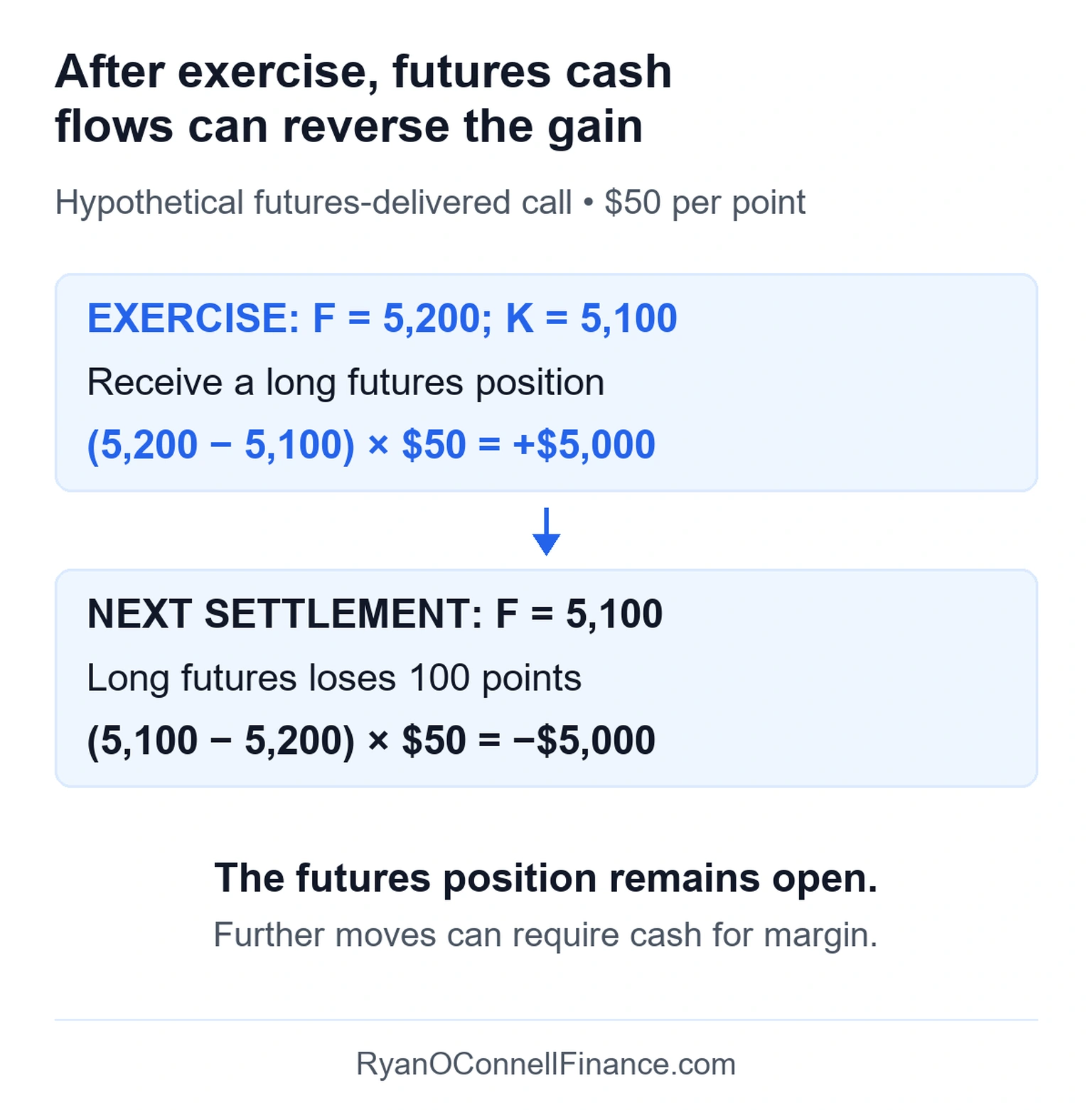
The $5,000 initial settlement credit is reversed by the subsequent 100-point decline. The option premium is a separate cost; once the future exists, adverse moves can create additional cash obligations.
Exercise style is contract-specific. Commodity and Treasury futures options (crude oil, gold, corn, T-bond) are typically American-style, meaning they can be exercised at any time before expiration. Many equity index futures options — such as S&P 500 end-of-month options — are European-style, exercisable only at expiration. Always check the contract specifications before trading.
Options on Futures vs Equity Options
While both are option contracts, futures options and equity options differ in fundamental ways that affect pricing, margining, and risk management.
Futures Options
- Underlying is a futures contract (marked to market daily)
- Priced using Black’s model (Black-76)
- Exercise delivers a futures position (long or short)
- SPAN margining (portfolio-based, cross-margining)
- Contract multiplier varies: $50/pt (E-mini), $10/tick (crude oil)
- No cash outlay for underlying at exercise — just post futures margin
- Assigned position subject to daily settlement
Equity Options
- Underlying is stock shares
- Priced using Black-Scholes model
- Exercise delivers 100 shares of stock (or cash for index options)
- Reg-T margining (strategy-based)
- Standard multiplier: 100 shares per contract
- Exercise requires cash or margin to purchase/deliver stock
- No mark-to-market on the underlying stock position
The most important structural difference is that exercising a futures option creates a futures position — a leveraged, margined instrument with daily settlement — rather than a stock position. This means the risk profile changes immediately upon exercise: the former option holder now faces variation margin calls on adverse price moves. For a deeper look at option Greeks applied to futures, note that futures option delta is quoted directly relative to the futures price, with no forward-price adjustment needed.
Black’s Model (Black-76)
Options on futures are priced using Black’s model, published by Fischer Black in 1976. The Black-Scholes model prices options on assets that earn a cost of carry (such as stocks with dividends). Black’s model simplifies this by recognizing that the futures price already incorporates the cost of carry — so the model uses F (futures price) directly rather than SerT.
Key assumptions of Black-76:
- European exercise — the model assumes the option can only be exercised at expiration
- Lognormal futures prices — continuously compounded futures returns, or log returns, are normally distributed
- Constant volatility — implied volatility does not change over the option’s life
- Constant risk-free rate — interest rates are fixed over the option’s life
Black-76 is the European pricing benchmark for futures options. Since most commodity and Treasury futures options are American-style (exercisable before expiry), practitioners often use numerical methods — binomial trees or finite-difference models — to capture the early-exercise premium. For short-dated, out-of-the-money options, the early-exercise premium is typically small and Black-76 provides a close approximation.
Options on Futures Examples
Hypothetical Black-76 example: E-mini S&P 500 futures price F = 5,000, strike K = 5,100, time to expiration T = 0.25 years (3 months), volatility σ = 18%, risk-free rate r = 5%. Contract multiplier = $50 per index point.
Step 1 — Calculate d1:
d1 = [ln(5,000 / 5,100) + (0.182 / 2)(0.25)] / (0.18 × √0.25)
= [ln(0.9804) + (0.0162)(0.25)] / (0.18 × 0.50)
= [-0.01980 + 0.00405] / 0.09 = -0.1750
Step 2 — Calculate d2:
d2 = -0.1750 – 0.09 = -0.2650
Step 3 — Look up cumulative normal values (rounded to 4 decimal places):
N(d1) ≈ 0.4305 N(d2) ≈ 0.3955. The calculation below retains unrounded values.
Step 4 — Calculate call price:
C = e-0.0125 × [5,000 × N(d1) – 5,100 × N(d2)]
≈ 0.9875778 × [2,152.6417 – 2,017.0168]
≈ 0.9875778 × 135.6250 = 133.94 index points
Dollar value: Using the unrounded model price, C × $50 ≈ $6,697.01 per contract.
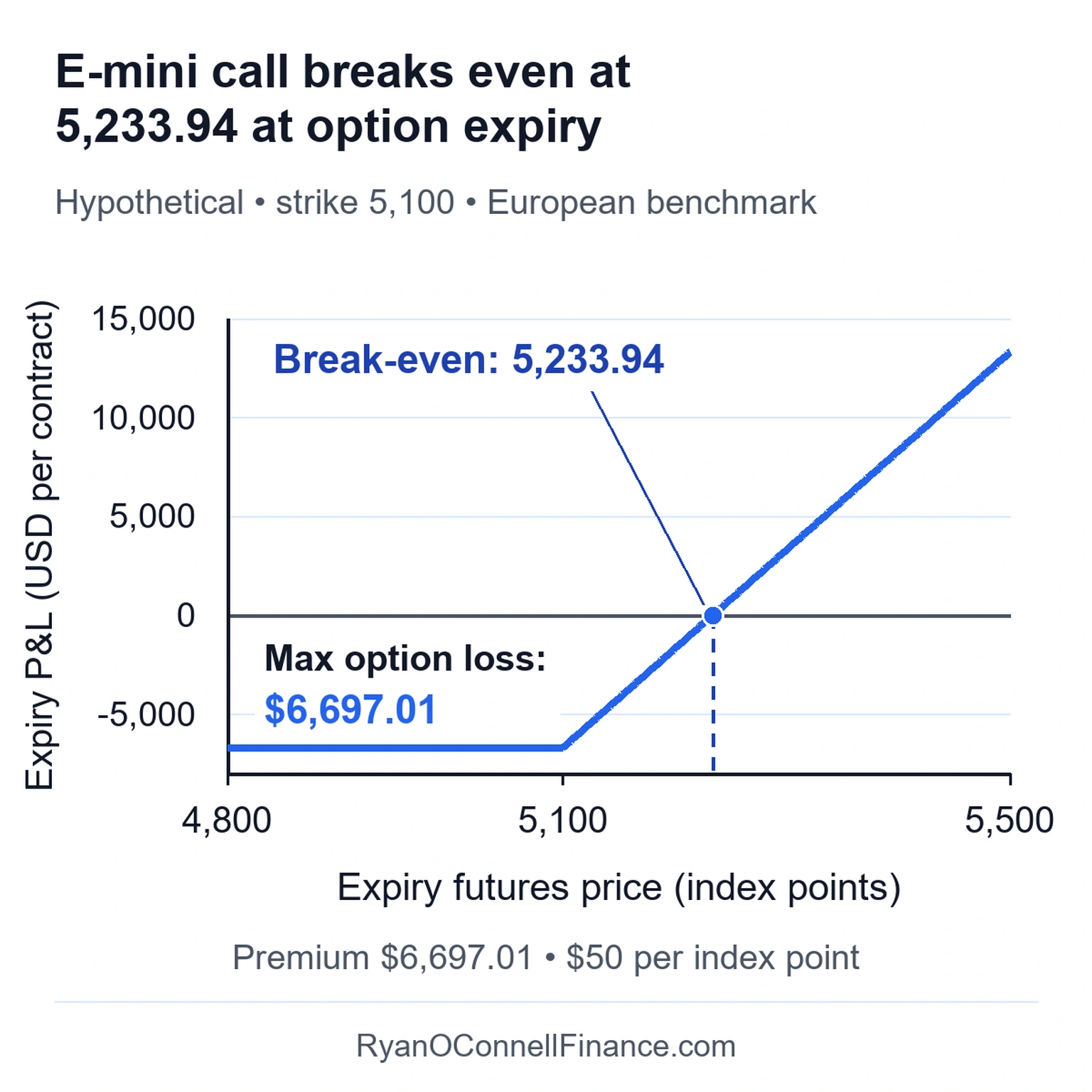
This out-of-the-money call has a strike 100 points above current futures. Its model premium is about $6,697.01, and its expiry break-even is 5,233.94 (5,100 + 133.9402 points), before fees and funding. The option premium is the maximum loss while held as an option; any resulting futures position has its own margin and price risk.
Hypothetical Black-76 example: WTI crude oil futures price F = $75/barrel, strike K = $72, T = 0.50 years (6 months), σ = 30%, r = 5%. Contract size = 1,000 barrels.
d1 = [ln(75/72) + (0.09/2)(0.50)] / (0.30 × √0.50) = [0.04082 + 0.02250] / 0.21213 = 0.2985
d2 = 0.2985 – 0.2121 = 0.0864
N(-0.2985) = 0.3827 N(-0.0864) = 0.4656
Put price:
Using unrounded cumulative-normal values, P = e-0.025 × [72 × N(-d2) – 75 × N(-d1)]
≈ 0.9753099 × [33.5222 – 28.6995] = $4.7036 per barrel
Dollar value: Using the unrounded model price, P × 1,000 ≈ $4,703.63 per contract.
An oil producer or a holder of crude inventory could use this put against falling futures prices. The $4,703.63 model premium is the illustrative insurance cost; actual American-style pricing and any physical-price basis risk require separate analysis.
| Expiry futures price (USD/barrel) | Put payoff (USD/contract) |
|---|---|
| 60 | 12000 |
| 66 | 6000 |
| 72 | 0 |
| 78 | 0 |
| 84 | 0 |
Hypothetical $72-strike put on 1,000 barrels. Gross expiry payoff excludes the $4,703.63 model premium and fees.
At a $66 expiry futures price, the put pays ($72 − $66) × 1,000 = $6,000 per contract. Subtracting the model premium leaves about $1,296.37 before fees and funding. A put benefits from falling prices; a consumer seeking protection against rising input costs generally needs a different hedge direction.
How to Analyze Options on Futures
Analyzing options on futures follows the same framework as equity options analysis, with a few important adjustments:
Moneyness is relative to the futures price, not the spot price. An option’s intrinsic value is determined by comparing the strike to the current futures price, not the underlying commodity’s spot price. For commodity futures where the futures price may differ significantly from spot (due to contango or backwardation), this distinction matters.
Greeks are quoted relative to the futures price. Delta for futures options measures sensitivity to the futures price directly. For the premium-paid European Black-76 call, ΔF = e-rTN(d1), about 0.4252 in the E-mini example. A small one-point futures move therefore changes the option by about 0.4252 index points, holding other inputs fixed. The full Greeks framework — gamma, theta, vega, rho — also applies, with the contract’s quoting and settlement conventions respected.
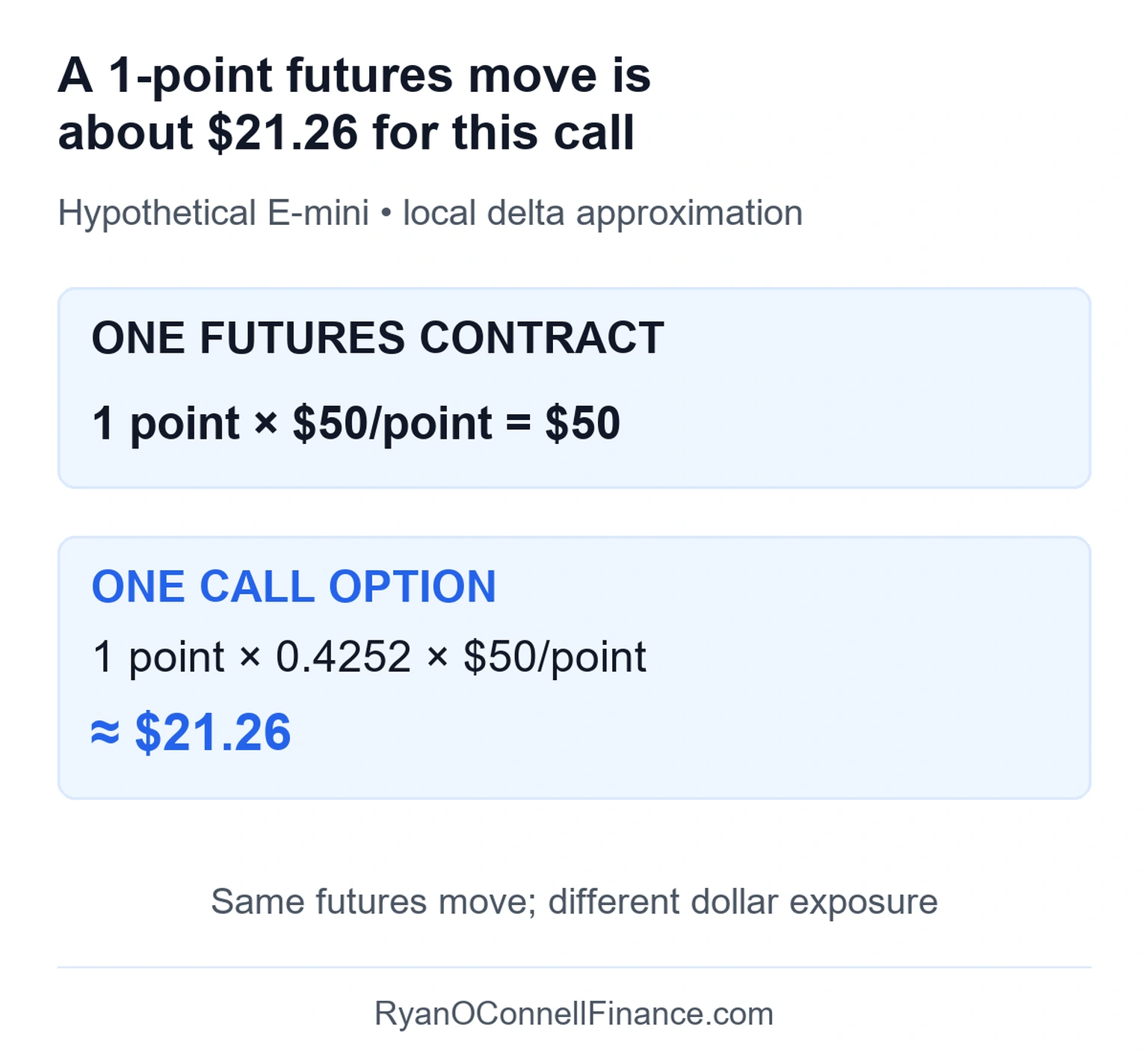
Multiplying the call’s 0.4252-point response by $50 per point gives about $21.26 per contract. One full futures contract has delta 1 and changes by $50 for the same one-point move; the option’s exposure changes as its delta changes.
Implied volatility analysis. Just like equity options, futures options exhibit volatility smiles and skews. Crude oil options, for example, often show a pronounced skew with higher implied volatility for out-of-the-money puts (reflecting crash risk), while equity index futures options show a similar pattern. Comparing implied volatility across strikes and expirations helps identify relative value opportunities.
Common Futures Options Markets
Futures options trade on major exchanges worldwide. The table below summarizes the most actively traded contracts, each with distinct specifications that affect pricing and risk management:
| Contract | Exchange | Multiplier / Size | Exercise Style | Typical Use |
|---|---|---|---|---|
| S&P 500 E-mini | CME | $50 per index point | American (quarterly); European (weekly/end-of-month) | Equity index hedging, speculation |
| WTI Crude Oil | NYMEX | 1,000 barrels; $0.01/bbl tick = $10 | American | Energy hedging (airlines, refiners) |
| Treasury Bonds | CBOT | $100,000 face value; 1/64 point tick | American | Interest rate hedging |
| Corn / Soybeans | CBOT | 5,000 bushels | American | Agricultural hedging (farmers, processors) |
| Gold | COMEX | 100 troy oz; $0.10/oz tick = $10 | American | Precious metals hedging, safe-haven plays |
Notice that exercise style varies even within the same underlying — S&P 500 E-mini options come in both American and European varieties depending on the expiration cycle. Treasury bond and interest rate futures options are among the most actively traded globally, used by banks, pension funds, and insurance companies to manage duration risk.
Common Mistakes
Working with options on futures introduces pitfalls that can lead to pricing errors, unexpected margin calls, or misstated P&L:
1. Using stock-option Black-Scholes inputs for futures options. Applying the standard BSM formula (which uses SerT) to a futures option misprices the option because the cost of carry is handled incorrectly. The futures price F already incorporates the cost of carry — using SerT double-counts it. Always use Black-76 with the futures price directly.
2. Forgetting that exercise creates a futures position. For a futures-delivered contract, exercise creates a futures position, along with any initial mark-to-market cash flow; it is not merely a one-time cash settlement. A call exercise creates a long futures position at the strike price; a put exercise creates a short futures position. This means immediate margin requirements and daily variation margin exposure that many equity option traders do not anticipate.
3. Ignoring post-assignment variation margin and liquidity risk. Once exercised into a futures position, the position is marked to market daily. Adverse price moves require immediate cash to meet variation margin. A trader who exercises a profitable in-the-money option may find themselves facing margin calls the very next day if the futures price reverses. Always plan for the margin implications of exercise.
4. Confusing exercise style across contracts. Exercise style is contract-specific, not universal. Commodity and Treasury futures options are typically American-style, while some equity index futures options (S&P 500 end-of-month) are European-style. Assuming all futures options are American — or European — can lead to incorrect pricing and hedging decisions.
5. Forgetting the contract multiplier and tick value. Each futures option contract has a unique multiplier that converts price changes to dollar P&L. One index point on an E-mini S&P 500 option is $50, while one point on a crude oil option is $1,000 (1,000 barrels × $1/barrel). Misidentifying the multiplier leads to materially misstated profit, loss, and risk calculations.
Limitations
Black-76 assumes European exercise, but most commodity and Treasury futures options are American-style. For deep in-the-money options or options on futures with significant carry, the early-exercise premium can be material. Practitioners use binomial trees or finite-difference methods to capture this premium — Black-76 serves as a starting point, not the final answer for American-style contracts.
Constant volatility assumption. Black-76 assumes volatility is fixed over the option’s life. In practice, commodity volatility is often seasonal — natural gas volatility spikes in winter, agricultural volatility rises during planting season. Energy and agricultural futures options traders must account for these patterns when interpreting Black-76 prices.
Liquidity varies across the option chain. At-the-money options on major contracts (E-mini, crude oil) are highly liquid, but deep out-of-the-money strikes and distant expirations can have wide bid-ask spreads and thin volume. This illiquidity makes it difficult to execute large trades at theoretical prices.
Margin requirements can change rapidly. Exchanges adjust SPAN margin parameters in response to market volatility. During periods of extreme price movement — oil price shocks, equity market crashes, agricultural supply disruptions — margin requirements can increase sharply, requiring additional capital on short notice or forcing position liquidation.
Constant interest rate assumption. Black-76 assumes a fixed risk-free rate. For short-dated options (under 3 months), this is a minor limitation. For longer-dated options, changes in interest rates can meaningfully affect option values through the discount factor e-rT.
Frequently Asked Questions
Disclaimer
This article is for educational and informational purposes only and does not constitute investment or trading advice. Options on futures involve substantial risk of loss due to leverage. Example calculations use unrounded Black-76 inputs and cumulative-normal values internally, with displayed intermediate values rounded for readability; actual market prices may differ due to American-exercise premiums, volatility skew, and liquidity conditions. Contract specifications may change; verify current specs on the exchange’s website. Always conduct your own research and consult a qualified financial professional before trading futures options.
Keep reading
Next in this series
Part 9 of 9 in Futures & Forwards
Interest Rate Futures: Treasury Bonds, SOFR, and Duration-Based HedgingMore in Options & Derivatives
-
Call Options: Buying and Selling Calls Explained
Complete guide to call options — how they work, buying vs selling calls, payoff diagrams, and when to use call options in your trading strategy.
-
Put Options: Buying and Selling Puts Explained
Complete guide to put options — how they work, buying vs selling puts, payoff diagrams, hedging applications, and when to use put options.
-
Option Greeks: The Complete Beginner’s Guide
Complete guide to the five option Greeks — delta, gamma, theta, vega, and rho — what they measure, how they interact, and how to use them for options analysis.