Price Ceilings & Price Floors

A price ceiling and price floor are two of the most common forms of government intervention in markets. When policymakers believe market prices are too high for buyers or too low for sellers, they impose legal limits — often with significant unintended consequences. This guide explains what price ceilings and price floors are, when they actually affect the market (binding vs non-binding), and the real-world effects of policies like rent control and agricultural price supports. For the underlying supply and demand model, see our dedicated article.
What Are Price Ceilings and Price Floors?
Price ceilings and price floors are government-imposed limits on how high or low a market price can go. Both are tools of price control — direct interventions that, when binding, prevent the legal price from adjusting to the market-clearing level.
A price ceiling is a legal maximum price — sellers cannot charge more than this amount. It is designed to protect buyers. A price floor is a legal minimum price — buyers cannot pay less than this amount. It is designed to protect sellers. Whether either control actually affects the market depends on whether it is binding.
Governments impose price controls for political and social reasons: to keep housing affordable (rent control), to support farm incomes (agricultural price supports), or to prevent price gouging during emergencies. However, as we will see, the economic consequences often undermine the intended goals.
Binding vs Non-Binding Price Controls
A price control only affects the market when it prevents the price from reaching equilibrium. This is the distinction between binding and non-binding controls.
Binding vs Non-Binding Price Ceiling
A price ceiling is binding when it is set below the equilibrium price — the legal maximum prevents the price from rising to where supply equals demand. The result is a shortage: more people want to buy at the lower price than sellers are willing to supply.
A price ceiling set above equilibrium is non-binding — the market naturally settles at equilibrium without hitting the legal limit, so the ceiling has no effect on price, quantity, or welfare.
Binding vs Non-Binding Price Floor
A price floor is binding when it is set above the equilibrium price — the legal minimum prevents the price from falling to where supply equals demand. The result is a surplus: sellers want to supply more than buyers are willing to purchase at the higher price.
A price floor set below equilibrium is non-binding — the market settles at equilibrium on its own, and the floor is irrelevant.
The quick test: a price ceiling only binds when set below equilibrium, and a price floor only binds when set above equilibrium. If the control is on the “wrong” side of equilibrium, the market ignores it entirely — no shortage, no surplus, no welfare change.
Price Ceiling Effects
When a binding price ceiling holds the price below equilibrium, several consequences follow beyond the immediate shortage.
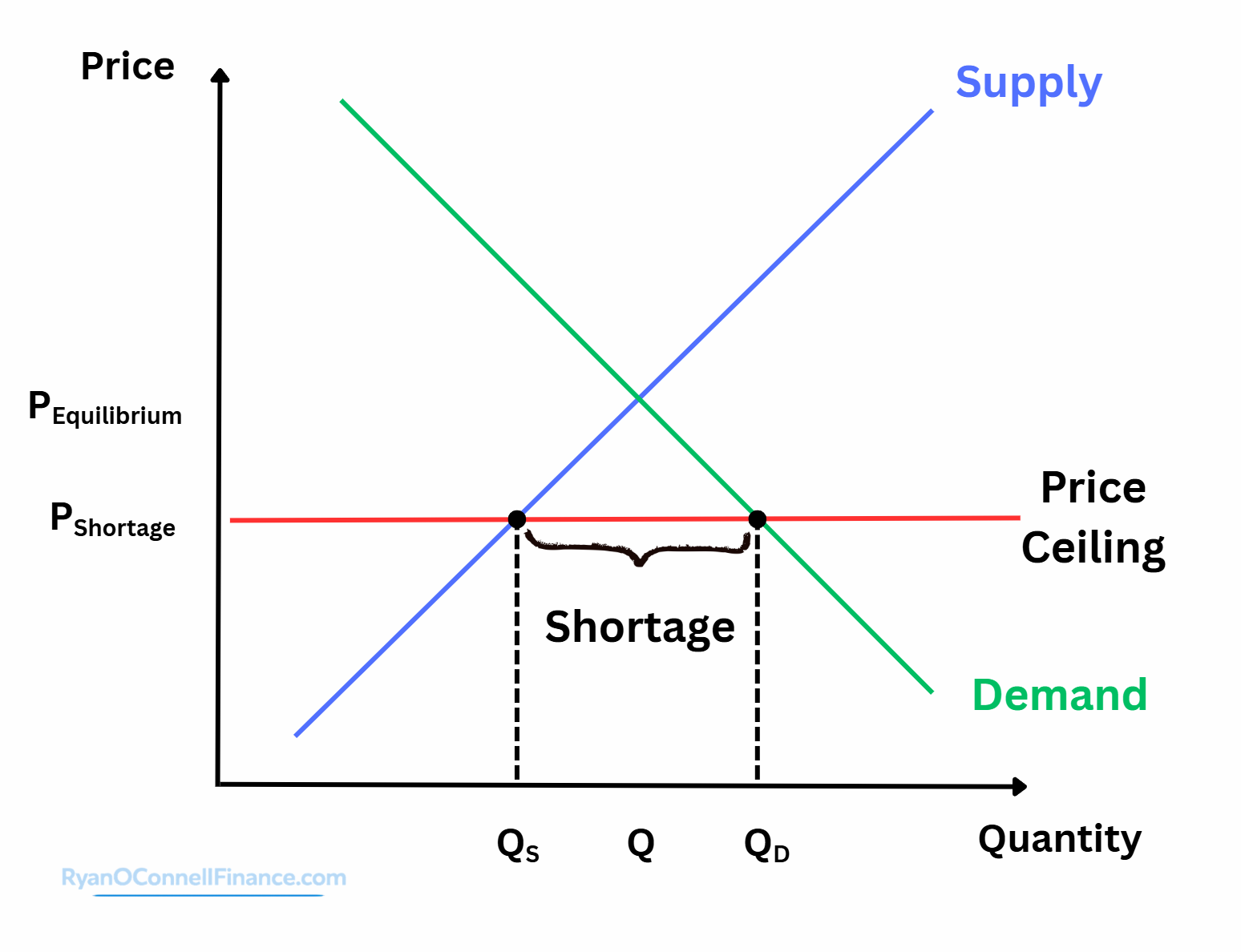
Shortage and Non-Price Rationing
In a free market, prices ration scarce goods — whoever is willing to pay the market price gets the good. A binding ceiling removes this mechanism, so alternative rationing methods emerge:
- Long lines and waiting lists — buyers spend time instead of money (time costs replace price costs)
- Seller discrimination — sellers choose buyers based on personal relationships, race, or other non-price criteria
- Black markets — buyers and sellers transact illegally above the ceiling price
- Side payments — under-the-table fees that push the effective price closer to equilibrium
These non-price rationing mechanisms are typically less efficient and less fair than price-based rationing.
Quality Deterioration
With prices held artificially low, sellers have reduced incentive to maintain quality. Landlords under rent control, for example, often defer maintenance because they cannot raise rents to cover costs — and with a shortage of apartments, tenants have few alternatives.
Case Study: Rent Control
Rent control is perhaps the most widely studied price ceiling. In the short run, when housing supply and demand are relatively inelastic, a binding rent ceiling creates a modest shortage. Rents fall, and incumbent tenants who secure apartments benefit — though even in the short run, some renters searching for new housing face the emerging shortage.
In the long run, however, supply and demand become more elastic. Landlords stop building new units and reduce maintenance on existing ones. Meanwhile, lower rents attract more people seeking apartments. The shortage grows dramatically — creating long waiting lists, discrimination against certain tenants, and under-the-table payments that push effective rents back toward market levels. As one economist famously observed, rent control is “the best way to destroy a city, other than bombing.” For a deeper analysis of the welfare effects, see our article on consumer surplus and producer surplus.
Case Study: 1973 U.S. Gasoline Controls
In 1973, the U.S. had existing price controls on gasoline. When OPEC reduced oil supply, the supply curve shifted left — and what had been a non-binding ceiling suddenly became binding at the new, lower supply level. The result was severe shortages: motorists waited hours in line to purchase only a few gallons. When the price controls were eventually repealed and prices were allowed to adjust, the lines disappeared. The lesson: the interaction of a supply shock with existing price controls caused the crisis, not the supply shock alone.
Price Floor Effects
When a binding price floor holds the price above equilibrium, the mirror-image problems arise.
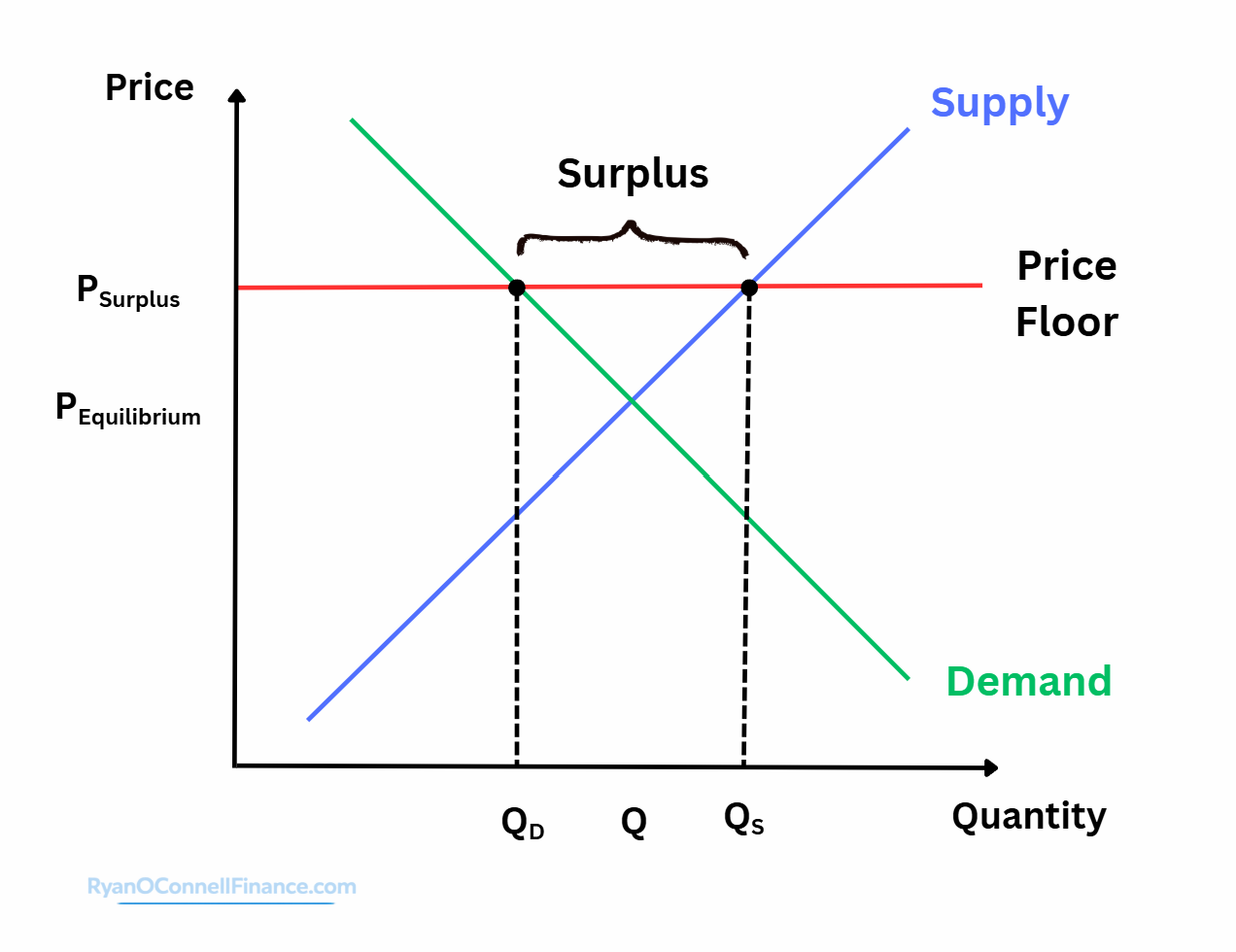
Surplus and Wasted Resources
At the artificially high price, sellers produce more than buyers want to purchase. This surplus must go somewhere — it may be stored at significant cost, destroyed, exported at a loss, or purchased by the government. In all cases, resources are allocated inefficiently.
Case Study: Agricultural Price Supports
The U.S. government has historically set minimum prices for crops like wheat, corn, and dairy products to protect farmers’ incomes. When the price floor exceeds the equilibrium price, farmers produce more than consumers demand at that price. The government then purchases and stores the surplus — sometimes at enormous cost. While these programs support farm incomes, they also raise food prices for consumers, encourage overproduction, and create costly stockpiles.
Minimum Wage as a Price Floor
The minimum wage is a price floor in the labor market. The federal minimum wage has been $7.25 per hour since 2009, though many states and cities set higher minimums. For workers whose equilibrium wage is already above the minimum (skilled and experienced workers), the floor is non-binding and has no effect. For workers in lower-wage labor markets — particularly entry-level and less-experienced workers — the minimum wage is more likely to bind, potentially creating a surplus of labor (unemployment).
The economics of the minimum wage involves significant empirical debate beyond the simple competitive model — including monopsony effects and the Card-Krueger studies. For a comprehensive treatment of these issues, see our dedicated article on minimum wage economics.
Deadweight Loss from Price Controls
Price controls create deadweight loss — a net reduction in total economic welfare — whenever they are binding. Unlike taxes, which generate government revenue alongside the deadweight loss, binding price controls create deadweight loss without generating any revenue for the government.
Deadweight loss from price controls occurs only when the control is binding. A non-binding ceiling or floor does not change the quantity traded and therefore creates no welfare loss.
A binding price ceiling prevents trades that would have occurred between equilibrium and the ceiling price. Buyers who value the good above the ceiling price and sellers willing to supply at that price cannot transact — those mutually beneficial trades are lost. Similarly, a binding price floor prevents trades between the floor price and equilibrium.
The size of the deadweight loss depends on the elasticity of supply and demand. More elastic curves mean the quantity distortion is larger, producing greater deadweight loss. This is why rent control’s welfare costs grow dramatically in the long run as supply and demand become more elastic. For a formal treatment of deadweight loss in the context of taxation, see our article on deadweight loss and taxation.
Examples of Price Ceilings and Price Floors
Suppose the equilibrium rent in a city is $2,000/month, with 100,000 apartments demanded and supplied at that price.
The city imposes a rent ceiling of $1,500/month (binding — below equilibrium).
| Variable | At Equilibrium ($2,000) | At Ceiling ($1,500) |
|---|---|---|
| Quantity Demanded | 100,000 apartments | 120,000 apartments |
| Quantity Supplied | 100,000 apartments | 70,000 apartments |
| Shortage | None | 50,000 apartments |
At the $1,500 ceiling, 120,000 people want apartments but only 70,000 are available — a shortage of 50,000 units. Consequences include long waiting lists, deteriorating building conditions, and under-the-table payments that push effective rents back toward $2,000.
Suppose the equilibrium price of wheat is $5 per bushel, with 10 million bushels demanded and supplied at that price.
The government sets a price floor of $7 per bushel (binding — above equilibrium).
| Variable | At Equilibrium ($5) | At Floor ($7) |
|---|---|---|
| Quantity Demanded | 10 million bushels | 7 million bushels |
| Quantity Supplied | 10 million bushels | 14 million bushels |
| Surplus | None | 7 million bushels |
At the $7 floor, farmers produce 14 million bushels but consumers only buy 7 million — a surplus of 7 million bushels. The government must purchase, store, or dispose of the surplus at taxpayer expense.
Price Ceiling vs Price Floor
Price Ceiling
- Legal maximum price
- Designed to protect buyers
- Binding when set below equilibrium
- Non-binding when set above equilibrium
- Creates a shortage (Qd > Qs)
- Unintended effects: rationing, black markets, quality decline
- Examples: rent control, gasoline price caps
Price Floor
- Legal minimum price
- Designed to protect sellers
- Binding when set above equilibrium
- Non-binding when set below equilibrium
- Creates a surplus (Qs > Qd)
- Unintended effects: overproduction, wasted resources, unemployment
- Examples: minimum wage, agricultural price supports
Common Mistakes
1. Getting the binding direction backwards. A price ceiling binds when set below equilibrium (not above). A price floor binds when set above equilibrium (not below). Mnemonic: ceilings press down from below equilibrium, floors push up from above.
2. Confusing the posted price with the full cost. When a price ceiling creates a shortage, the posted legal price understates the true cost to buyers. Time spent in lines, search costs, side payments, and reduced quality all raise the effective price — sometimes close to what the equilibrium price would have been.
3. Assuming price controls help everyone they intend to help. Rent control benefits tenants who secure an apartment at the lower price, but it harms those who cannot find housing at all. Minimum wages help workers who keep their jobs at the higher wage, but may reduce opportunities for those who are not hired. The intended beneficiaries and the actual beneficiaries often differ.
4. Ignoring long-run effects. Price controls often appear effective in the short run because supply and demand are inelastic — quantities do not adjust much. Over time, as supply and demand become more elastic, the shortages or surpluses grow dramatically. Rent control’s modest short-run shortage can become a severe long-run housing crisis.
5. Forgetting that controls create deadweight loss. Unlike a world with no intervention, binding price controls prevent mutually beneficial trades from occurring. This creates deadweight loss even though no tax revenue is collected. For how deadweight loss works in a tax context, see our article on deadweight loss and taxation.
Limitations of Price Control Analysis
The standard analysis of price ceilings and price floors relies on the competitive supply-and-demand model. While powerful, this framework has important limitations:
The textbook model assumes perfectly competitive markets with full information and no other distortions. Real-world markets may have features — such as market power, information asymmetries, or behavioral factors — that complicate the simple shortage/surplus predictions.
Monopsony and market power. In labor markets where a single employer (or small number of employers) has wage-setting power, a modest minimum wage may not create unemployment as the competitive model predicts. This is why the empirical debate around minimum wages is more nuanced than the textbook price-floor analysis suggests.
Better alternatives may exist. Most economists prefer targeted subsidies over price controls. Housing vouchers (rent subsidies) help low-income tenants afford housing without reducing the quantity supplied. The Earned Income Tax Credit (EITC) supplements low wages without discouraging hiring. These alternatives address affordability without creating the shortages and surpluses that price controls produce.
Distributional effects. The simple model measures total surplus but does not capture who gains and who loses. Policymakers may accept some efficiency loss if the distributional outcome is considered more equitable — a value judgment that economics alone cannot resolve. For the framework used to measure welfare changes, see our article on consumer surplus and producer surplus.
Frequently Asked Questions
Disclaimer
This article is for educational and informational purposes only and does not constitute investment or policy advice. The examples and data cited are for illustrative purposes and may not reflect current market conditions or regulations. Always consult primary sources and qualified professionals for policy analysis and investment decisions.


