Price Elasticity of Demand

Price elasticity of demand is one of the most practical concepts in economics. Whether you are analyzing how a price change will affect sales, evaluating government tax policy, or studying for an economics exam, understanding elasticity is essential. This guide covers everything you need to know — what price elasticity of demand measures, how to calculate it using the midpoint method, the five determinants that drive it, and how it connects to total revenue.
What Is Price Elasticity of Demand?
Price elasticity of demand measures how much the quantity demanded of a good responds to a change in its price. In practical terms, it answers the question: if a company raises its price by 10%, how much will the quantity consumers buy change?
When demand is elastic, consumers are highly responsive to price changes — a small price increase causes a large drop in quantity demanded. When demand is inelastic, consumers are relatively unresponsive — even a significant price increase causes only a small reduction in quantity demanded.
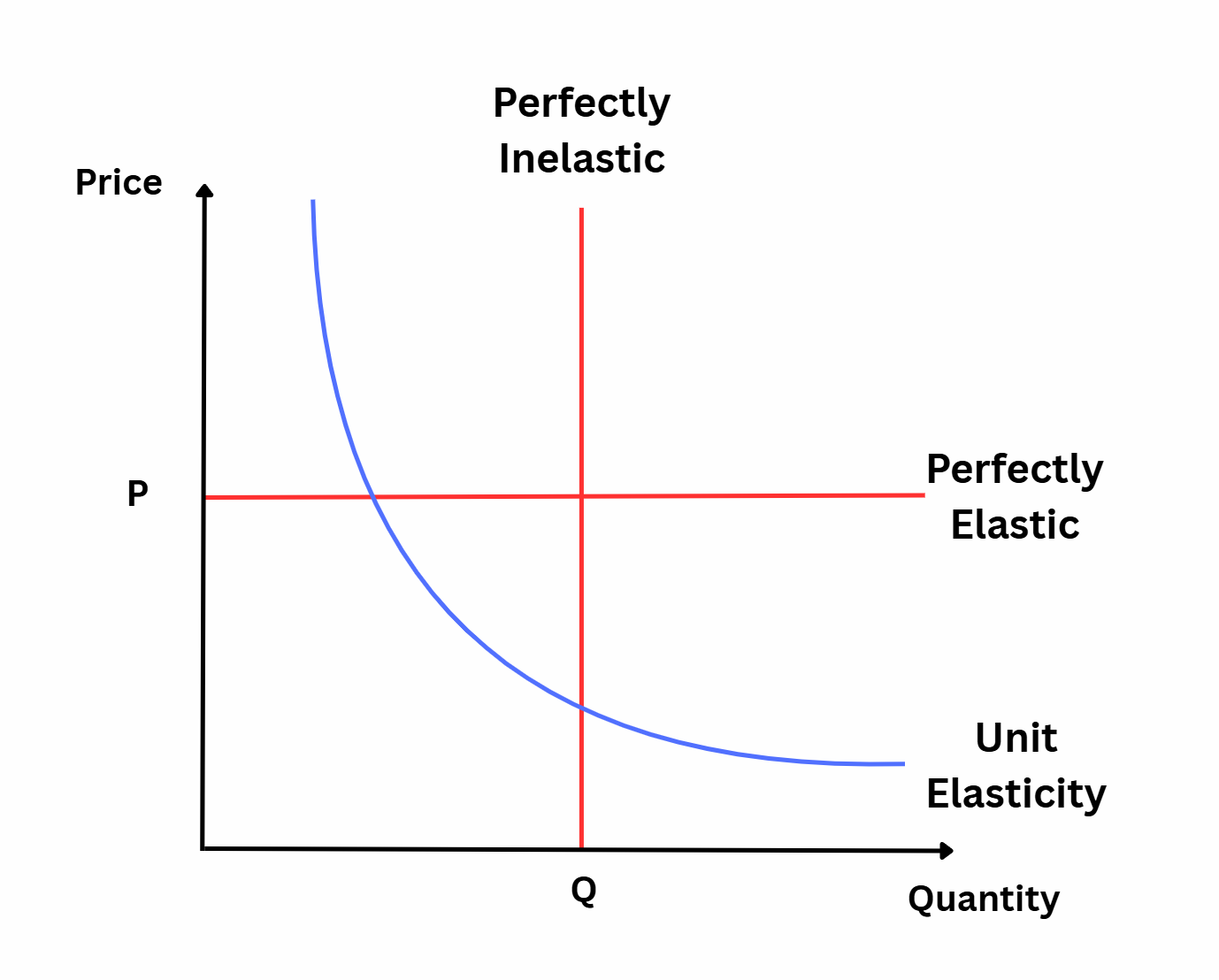
By the law of demand, price and quantity demanded move in opposite directions, so the price elasticity of demand is technically a negative number. However, economists conventionally report and classify it using its absolute value. When someone says “the elasticity is 2,” they mean the magnitude is 2, indicating elastic demand.
This concept has direct applications in business strategy, public policy, and financial analysis. Companies use elasticity to set optimal prices. Governments use it to predict revenue from excise taxes and to understand how the burden of taxation is shared between consumers and producers (which depends on the relative elasticities of both demand and supply). Investors use it to evaluate how sensitive a firm’s revenue is to pricing power. Elasticity also plays a role in macroeconomic analysis — for example, understanding how price-level changes affect aggregate demand and aggregate supply or how wage rigidity relates to the Phillips curve.
The Price Elasticity of Demand Formula
The basic formula expresses elasticity as the ratio of two percentage changes:
Where:
- Ed — price elasticity of demand (reported as an absolute value)
- % Change in Qd — percentage change in quantity demanded
- % Change in Price — percentage change in price
For example, if a 10% increase in the price of a product causes quantity demanded to fall by 20%, the elasticity is |−20% / 10%| = 2.0. Because the absolute value exceeds 1, demand is classified as elastic — consumers are highly responsive to price changes for this good.
The Midpoint Method
A problem with the basic percentage-change formula is that it gives different answers depending on the direction of the change. The midpoint method solves this by using the average of the starting and ending values as the base for each percentage change:
Suppose the price of a good rises from $4 to $6, and the quantity demanded falls from 120 units to 80 units.
Using the standard method:
- A → B: % ΔQ = (80 − 120) / 120 = −33.3%; % ΔP = (6 − 4) / 4 = 50% → Ed = 0.67
- B → A: % ΔQ = (120 − 80) / 80 = 50%; % ΔP = (4 − 6) / 6 = −33.3% → Ed = 1.50
Using the midpoint method:
- Midpoint Q = (120 + 80) / 2 = 100; Midpoint P = ($4 + $6) / 2 = $5
- % ΔQ = (80 − 120) / 100 = −40%; % ΔP = (6 − 4) / 5 = 40%
- Ed = |−40% / 40%| = 1.0 (unit elastic) — same result in both directions
Always use the midpoint method when calculating price elasticity of demand between two points. It eliminates the direction-of-change problem and is the standard method used in economics textbooks and on exams.
Interpreting Elasticity Values
Elasticity values (expressed as absolute values) fall on a continuous spectrum. Here are the five key classifications:
| Classification | |Ed| Value | Meaning | Demand Curve Shape |
|---|---|---|---|
| Perfectly Inelastic | 0 | Quantity does not change at all when price changes | Vertical line |
| Inelastic | Between 0 and 1 | Quantity changes proportionally less than price | Steep curve |
| Unit Elastic | Exactly 1 | Quantity changes in the same proportion as price | Moderate curve |
| Elastic | Greater than 1 | Quantity changes proportionally more than price | Flat curve |
| Perfectly Elastic | ∞ | Any price increase causes quantity demanded to drop to zero | Horizontal line |
The flatter the demand curve, the more elastic the demand. The steeper the curve, the more inelastic. This visual intuition helps when analyzing graphs, but remember that slope and elasticity are not the same thing — a point we address in the Common Mistakes section below.
Determinants of Price Elasticity
What makes demand for one good elastic and another inelastic? Five key factors determine the price elasticity of demand:
1. Availability of Close Substitutes — Goods with many close substitutes tend to have more elastic demand. If the price of butter rises, consumers can easily switch to margarine. But if the price of eggs rises, there are few direct substitutes, so consumers reduce purchases only slightly.
2. Necessities vs. Luxuries — Demand for necessities (such as healthcare and basic food) tends to be inelastic because people buy them regardless of price. Demand for luxuries (such as designer clothing and exotic vacations) tends to be elastic because consumers can easily forgo them when prices rise.
3. Definition of the Market — Narrowly defined markets have more elastic demand than broadly defined ones. The demand for “food” is very inelastic (no substitute for eating), but the demand for “vanilla ice cream” is highly elastic (many other flavors and desserts available).
4. Time Horizon — Demand becomes more elastic over time. When gasoline prices spike, consumers initially have few options. Over months and years, they buy fuel-efficient cars, move closer to work, or switch to public transit — making long-run demand much more elastic than short-run demand.
5. Share of Consumer’s Budget — Goods that represent a small share of a consumer’s budget tend to have inelastic demand. A 20% increase in the price of salt barely affects household spending, so quantity demanded hardly changes. A 20% increase in the price of housing, which consumes a large share of most budgets, has a much larger impact on decisions.
| Good | Elasticity Category | Why |
|---|---|---|
| Eggs | Very inelastic | Few substitutes, necessity, small budget share |
| Healthcare | Inelastic | Necessity, limited alternatives |
| Housing | Inelastic | Necessity, but large budget share moderates inelasticity |
| Beef | Mildly elastic | Substitutes available (chicken, pork, fish) |
| Restaurant meals | Elastic | Luxury, many substitutes (cooking at home) |
| Brand-specific sodas | Very elastic | Narrowly defined market, many close substitutes |
Elasticity and Total Revenue
One of the most important applications of price elasticity is predicting how a price change affects total revenue — the total amount consumers spend on a good (and the total amount sellers receive).
The total revenue test establishes a clear relationship between elasticity and how revenue responds to price changes:
| Demand Type | Price Increase | Price Decrease |
|---|---|---|
| Elastic (|Ed| > 1) | Revenue falls | Revenue rises |
| Unit Elastic (|Ed| = 1) | Revenue unchanged | Revenue unchanged |
| Inelastic (|Ed| < 1) | Revenue rises | Revenue falls |
The logic is straightforward: when demand is elastic, the percentage drop in quantity exceeds the percentage rise in price, so the revenue lost from fewer sales outweighs the revenue gained from a higher price. When demand is inelastic, the reverse is true — the quantity drop is proportionally small, so higher prices increase total revenue.
This principle explains real-world pricing strategies. OPEC’s strategy of restricting oil supply to raise prices works because demand for oil is relatively inelastic in the short run — consumers cannot quickly find alternatives, so higher prices raise total revenue for oil producers. Conversely, a luxury resort that raises prices too aggressively may see revenue fall because its customers have many alternative vacation options (elastic demand).
A straight-line demand curve has a constant slope, but elasticity is not constant along it. Elasticity uses percentage changes, not absolute changes. Near the top of a linear demand curve (high price, low quantity), demand is elastic. Near the bottom (low price, high quantity), demand is inelastic. Total revenue is maximized at the midpoint where demand is unit elastic.
Price Elasticity of Demand Example
To see how elasticity affects real-world outcomes, consider two goods with very different elasticities responding to the same 10% price increase:
Gasoline (Inelastic Demand, |Ed| ≈ 0.2):
- A 10% price increase reduces quantity demanded by only 2% (0.2 × 10%)
- Revenue impact: Price rises 10%, quantity falls 2% → total revenue increases by approximately 7.8%
- Consumers still need to commute and cannot quickly switch to alternatives
Luxury Caribbean Vacation (Elastic Demand, |Ed| ≈ 1.5):
- A 10% price increase reduces quantity demanded by 15% (1.5 × 10%)
- Revenue impact: Price rises 10%, quantity falls 15% → total revenue decreases by approximately 6.5%
- Consumers have many substitutes — a different destination, a staycation, or delaying travel
This example illustrates why understanding elasticity is critical for pricing strategy. At the market level, gasoline producers benefit from inelastic demand — industry-wide price increases raise total revenue. However, an individual gas station faces a much narrower market with many nearby competitors, so its firm-level demand is far more elastic. A luxury travel company must also be cautious — raising prices aggressively drives customers to substitute destinations and reduces total revenue. For more on how governments use elasticity to analyze the effects of price controls and market interventions, see our article on price ceilings and price floors.
How to Calculate Price Elasticity of Demand
Calculating price elasticity of demand between two observed data points is a straightforward four-step process:
- Identify the two data points: Record the initial price and quantity (P1, Q1) and the new price and quantity (P2, Q2)
- Calculate the percentage change in quantity using the midpoint method: (Q2 − Q1) / ((Q2 + Q1) / 2) × 100
- Calculate the percentage change in price using the midpoint method: (P2 − P1) / ((P2 + P1) / 2) × 100
- Divide and take the absolute value: |% Change in Qd / % Change in Price| = |Ed|
A coffee shop raises the price of a latte from $4.00 to $5.00. Weekly sales drop from 200 to 150 lattes.
- % ΔQ = (150 − 200) / ((150 + 200) / 2) × 100 = −50 / 175 × 100 = −28.6%
- % ΔP = (5 − 4) / ((5 + 4) / 2) × 100 = 1 / 4.50 × 100 = 22.2%
- Ed = |−28.6% / 22.2%| = 1.29 (elastic)
Because demand is elastic (|Ed| > 1), the price increase reduced total revenue — from $800 to $750 per week. The coffee shop would have been better off keeping prices lower.
If your calculated elasticity is close to 1.0, be cautious about drawing strong conclusions. Small measurement errors in the data can push the result from elastic to inelastic or vice versa. Consider the determinants of elasticity as a qualitative cross-check.
Price Elasticity vs. Income and Cross-Price Elasticity
Price elasticity of demand is the most commonly discussed type, but economists also measure responsiveness to other variables. Understanding the differences helps avoid confusion:
Price Elasticity of Demand
- Measures responsiveness to own-price changes
- Classified by absolute value (always reported as positive)
- Key application: pricing strategy and total revenue
- Elastic (>1) vs. inelastic (<1)
- Uses: setting prices, forecasting sales impact
Income Elasticity of Demand
- Measures responsiveness to consumer income changes
- Sign matters: positive for normal goods, negative for inferior goods
- Key application: demand forecasting during economic cycles
- Necessities (small positive) vs. luxuries (large positive)
- Uses: recession planning, product mix decisions
Cross-Price Elasticity of Demand
Cross-price elasticity measures how the quantity demanded of one good responds to a price change in a different good:
- Substitutes (positive cross-price elasticity): When the price of hot dogs rises, demand for hamburgers increases. Examples: Coca-Cola and Pepsi, butter and margarine.
- Complements (negative cross-price elasticity): When the price of computers rises, demand for software falls. Examples: printers and ink cartridges, cars and gasoline.
Common Mistakes
Price elasticity of demand is conceptually straightforward, but several common errors trip up students and practitioners:
1. Confusing “elastic” with “rigid” — The word “elastic” in everyday language suggests flexibility, and that is exactly what it means in economics. Elastic demand means consumers are flexible and responsive to price changes. Inelastic demand means consumers are unresponsive. Do not reverse the terms.
2. Not using the midpoint method — The standard percentage-change formula gives different elasticity values depending on whether you calculate from point A to B or from B to A. Always use the midpoint method for a consistent, direction-independent result.
3. Confusing slope with elasticity — A linear demand curve has a constant slope, but its elasticity varies at every point. Slope measures the absolute change in quantity per dollar change in price (rise over run). Elasticity measures percentage changes, which depend on the starting values. At low prices and high quantities, the same absolute change represents a smaller percentage change in quantity and a larger percentage change in price — making demand inelastic.
4. Assuming elasticity is constant along a demand curve — Related to the slope mistake, many students assume that if a demand curve is “steep” it is inelastic everywhere. In reality, a straight-line demand curve transitions from elastic at the top, through unit elastic at the midpoint, to inelastic at the bottom.
5. Ignoring the time horizon — Short-run elasticity for a good like gasoline may be very low (around 0.2), but long-run elasticity is significantly higher as consumers adjust their behavior, technology, and consumption patterns. Policy analyses that rely only on short-run estimates can significantly underestimate behavioral responses.
Limitations of Price Elasticity
While price elasticity of demand is a powerful analytical tool, it has several important limitations:
Elasticity is a backward-looking estimate based on observed data. It describes how consumers have responded to past price changes, but it does not guarantee the same response in the future, particularly if market conditions, consumer preferences, or available substitutes have changed.
1. Varies Along the Demand Curve — As discussed above, elasticity is not a single fixed number for a product. It changes depending on the current price level, making it difficult to assign one elasticity value to an entire market.
2. Difficult to Measure Precisely — Isolating the effect of price on quantity demanded requires controlling for all other factors (income, tastes, competitor prices, seasonality). In practice, real-world data is noisy, and different studies often produce different elasticity estimates for the same good.
3. Ceteris Paribus Assumption — The elasticity formula assumes “all else equal.” In reality, prices, incomes, and substitute availability often change simultaneously, making it challenging to attribute changes in quantity demanded solely to price.
4. Historical Data May Not Predict Future Behavior — Structural changes in an industry (new technology, regulatory shifts, changing demographics) can fundamentally alter consumer responsiveness. The elasticity of demand for taxi rides, for example, changed dramatically with the introduction of ride-sharing services.
Despite these limitations, price elasticity of demand remains one of the most widely used tools in economics for analyzing pricing decisions, tax policy, and market dynamics. For a deeper exploration of how elasticity interacts with taxation, see our article on deadweight loss and taxation.
Frequently Asked Questions
Disclaimer
This article is for educational and informational purposes only. Elasticity estimates cited are approximate and vary across studies depending on data sources, time periods, and methodology. The examples and calculations are illustrative and should not be used as the sole basis for business or policy decisions.