Supply and Demand: How Markets Determine Prices

Supply and demand is the most fundamental model in economics. Whether you are analyzing commodity prices, evaluating a housing market, or studying macroeconomic policy, it all starts here. This guide covers everything you need to know — what supply and demand are, how markets reach equilibrium, what causes prices to change, and where the model falls short.
What is Supply and Demand?
Supply and demand is the framework economists use to explain how prices and quantities are determined in a market. Demand represents the quantity of a good or service that buyers are willing and able to purchase at various prices. Supply represents the quantity that sellers are willing and able to produce and offer for sale at various prices.
In a competitive market — one with many buyers and sellers, where no single participant can influence the price, and goods are essentially identical — the interaction of supply and demand determines the equilibrium price and quantity. This is the price at which the quantity buyers want to purchase exactly equals the quantity sellers want to sell.
The supply and demand model works best for competitive markets such as gasoline, agricultural products, and other commodity-like goods. While most real-world markets deviate from perfect competition to some degree, the model provides a powerful starting point for understanding how prices are set and how they respond to changing conditions. Limitations are discussed later in this article.
The Demand Curve
Law of Demand
The law of demand states that, all else being equal (ceteris paribus), when the price of a good rises, the quantity demanded falls — and when the price falls, the quantity demanded rises. This inverse relationship between price and quantity demanded is one of the most reliable patterns in economics.
Three forces drive this relationship: the substitution effect (higher prices make consumers switch to alternatives), the income effect (higher prices reduce consumers’ real purchasing power), and diminishing marginal utility (each additional unit provides less satisfaction, so consumers only buy more at lower prices).
Demand Schedule and Demand Curve
A demand schedule is a table showing the quantity demanded at each price level. When plotted on a graph with price on the vertical axis and quantity on the horizontal axis, these points form the demand curve — a downward-sloping line reflecting the law of demand.
Individual vs. Market Demand
The market demand curve is the horizontal sum of all individual demand curves. At each price, you add up how much every buyer in the market wants to purchase. As the number of buyers increases, the market demand curve shifts to the right.
The demand curve holds all other factors constant (ceteris paribus). This assumption is what distinguishes a movement along the curve from a shift of the curve — the single most important distinction in supply and demand analysis.
Determinants of Demand
Five factors can shift the entire demand curve to the left or right. These are changes in conditions other than the good’s own price — they cause the quantity demanded to change at every price level, not just at one price point.
| Determinant | Effect on Demand | Real-World Example |
|---|---|---|
| Income | Normal goods: income rises → demand increases. Inferior goods: income rises → demand decreases. | Rising wages increase restaurant dining (normal good) but decrease instant ramen consumption (inferior good) |
| Prices of related goods | Substitutes: substitute price rises → demand increases. Complements: complement price rises → demand decreases. | Higher Uber prices increase Lyft demand (substitutes); higher gasoline prices decrease SUV demand (complements) |
| Tastes and preferences | Favorable change in tastes → demand increases | Health-consciousness trends increase demand for organic food |
| Expectations | Expected future price increase → current demand increases | Anticipated tariffs on electronics boost current consumer purchases |
| Number of buyers | More buyers → demand increases | Population growth in a city increases housing demand |
The distinction between normal goods and inferior goods is important. A normal good sees demand rise as income rises — think restaurant meals, new cars, or vacations. An inferior good sees demand fall as income rises because consumers switch to higher-quality alternatives — think generic store brands, public transit in car-oriented cities, or instant noodles.
The Supply Curve
Law of Supply
The law of supply states that, all else being equal, when the price of a good rises, the quantity supplied rises — and when the price falls, the quantity supplied falls. This positive relationship exists because higher prices make production more profitable, encouraging existing firms to produce more.
Supply Schedule and Supply Curve
A supply schedule is a table showing the quantity supplied at each price level. Plotted on a graph, these points form the supply curve — an upward-sloping line reflecting the law of supply.
Individual vs. Market Supply
The market supply curve is the horizontal sum of all individual supply curves. At each price, you add up how much every seller in the market is willing to produce. As new firms enter the market, the market supply curve shifts to the right.
Determinants of Supply
Five factors can shift the entire supply curve to the left or right. Like demand shifters, these are changes in conditions other than the good’s own price.
| Determinant | Effect on Supply | Real-World Example |
|---|---|---|
| Input prices | Higher input costs → supply decreases | Rising steel prices reduce automobile supply |
| Technology | Better technology → supply increases | Hydraulic fracturing (fracking) dramatically increased U.S. oil supply |
| Expectations | Expected future price increase → may decrease current supply | Oil producers withhold inventory when they expect prices to rise |
| Number of sellers | More sellers → supply increases | New electric vehicle manufacturers entering the market increase vehicle supply |
| Natural conditions | Favorable conditions → supply increases | Good weather increases agricultural crop yields |
How Supply and Demand Determine Equilibrium Price
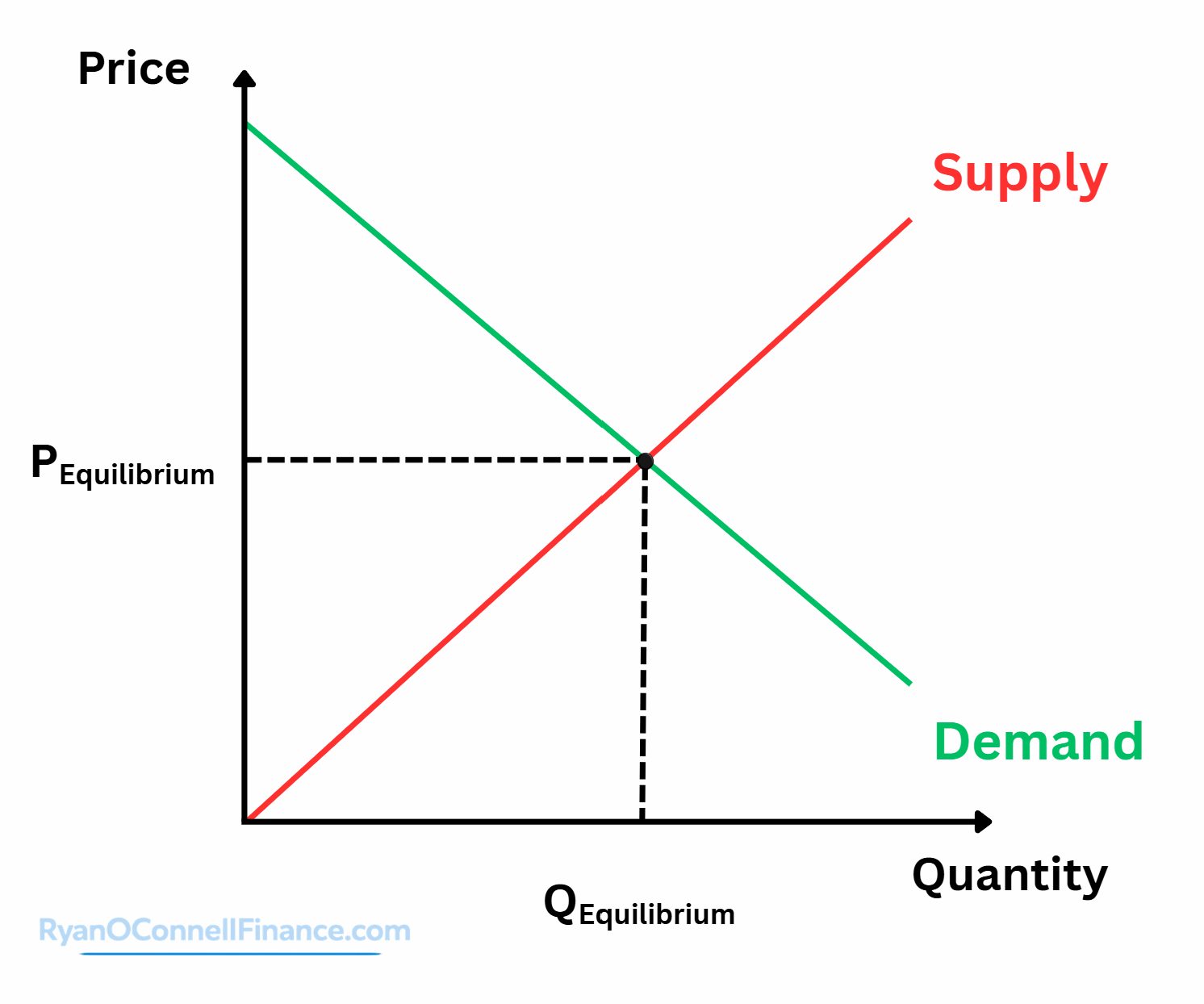
The supply and demand curves together determine the market’s equilibrium — the point where the quantity buyers want to purchase exactly matches the quantity sellers want to produce.
Surplus and Shortage
When the market price is above the equilibrium price, a surplus (excess supply) occurs: sellers want to sell more than buyers want to buy (Qs > Qd). Unsold goods accumulate, putting downward pressure on the price. When the market price is below the equilibrium price, a shortage (excess demand) occurs: buyers want to purchase more than sellers are offering (Qd > Qs). Competition among buyers pushes the price upward.
In competitive markets with flexible prices, surpluses and shortages are self-correcting. A surplus puts downward pressure on price; a shortage puts upward pressure. This tendency toward equilibrium is what Adam Smith called the “invisible hand” — no central authority is needed for the market to find the right price.
Three Steps to Analyze a Market Change
Economists use a systematic three-step framework to predict how an event will affect a market:
- Identify which curve shifts — Does the event affect supply, demand, or both?
- Determine the direction of the shift — Does the curve shift left (decrease) or right (increase)?
- Compare the new equilibrium to the old — How do the equilibrium price and quantity change?
When only one curve shifts, the effects on both price and quantity are predictable. When both curves shift simultaneously, one variable (price or quantity) can be predicted, but the other is ambiguous — it depends on which shift is larger.
| Price per Unit | Qd (Demanded) | Qs (Supplied) | Market Condition |
|---|---|---|---|
| $2 | 100 | 40 | Shortage (60 units) — price rises |
| $3 | 80 | 80 | Equilibrium (market clears) |
| $4 | 60 | 120 | Surplus (60 units) — price falls |
At $2, buyers want 100 units but sellers only offer 40 — the shortage of 60 units drives the price up. At $4, sellers offer 120 units but buyers only want 60 — the surplus drives the price down. At $3, the market clears: Qd = Qs = 80 units.
Once a market reaches equilibrium, the concepts of consumer surplus and producer surplus measure the gains from trade that buyers and sellers enjoy — but the measurement of those surpluses is a separate topic.
Real-World Supply and Demand Examples
The three-step framework is not just a classroom exercise — it explains real market events that affect investors and consumers every day.
Step 1: Russia’s invasion of Ukraine in early 2022 disrupted global crude oil supply — a key input for gasoline. This is a supply-side event.
Step 2: The supply curve shifted left (decreased supply) as sanctions and disruptions reduced the amount of oil available to global markets.
Step 3: The equilibrium price rose sharply. The U.S. national average for regular gasoline exceeded $5 per gallon in June 2022, up from roughly $3 before the conflict. Quantity consumed declined as consumers cut back on driving and sought alternatives.
Simultaneously, the ongoing shift toward remote work reduced commuting demand, shifting the demand curve slightly left and partially offsetting the price spike. This is an example of both curves shifting at the same time — the price increase was unambiguous, but the net effect on quantity depended on which shift dominated.
Demand shift right: The pandemic-era expansion of remote work allowed millions of workers to live farther from offices. Demand for suburban and exurban housing surged as buyers no longer needed to commute daily.
Supply shift left: At the same time, supply was constrained by lumber shortages, construction labor scarcity, and existing homeowners reluctant to sell (many had locked in low mortgage rates).
Result: Both shifts pushed prices in the same direction — sharply higher. Median U.S. home prices rose substantially over this period, illustrating how simultaneous demand increases and supply decreases amplify price effects.
Shift vs. Movement Along the Supply or Demand Curve
The single most common source of confusion in supply and demand analysis is the difference between a shift of the curve and a movement along the curve. Mastering this distinction is essential.
Shift of the Curve
- Caused by a change in a determinant (income, input prices, technology, etc.)
- The entire curve moves left or right
- Changes the equilibrium price and quantity
- Called a “change in demand” or “change in supply”
- Example: New technology shifts the supply curve right
Movement Along the Curve
- Caused by a change in the good’s own price
- Quantity adjusts along the existing curve
- Follows the law of demand or law of supply
- Called a “change in quantity demanded” or “change in quantity supplied”
- Example: Gasoline price rises → consumers buy less
The distinction applies to both sides of the market:
- “Change in demand” (shift of the demand curve) vs. “change in quantity demanded” (movement along the demand curve)
- “Change in supply” (shift of the supply curve) vs. “change in quantity supplied” (movement along the supply curve)
Rule of thumb: If the good’s own price changed, it is a movement along the curve. If anything else changed (income, input prices, tastes, technology, etc.), it is a shift of the curve.
Saying “demand increased because the price fell” is incorrect. A price decrease causes an increase in quantity demanded (movement along the curve), not an increase in demand (shift of the curve). This wording distinction is not pedantic — it reflects a fundamentally different economic mechanism.
Common Mistakes
Even experienced students of economics make these errors when working with the supply and demand model:
1. Confusing shifts with movements along curves. This is the most frequent mistake. Remember: a change in the good’s own price causes a movement along the curve. A change in any other factor (income, technology, input prices, tastes) causes a shift of the entire curve. The wording matters — “demand increased” means the curve shifted; “quantity demanded increased” means price fell.
2. Assuming markets are always at equilibrium. Equilibrium is a tendency, not a guarantee. Real markets take time to adjust — gasoline markets may reach a new equilibrium in days, while housing markets can take months or years. Adjustment requires flexible prices, which is not always the case (wages, for instance, tend to be sticky downward).
3. Ignoring that equilibrium changes when curves shift. When a determinant changes, the old equilibrium price and quantity no longer hold. A rightward shift in demand, for example, creates a shortage at the old price — the price must rise to reach the new equilibrium. Failing to trace through to the new equilibrium leads to incomplete analysis.
4. Inferring a curve from observed price-quantity data. Seeing that both price and quantity rose over time does not violate the law of demand. It usually means the demand curve shifted right — buyers wanted more at every price, which pushed both the equilibrium price and quantity higher. You cannot identify a demand or supply curve from observed data unless you know which curve moved.
Limitations of the Supply and Demand Model
The supply and demand model is one of the most powerful tools in economics, but it rests on assumptions that do not always hold in the real world.
The supply and demand model describes an idealized competitive market. Before applying its predictions, consider whether the market in question actually meets the model’s assumptions — particularly regarding competition and price flexibility.
Market power and imperfect competition. The model assumes no buyer or seller can influence the market price. In reality, monopolies, oligopolies, and firms with strong brand differentiation often have significant pricing power. Markets for smartphones, pharmaceuticals, or cable internet do not behave like the textbook competitive market.
Sticky prices and institutional frictions. The model assumes prices adjust freely and quickly. In practice, wages are often set by contracts and resist downward adjustment. Rents may be locked in by leases. Menu costs discourage frequent price changes. These frictions mean markets can remain in disequilibrium for extended periods.
Externalities. The model considers only private costs and benefits to buyers and sellers. It does not account for third-party effects such as pollution, congestion, or public health impacts. When externalities are significant, the market equilibrium may not be socially optimal.
Behavioral departures from rationality. The model assumes buyers and sellers make rational decisions based on complete information. Behavioral economics has shown that real decision-making is influenced by cognitive biases — anchoring, loss aversion, herd behavior, and limited attention — that can cause markets to deviate from predicted outcomes.
For how governments intervene when markets produce undesirable outcomes, see Price Ceilings and Price Floors. For measuring how responsive buyers and sellers are to price changes, see Price Elasticity of Demand.
Frequently Asked Questions
Disclaimer
This article is for educational and informational purposes only and does not constitute investment advice. The examples cited use approximate figures and are intended to illustrate economic concepts, not to provide precise market data. Always conduct your own research and consult a qualified financial advisor before making investment decisions.