Money Supply & Money Creation: How Banks Create Money

Table of Contents
The money supply is one of the most important concepts in macroeconomics. It determines how much purchasing power flows through an economy, shapes the effectiveness of monetary policy, and plays a central role in inflation. Much of the money in your bank account exists because a bank made a loan — understanding how that process works reveals the mechanics behind modern economies. This guide covers what money is, how the money supply is measured, how banks create money through lending, and how the system works in practice today.
What Is the Money Supply?
The money supply is the total amount of money available in an economy at a given time. It includes physical currency, bank deposits, and other liquid assets that can be readily used for transactions or converted into spending power.
Money serves three functions in an economy: as a medium of exchange (you can use it to buy goods and services), a unit of account (prices are quoted in dollars, not bushels of wheat), and a store of value (you can hold it and spend it later). Any asset that reliably performs all three functions qualifies as money.
Modern economies use fiat money — currency that has value because the government declares it legal tender and people accept it in exchange, not because it is backed by a physical commodity like gold. This contrasts with commodity money, such as gold coins, which has intrinsic value independent of government decree. The United States formally abandoned the gold standard in 1971, and today the U.S. dollar is entirely fiat money.
Money is the most liquid asset — it can be used for transactions immediately without conversion. Other assets like stocks, bonds, or real estate must be sold first, which takes time and may involve transaction costs. The money supply measures the stock of these highly liquid assets available in the economy.
Measuring the Money Supply: M1 vs M2
The Federal Reserve tracks the money supply using two primary measures, M1 and M2, which differ by how broadly they define “money.” The Fed updated these definitions in May 2020, so current measures differ significantly from historical ones.
| Measure | Components | Approximate Size (Early 2026) |
|---|---|---|
| M1 | Currency in circulation + demand deposits + other liquid deposits (includes savings deposits and money market deposit accounts) | ~$19.2 trillion |
| M2 | M1 + small-denomination time deposits (<$100,000) + retail money market funds | ~$22.4 trillion |
M1 captures the most liquid forms of money — assets you can spend immediately or with minimal effort. M2 adds near-money assets that are slightly less liquid but can be converted to spending power quickly. M2 is the broader and more commonly cited measure in macroeconomic analysis.
The gap between M1 and M2 has narrowed substantially since the May 2020 reclassification. Before the change, M1 was roughly $5 trillion while M2 was about $18 trillion — a gap reflecting the large volume of savings deposits classified outside M1. Today, with savings deposits included in M1, the difference between the two measures consists mainly of small time deposits and retail money market funds.
In May 2020, the Federal Reserve reclassified savings deposits as part of M1, causing a dramatic statistical break. M1 jumped from roughly $5 trillion to over $16 trillion overnight — not because more money was created, but because the definition changed. Historical M1 comparisons across this break are misleading. Always check whether data sources use the pre- or post-2020 definition.
How Banks Create Money: Fractional Reserve Banking
One of the most important insights in monetary economics is that commercial banks create money through the process of lending. This is possible because of fractional reserve banking — the system in which banks hold only a fraction of their deposits as reserves and lend out the rest.
In the textbook model of fractional reserve banking, when a bank receives a deposit, it holds a portion as reserves and lends the remainder. That loan is deposited at another bank, which holds a fraction and lends again. Through this chain of deposit → reserve → lend → deposit, an initial increase in reserves is multiplied into a much larger increase in the total money supply.
Consider a simplified balance sheet. A bank receives a $10,000 deposit. If the reserve ratio is 10%, the bank holds $1,000 in reserves and can lend $9,000. The borrower spends that $9,000, and it is deposited at another bank. That bank holds $900 in reserves and lends $8,100. The process continues through the banking system, creating new deposits at each step.
For a deeper look at the Federal Reserve’s institutional structure and its role in this system, see our dedicated article.
Notice what has happened: the banking system has not created money from nothing. It has transformed a relatively illiquid asset (a loan, which cannot be spent directly) into a liquid one (a deposit, which can). No new wealth appears from nowhere — for every new deposit created, there is a corresponding loan obligation on the other side of the bank’s balance sheet. Bank balance sheets expand in the process (both assets and liabilities grow), but the money supply has increased because deposits count as money while loans do not.
This textbook model builds essential intuition about how banking amplifies the monetary base. However, as we will see in the Modern Money Creation section below, real-world banking today operates under different constraints.
Money Creation Example: The Textbook Multiplier
To see how money creation works in the textbook model, trace a $10,000 increase in bank reserves — for example, from a Federal Reserve asset purchase — through five rounds of lending at a 10% reserve ratio.
| Round | New Deposits | Reserves Held (10%) | Amount Lent |
|---|---|---|---|
| Bank A | $10,000.00 | $1,000.00 | $9,000.00 |
| Bank B | $9,000.00 | $900.00 | $8,100.00 |
| Bank C | $8,100.00 | $810.00 | $7,290.00 |
| Bank D | $7,290.00 | $729.00 | $6,561.00 |
| Bank E | $6,561.00 | $656.10 | $5,904.90 |
| After 5 rounds | $40,951.00 | $4,095.10 | $36,855.90 |
| Ultimate total (∞ rounds) | $100,000.00 | $10,000.00 | $90,000.00 |
Result: A $10,000 increase in reserves ultimately supports $100,000 in total deposits. The net new money created beyond the original $10,000 is $90,000 — all created through the banking system’s lending process.
The process converges because each round creates a smaller deposit than the last. After infinite rounds, total deposits equal the initial reserves divided by the reserve ratio: $10,000 ÷ 0.10 = $100,000.
Several important assumptions underlie this example. It assumes every dollar lent is redeposited in the banking system (no currency drain), every bank lends the maximum allowed (no excess reserves), and there is unlimited demand for loans at prevailing rates. In practice, none of these assumptions fully holds, which is why the actual expansion is always less than the theoretical maximum.
The Money Multiplier Formula
The textbook model expresses the relationship between the monetary base and the money supply through two formulas. These are useful conceptual tools, but they describe a simplified world — not a stable operating rule for modern banking.
Where:
- M — money supply (M1 or M2)
- m — money multiplier
- B — monetary base (currency in circulation + bank reserves; the official term for what is sometimes informally called M0)
- r — reserve requirement ratio
In reality, the actual multiplier is always smaller than 1/r because:
- Excess reserves — Banks often hold reserves above the required minimum, especially when lending opportunities are limited or uncertain
- Currency drain — Some money leaks out of the banking system as people hold cash rather than depositing it
- Borrower demand — Money creation requires willing, creditworthy borrowers — banks cannot force loans into existence
The simple multiplier (1/r) is a theoretical maximum that assumes all money stays in the banking system and banks lend every dollar above required reserves. In practice, the actual money multiplier is smaller, unstable over time, and — since 2020 — no longer constrained by reserve requirements at all. Treat these formulas as conceptual tools, not forecasting models.
Modern Money Creation
The textbook fractional-reserve model provides valuable intuition, but the way money is actually created in the United States today looks quite different.
On March 26, 2020, the Federal Reserve reduced required reserve ratios to 0% for all depository institutions. The U.S. now operates under an ample-reserves regime, in which reserve requirements no longer constrain bank lending. Instead, lending is governed by capital requirements, liquidity regulations, and the profitability of making loans.
With a 0% reserve requirement, the textbook formula 1/r would imply an infinite multiplier — which is obviously not what happens. This reveals the model’s key limitation: reserve requirements were never the only — or even the primary — constraint on bank lending in the modern era. By the time they were formally eliminated, they had already ceased to play an essential role in the Fed’s operating framework.
What actually constrains bank lending today:
- Capital requirements (Basel III) — Banks must maintain minimum ratios of equity capital to risk-weighted assets. This limits how much total lending a bank can do regardless of its reserves.
- Liquidity coverage ratio (LCR) — Banks must hold enough high-quality liquid assets to survive a 30-day stress scenario.
- Net stable funding ratio (NSFR) — Banks must maintain stable funding sources relative to their asset profiles.
- Central bank policy rates — The federal funds rate influences the cost of funding, which affects the profitability of new loans.
- Borrower creditworthiness and demand — Banks only lend when they find creditworthy borrowers who want to borrow at prevailing rates.
From the endogenous money perspective — widely accepted among central bankers today — the causation in modern banking often runs in the opposite direction from the textbook: loans create deposits, not the other way around. When a bank approves a loan, it credits the borrower’s account with new deposits — creating money in the process. The bank then obtains any reserves it needs through interbank markets or from the Fed. The Bank of England published an influential 2014 paper confirming this view, noting that “the reality of how money is created today differs from the description found in some economics textbooks.”
Reserves still matter — banks need them for payment settlement between institutions and for meeting the Fed’s policy implementation framework. But reserves are no longer the binding constraint that limits how much money the banking system can create.
Money Destruction: The Mirror Image
Just as lending creates money, loan repayment destroys it. When a borrower repays a loan, the bank debits the borrower’s deposit account and cancels the loan — both the deposit and the loan disappear from the bank’s balance sheet, and the money supply contracts. (Note that charge-offs are different: when a bank writes off a bad loan, it reduces the bank’s assets and capital, but the deposits created when the loan was originally made have already been spent and remain in the system.) This process explains why the money supply can shrink even without any deliberate policy action.
A striking real-world example: in 2022–2023, as the Federal Reserve raised interest rates aggressively and began tightening its balance sheet, bank lending slowed and M2 declined for the first time in decades. Higher rates reduced borrower demand and increased loan repayments relative to new lending — demonstrating that money destruction is not just theoretical. Between April 2022 and October 2023, M2 fell by roughly $1 trillion from its peak, a historically unusual contraction that reflected the combined effects of monetary tightening, reduced bank lending, the unwinding of pandemic-era fiscal deposits, and depositors migrating funds to higher-yielding instruments outside M2 — such as Treasury bills and institutional money market funds.
The reserve-multiplier model remains valuable for building intuition about how banking amplifies the monetary base. But modern money creation is governed by capital adequacy, regulatory frameworks, and the ample-reserves regime — not by reserve requirements. Understanding both the textbook model and its limitations is essential for interpreting monetary data correctly.
Money Supply vs Monetary Base
The monetary base and the money supply are related but fundamentally different measures. Understanding the distinction is critical for interpreting Federal Reserve actions and their economic effects.
Monetary Base
- Currency in circulation + bank reserves held at the Fed
- Influenced most directly by the Fed via its balance sheet
- Also called “high-powered money” (M0 is informal shorthand)
- Approximately $5.4 trillion (early 2026)
- Represents the raw material for money creation
Money Supply (M1/M2)
- Currency + deposits held by the public
- Determined by banking system behavior and public preferences
- Much larger than the monetary base
- M2 approximately $22.4 trillion (early 2026)
- Represents the total purchasing power available in the economy
The Fed influences the monetary base through its balance sheet operations, but the money supply depends on how actively banks lend and how the public chooses to hold its wealth (as deposits vs. cash). This distinction explains a puzzle from the 2008 financial crisis: the Fed massively expanded the monetary base through quantitative easing, yet the money supply grew much more slowly. Banks held the new reserves as excess reserves rather than lending them out, so the multiplier collapsed. The monetary base tripled, but M2 grew at a moderate pace.
Conversely, in a healthy economy with strong loan demand, a relatively small monetary base can support a large money supply because the multiplier is high. The relationship between base and supply is not fixed — it depends on banking system behavior, regulatory conditions, and the economic environment.
For a detailed look at the monetary policy tools the Fed uses to influence the money supply — including open market operations, the discount rate, and the federal funds rate — see our dedicated article.
The Money Market: How Supply and Demand Determine Interest Rates
The money supply and money demand framework shows how the nominal interest rate is determined in the money market. The money supply curve is upward-sloping — as interest rates rise, banks find lending more profitable and expand credit, increasing the quantity of money in the economy. The money demand curve is downward-sloping — at lower interest rates, the opportunity cost of holding money falls, so households and firms prefer to hold more of their wealth as liquid money rather than interest-bearing assets like bonds.
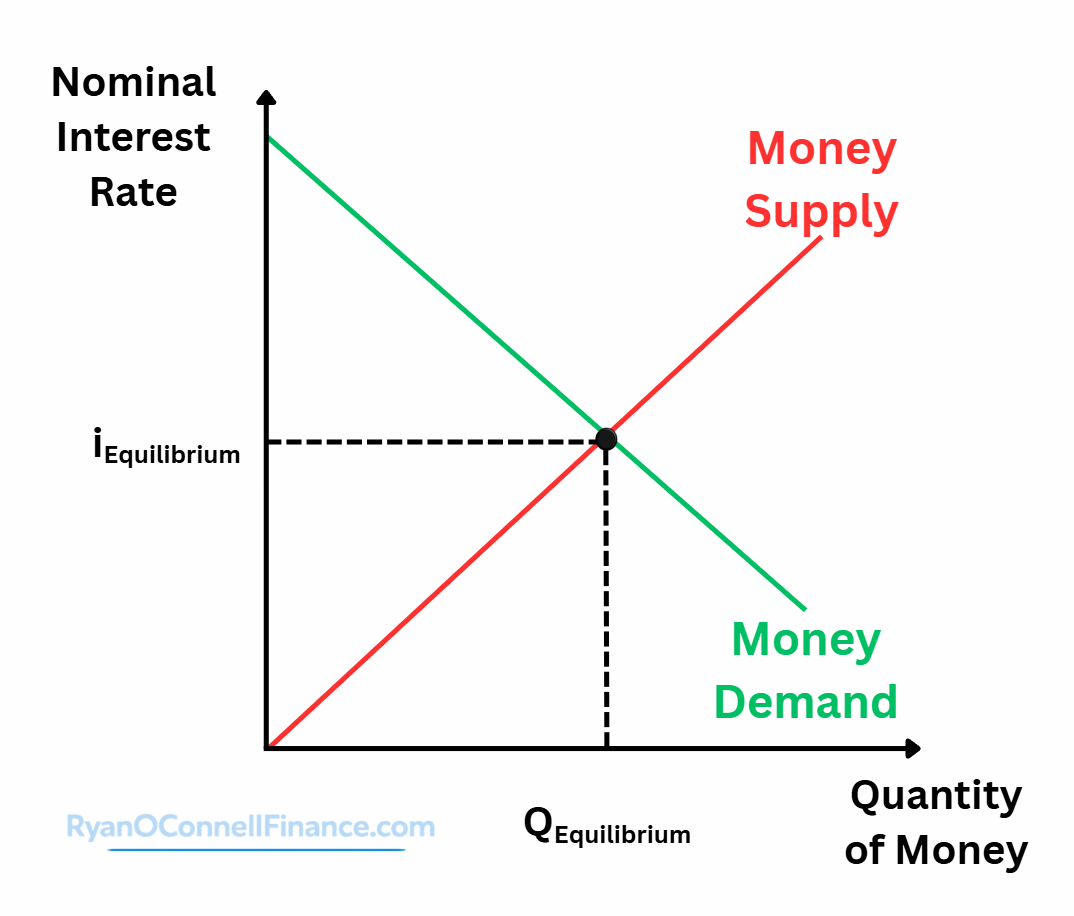
Where the two curves intersect, the money market is in equilibrium — the quantity of money supplied equals the quantity demanded, and the nominal interest rate settles at iEquilibrium. If the interest rate were above equilibrium, the quantity of money supplied would exceed the quantity demanded, putting downward pressure on rates. If the rate were below equilibrium, excess demand for money would push rates upward.
This framework connects directly to monetary policy. When the Federal Reserve expands the monetary base — for example, through open market purchases — the money supply curve shifts right, lowering the equilibrium interest rate. Conversely, when the Fed tightens policy, the supply curve shifts left, raising rates. Changes in economic activity or expectations can shift the money demand curve: stronger economic growth increases the demand for money (shifting the curve right and pushing rates up), while a recession reduces it.
How to Interpret Money Supply Data
When analyzing money supply trends, keep three principles in mind. First, always check the definition vintage — pre- and post-May 2020 M1 data are not directly comparable. Second, consider money supply changes alongside interest rates and credit conditions, not in isolation. A surge in M2 during a recession (like 2020) has very different implications than a surge during an overheating economy. Third, watch the gap between base and broad money: if the monetary base is growing but M2 is not, banks are accumulating reserves rather than lending — a signal of tight credit conditions.
Common Mistakes
The money supply is a topic where intuition often misleads. These are the most frequent errors students and analysts make:
1. Treating the simple multiplier (1/r) as exact. The textbook multiplier is a theoretical maximum. The actual multiplier is smaller and varies over time because banks hold excess reserves, the public holds cash, and lending depends on borrower demand. Since 2020, the reserve requirement is 0%, making the simple formula inapplicable to the current U.S. system.
2. Assuming the Fed directly controls M1 or M2. The Fed influences the monetary base through its balance sheet, but the money supply depends on bank lending decisions and public behavior. The Fed can create conditions that encourage or discourage lending, but it cannot dictate the final level of M1 or M2.
3. Confusing money with wealth or income. Money is the most liquid subset of wealth — it does not include stocks, bonds, real estate, or other assets. Income is a flow (dollars earned per year), while money is a stock (dollars held at a point in time). A person can have high income but low money holdings, or vice versa.
4. Believing banks lend out deposits to other customers. This is one of the most common misunderstandings. When a bank makes a loan, it does not take one customer’s deposit and hand it to another. Instead, the bank creates a new deposit in the borrower’s account. The loan itself generates the deposit — this is how bank lending expands the money supply.
5. Ignoring that money creation requires willing borrowers. Banks cannot force loans into existence. During recessions, even with ample reserves and low interest rates, weak loan demand can limit money creation. The money supply depends on both the willingness of banks to lend and the willingness of households and firms to borrow.
Limitations of Money Supply Analysis
Money supply data is widely used in macroeconomic analysis, but it comes with important limitations that affect its reliability as an economic indicator and policy guide.
Money supply measures are imperfect and evolving. They should be used as one input among many when analyzing monetary conditions — not as a standalone indicator of economic health or inflation risk.
1. Definitional instability. The May 2020 reclassification of savings deposits into M1 demonstrates that money supply measures depend on how “money” is defined. As financial products evolve, the boundaries between M1 and M2 continue to blur.
2. Financial innovation. Sweep accounts, money market funds, fintech payment platforms, and other innovations create money-like instruments that may or may not be captured in official measures. The money supply statistics may not fully reflect the actual purchasing power available in the economy.
3. Digital currencies and stablecoins. Cryptocurrencies and stablecoins are creating new forms of exchange that exist outside traditional money supply measures. As adoption grows, the conventional M1/M2 framework may need further revision.
4. Velocity is not constant. The link between money supply and economic outcomes depends on the velocity of money — how quickly each dollar changes hands. Velocity is not stable over time, which complicates any simple relationship between money supply growth and inflation. For more on this, see our article on the quantity theory of money.
5. Data revisions. Money supply figures are revised frequently. Preliminary estimates can differ significantly from final numbers, making real-time policy analysis based on money supply data inherently uncertain.
Despite these limitations, money supply analysis remains a core tool in macroeconomics. When combined with data on interest rates, credit conditions, and real economic activity, money supply trends provide valuable signals about the direction of monetary policy and its likely effects on the economy.
Frequently Asked Questions
Disclaimer
This article is for educational and informational purposes only and does not constitute investment or financial advice. The figures cited are approximate and based on publicly available Federal Reserve data as of early 2026. Monetary aggregates are revised frequently. Always conduct your own research and consult qualified professionals before making financial decisions.