Crowding Out Effect & Government Deficits

The crowding out effect is one of the most important concepts in macroeconomics for understanding the real-world impact of government deficit spending. When a government borrows to finance its budget deficit, it competes with the private sector for a limited pool of savings — pushing interest rates higher and reducing private investment. Whether you’re studying fiscal policy, analyzing government debt, or preparing for an economics exam, understanding crowding out is essential for evaluating whether deficit spending actually stimulates the economy or simply reshuffles resources.
What is the Crowding Out Effect?
The crowding out effect refers to the reduction in private investment that occurs when government borrowing drives up interest rates. When the government runs a budget deficit and finances it by issuing bonds, it absorbs savings that would otherwise be available to fund private capital formation — business expansion, new factories, home construction, and equipment purchases.
Crowding out occurs because the supply of loanable funds is limited. When the government runs a deficit, it reduces national saving — shrinking the supply of funds available for private borrowers and pushing the equilibrium interest rate higher. At higher interest rates, fewer private investment projects are profitable, so private investment declines.
The crowding out effect operates through the loanable funds market — the market where savers supply funds and firms and households borrow to invest. Understanding this market mechanism is critical because it reveals why deficit spending may not deliver the full economic stimulus that policymakers intend.
Crowding out matters for long-run economic growth because private investment is a primary driver of capital accumulation, productivity gains, and rising living standards. When government borrowing displaces private investment, it can slow the economy’s long-run growth trajectory — even if deficit spending provides a short-run boost to aggregate demand.
How Crowding Out Works
The crowding out mechanism follows a clear chain of cause and effect through the loanable funds market:
- Government runs a budget deficit — Government spending exceeds tax revenue (G > T), creating a shortfall that must be financed
- Government issues bonds to borrow — The Treasury sells bonds in financial markets, competing with private borrowers for available savings
- National saving decreases — Public saving (T − G) turns negative, reducing the total supply of loanable funds available for private use
- Interest rates rise — With less savings available relative to demand, the equilibrium interest rate in the loanable funds market increases
- Private investment falls — At higher interest rates, fewer business projects and home purchases are financially viable, so private investment declines
The result is that some portion of the government’s deficit spending is offset by reduced private-sector activity. The economy doesn’t gain the full value of the fiscal stimulus because private investment is “crowded out” by government borrowing.
Crowding out is most significant when the economy is operating at or near full employment. When resources are fully utilized, government borrowing genuinely competes with the private sector for scarce savings. During a deep recession with high unemployment and excess savings, crowding out is typically much weaker because idle funds are available and interest rates may already be very low.
The Crowding Out Formula
The economics of crowding out is best understood through the national saving identity, which shows how government deficits directly reduce the pool of savings available for private investment:
Where:
- S — national saving (total saving in the economy)
- Y — national income (GDP)
- T — taxes
- C — consumption
- G — government spending
- (Y − T − C) — private saving (what households keep after taxes and consumption)
- (T − G) — public saving (positive when government runs a surplus, negative when it runs a deficit)
When the government runs a deficit (G > T), public saving becomes negative. This reduces national saving (S), which means fewer loanable funds are available. With less supply in the loanable funds market, the interest rate rises until saving and investment reach a new, lower equilibrium. The decline in investment from the old equilibrium to the new one is the crowding out effect.
Crowding Out Example
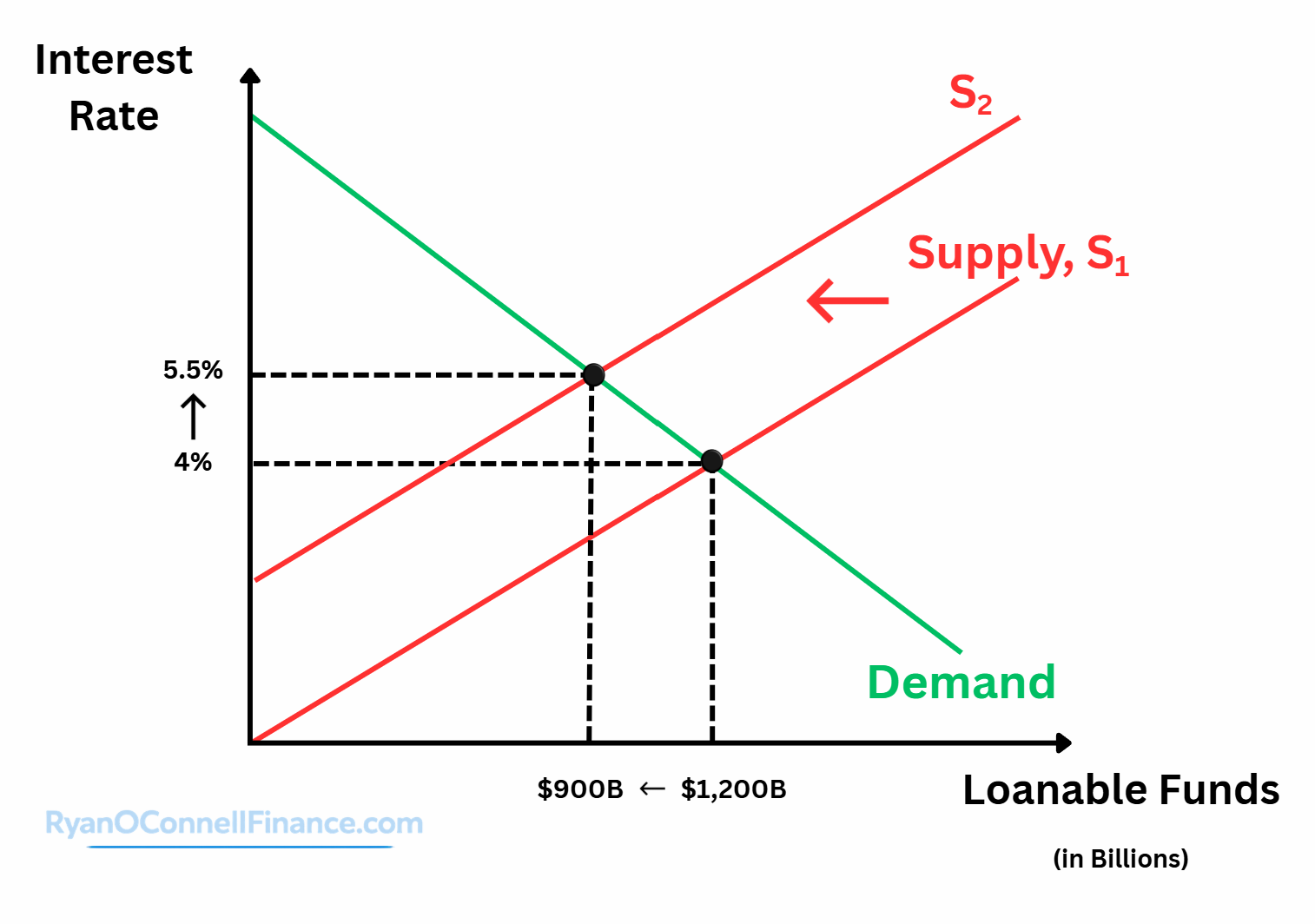
Suppose the economy starts in equilibrium with:
- National saving and investment = $1,200 billion
- Equilibrium interest rate = 4%
- Government budget is balanced (T = G)
The government increases spending by $500 billion without raising taxes, creating a $500 billion deficit financed by borrowing.
What happens:
- Public saving falls by $500 billion (from $0 to −$500B)
- Supply of loanable funds shifts left
- Interest rate rises from 4% to 5.5%
- Private investment falls from $1,200B to $900B — a decline of $300 billion
Result: The government injected $500 billion in new spending, but $300 billion of private investment was crowded out. The net increase in total spending is only $200 billion — partial crowding out reduced the effectiveness of the fiscal stimulus by 60%.
Historical Example: The 1980s Reagan Deficits
The United States experienced significant crowding out during the early 1980s. The Reagan administration simultaneously cut income taxes (the Economic Recovery Tax Act of 1981) and increased defense spending, producing large budget deficits that averaged over 4% of GDP from 1982 to 1986.
The federal government’s heavy borrowing contributed to historically high real interest rates — roughly 5% to 8% after adjusting for inflation, well above the long-run average of about 2%. The 10-year Treasury nominal yield exceeded 13% in 1981 and remained elevated through the mid-1980s. Higher borrowing costs discouraged business investment and residential construction, and the strong dollar (attracted by high U.S. interest rates) made American exports less competitive abroad.
This period illustrates how large, sustained deficits can produce measurable crowding out through the interest rate channel, even while the economy experiences overall growth from the fiscal stimulus.
Counterexample: The 2009 Stimulus and Minimal Crowding Out
The post-2008 financial crisis provides a striking contrast. The U.S. federal deficit surged to nearly 10% of GDP in fiscal year 2009, driven by the $787 billion American Recovery and Reinvestment Act alongside collapsing tax revenues and automatic stabilizers. Despite this massive increase in government borrowing, interest rates did not rise — the 10-year Treasury yield remained in the 3.5% to 3.9% range from early 2008 through the end of 2009, and had briefly dipped below 2.5% during the worst of the crisis in late 2008. Crowding out was minimal because the economy was in a deep recession with excess savings, idle resources, and the Federal Reserve holding short-term rates near zero. This episode demonstrates that the magnitude of crowding out depends critically on economic conditions — the same level of deficit spending that would crowd out significant private investment near full employment may have negligible effects during a severe downturn.
Partial vs Complete Crowding Out
Not all crowding out is the same. The degree to which government borrowing displaces private investment varies depending on economic conditions:
| Type | Definition | Net Stimulus Effect | When It Occurs |
|---|---|---|---|
| Zero Crowding Out | Government borrowing does not raise interest rates or reduce private investment | Full multiplier effect — maximum stimulus | Deep recession with idle savings, near-zero interest rates (liquidity trap) |
| Partial Crowding Out | Some private investment is displaced, but not all | Reduced but positive stimulus | Most common scenario — economy between recession and full employment |
| Complete Crowding Out | Every dollar of government borrowing displaces a dollar of private investment | Zero net stimulus — resources are merely reshuffled | Economy at full capacity where additional government borrowing fully displaces private spending |
Partial crowding out is the most empirically relevant case. In practice, government borrowing raises interest rates somewhat but doesn’t completely eliminate private investment. The net effect of deficit spending is positive but smaller than the raw spending amount would suggest.
Ricardian Equivalence: A Theoretical Challenge
Economist Robert Barro formalized Ricardian equivalence, which argues that crowding out may not work through the interest rate channel at all. Instead, rational consumers recognize that today’s government borrowing means higher future taxes. In response, they increase their saving by exactly the amount of the deficit, keeping national saving unchanged and interest rates stable.
Ricardian equivalence is a useful theoretical benchmark but rarely holds in practice. It requires consumers to be perfectly forward-looking, to have long planning horizons (caring about future generations’ tax burdens), and to face no borrowing constraints. Empirical research consistently finds that deficit spending does affect interest rates and investment, suggesting that Ricardian equivalence is at best a partial description of reality.
Crowding Out vs Multiplier Effect
The crowding out effect and the fiscal multiplier effect are opposing forces that determine the actual impact of government spending on the economy. Understanding both is essential for evaluating fiscal policy.
Crowding Out Effect
- Direction: Offsets fiscal stimulus
- Government borrowing raises interest rates
- Higher rates reduce private investment
- Stronger near full employment
- Works through financial markets (interest rate channel)
- Reduces the net impact of deficit spending
Multiplier Effect
- Direction: Amplifies fiscal stimulus
- Each dollar of spending generates >$1 of aggregate demand
- Works through successive rounds of spending
- Stronger during recessions with idle resources
- Works through the spending chain (MPC channel)
- Increases the net impact of government spending
The actual impact of fiscal policy depends on which force dominates. During deep recessions — when interest rates are already low and resources are idle — the multiplier effect tends to dominate, and crowding out is minimal. Near full employment, crowding out becomes more significant, and the net stimulus from deficit spending may be small or even negligible.
Common Mistakes
1. Assuming crowding out is always complete
Incorrect: “Government borrowing completely displaces private investment, so deficit spending never works.”
Correct: Complete crowding out is a theoretical extreme. In practice, crowding out is usually partial — deficit spending still provides some net stimulus, just less than the raw spending amount.
2. Ignoring economic conditions
Incorrect: “Crowding out happens equally in recessions and expansions.”
Correct: Crowding out is significantly weaker during recessions when there are excess savings and idle resources. It is strongest when the economy is near full employment and savings are scarce.
3. Treating Ricardian equivalence as established fact
Incorrect: “Consumers fully offset deficits by saving more, so government borrowing never affects interest rates.”
Correct: Ricardian equivalence is a theoretical benchmark that requires strong assumptions (perfect foresight, no borrowing constraints, infinite planning horizons). Empirical evidence generally does not support complete Ricardian equivalence.
4. Confusing crowding out with all deficit effects
Incorrect: “Crowding out means deficits are always bad for the economy.”
Correct: Crowding out is specifically the interest rate and investment channel. Deficits can have other effects — on exchange rates, trade balances, and intergenerational equity — that are separate from crowding out. For the broader debate on national debt and fiscal sustainability, multiple channels must be considered together.
Limitations of the Crowding Out Theory
The standard crowding out model assumes a closed economy — one without international capital flows. In reality, most economies are open, and foreign investors can supply additional loanable funds, moderating the interest rate increase caused by government borrowing.
1. Open Economy Effects — In an open economy, government borrowing can attract foreign capital inflows. Foreign investors purchasing government bonds supplement the domestic supply of loanable funds, reducing the upward pressure on interest rates. The United States has historically benefited from this effect, as global demand for U.S. Treasuries has helped keep borrowing costs lower than a closed-economy model would predict.
2. Central Bank Response — If the central bank responds to government borrowing by expanding the money supply (monetizing the debt), it can offset the interest rate increase. However, this approach risks inflation and is generally considered poor monetary policy in the long run.
3. Liquidity Trap Conditions — When interest rates are already at or near zero (as in the U.S. after 2008 and during 2020), the crowding out mechanism may be negligible. In a liquidity trap, additional government borrowing may not meaningfully raise rates because monetary policy has already pushed rates to their lower bound.
4. Measurement Difficulty — Isolating the crowding out effect empirically is challenging. Interest rates are affected by many factors simultaneously — monetary policy, inflation expectations, global capital flows, and risk sentiment — making it difficult to attribute specific interest rate changes solely to government borrowing.
5. Productive Government Investment — If government borrowing finances highly productive investments (infrastructure, education, research), the resulting increase in future output and productivity may more than offset the short-run crowding out of private investment. The net long-run effect depends on the relative productivity of displaced private investment versus the government spending that replaced it.
Crowding out is a real and important phenomenon, but its magnitude depends heavily on economic conditions, institutional factors, and how the borrowed funds are used. It should be analyzed as one component of fiscal policy’s overall impact — not as the entire story.
Frequently Asked Questions
Disclaimer
This article is for educational and informational purposes only and does not constitute financial or investment advice. Economic models and examples presented are simplified representations of complex real-world dynamics. Always consult primary academic sources and qualified professionals for policy analysis and decision-making.