Start here
3 articles · 47 min
-
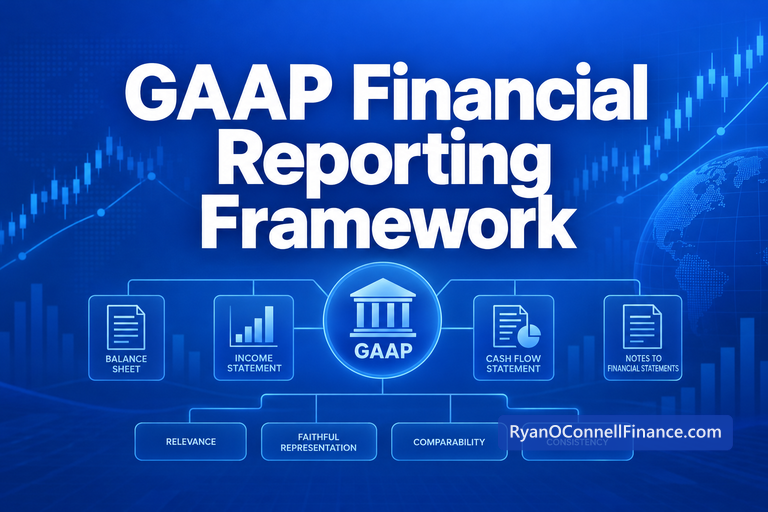
GAAP Conceptual Framework for Financial Reporting
The GAAP conceptual framework is the foundation of U.S. financial reporting. Learn about qualitative characteristics, recognition criteria, measurement bases…
-
Income Statement & Comprehensive Income: Structure, Components & Reporting
A complete guide to the income statement and comprehensive income under U.S. GAAP — income statement structure, OCI components, discontinued operations…
-
Statement of Cash Flows: Direct Method, Indirect Method & Preparation
Learn the statement of cash flows indirect method and direct method with a complete worked example. Covers operating, investing, and financing activities…
Financial Reporting Under US GAAP
14 parts · 3½ hours
Revenue Recognition Under ASC 606: The Five-Step Model
Learn how revenue recognition works under ASC 606. This guide covers the five-step model, variable consideration, performance obligations, principal vs agent…
Accounts Receivable & Bad Debt Expense: Allowance Method vs Direct Write-Off
Learn how companies estimate and record bad debt expense under GAAP using the allowance method, aging schedules, and CECL.
Inventory Valuation Methods: FIFO, LIFO & Weighted Average Under GAAP
Learn how FIFO, LIFO, and weighted average inventory valuation methods affect COGS, ending inventory, and net income under GAAP, with worked examples…
Depreciation Methods: Straight-Line, Declining Balance & Units of Production
Learn the major GAAP depreciation methods with formulas, real-world examples, and side-by-side comparison.
Asset Impairment Testing: PP&E, Intangibles & Goodwill Under ASC 350/360
Learn how to test assets for impairment under U.S. GAAP. Covers the ASC 360 two-step recoverability test for PP&E, the ASC 350 one-step goodwill impairment…
Intangible Assets & Goodwill: Recognition, Amortization & R&D Costs
A complete guide to intangible asset recognition under GAAP, the 6 categories, finite vs indefinite life classification, amortization methods, R&D cost…
Current Liabilities & Contingent Liabilities: Recognition & Measurement Under GAAP
Learn how contingent liabilities are recognized and measured under GAAP. Covers ASC 450 loss contingencies, warranty obligations, litigation contingencies…
Bond Accounting: Issuance, Premium/Discount Amortization & Effective Interest Method
Learn how to account for bonds payable from the issuer’s perspective — issuance at par, premium, and discount, the effective interest method, straight-line…
Lease Accounting Under ASC 842: Operating vs Finance Leases
Complete guide to lease accounting under ASC 842. Covers finance vs operating lease classification, ROU asset and lease liability measurement, lessee…
Stockholders Equity: Treasury Stock, Stock Dividends & Retained Earnings
Learn how to account for treasury stock (cost method vs par value method), stock dividends, and retained earnings under U.S. GAAP.
How to compute basic and diluted EPS under ASC 260 — weighted average shares, treasury stock method for options, if-converted method for convertible…
Deferred Tax Assets & Liabilities: Temporary Differences, Valuation Allowances & Tax Provision
Learn how deferred tax assets and liabilities arise from temporary differences under ASC 740, including valuation allowances, NOL carryforwards, and effective…
Pension Accounting: Defined Benefit Plans, PBO & Pension Expense Under ASC 715
Learn how employers account for defined benefit pension plans under ASC 715, including the projected benefit obligation, the five components of pension…
Investment Securities: Trading, AFS & HTM Classification Under ASC 320/321
Learn how companies classify investment securities under GAAP. Covers ASC 320 debt securities (trading, available-for-sale, held-to-maturity) and ASC 321…
More articles
28 articles · 7 hours
Absorption vs Variable Costing
Learn absorption vs variable costing with two-period income statements, fixed-overhead inventory reconciliation, reporting rules and practical managerial uses.
Accounting Cycle and Trial Balances
Follow the accounting cycle through adjustments, financial statements, closing entries, and three trial balances with a fully reconciled hypothetical example.
Activity-Based Costing Explained
Learn activity-based costing with cost pools, drivers, rates, and a two-product example showing how overhead allocation changes product margins and decisions.
Audit Opinions: Four Types Explained
Understand the four audit opinions, report wording, going-concern warnings, critical audit matters, and why financial-statement and ICFR opinions can differ.
Bank Reconciliation: Worked Example
Learn bank reconciliation with a complete cash-book example, deposits in transit, outstanding checks, bank errors and balanced adjusting journal entries.
Break-Even Analysis Explained From Corporate Finance
Learn break even analysis with unit and revenue formulas, a worked example, price-cut effects, target operating profit, and the margin of safety for sales.
Cash Management Models Explained
Learn cash management models with Baumol transfer sizes, Miller-Orr control limits, worked examples, daily rates and variance, and practical treasury limits.
Common-Size Financial Statements
Learn common-size financial statements with examples of income statements, balance sheets, horizontal changes, indexes and percentage-point differences.
Consolidated Financial Statements
Learn consolidated financial statements with a reconciled 80% subsidiary worksheet, goodwill, intercompany eliminations, and noncontrolling interest in equity.
Corporate Zero-Based Budgeting
Learn corporate zero-based budgeting through decision packages, service levels, a reconciled cash budget, implementation costs, and practical control checks.
Double-Entry Accounting Explained
Learn double-entry accounting with debit and credit rules, journal entries, and eight worked transactions that reconcile T-accounts and the accounting equation.
EBITDA Explained: Formula and Examples From Corporate Finance
Learn what EBITDA measures, calculate it from net income or EBIT, and understand adjusted EBITDA, margins, and why earnings differ from operating cash flow.
GMROI: Formula and Retail Examples
Learn GMROI with a retail category example, correct margin and turnover formulas, seasonal inventory averages, and practical limits of gross-profit returns.
Intercorporate Investments: Fair Value, Equity Method and Consolidation
Classify intercorporate investments under U.S. GAAP and follow a fully reconciled equity-method example covering purchase basis, income, OCI, dividends…
Managerial Accounting: Cost Basics
Learn managerial accounting with cost classifications, fixed and variable behavior, and prime and conversion examples that avoid double-counting direct labor.
Net Advantage to Leasing: NAL Example From Corporate Finance
Calculate net advantage to leasing with an after-tax lease-vs-buy example, matched cash-flow timing, residual risk, and a break-even annual lease payment.
Onerous Contracts: Loss Provisions
Learn how onerous contracts create IAS 37 provisions, compare fulfillment with exit costs, follow journal entries, and distinguish specific U.S. GAAP rules.
Overhead Allocation: Rates & Entries
Learn overhead allocation through predetermined rates, job costing, journal entries, and year-end adjustments for underapplied or overapplied factory overhead.
Prepaid Expenses: Entries & Cash Flow
Learn prepaid expenses with insurance journal entries, monthly adjustments, statement effects and a cash-flow reconciliation that avoids double counting cash.
Segment Reporting: Rules & Analysis
Learn segment reporting under ASC 280, including CODM, 10% tests, 75% revenue coverage, expense disclosures and reconciliations before valuing business units.
Sensitivity Analysis Explained From Financial Modeling
Learn sensitivity analysis with a complete profit example, tornado rankings, realistic input ranges, and decision thresholds that show which assumptions matter.
Supply Chain Finance Explained
Learn supply chain finance and reverse factoring: invoice costs, payment timelines, DPO, accounting disclosures and liquidity risk when funding is withdrawn.
The Enron scandal explained: how accounting estimates, conflicted partnerships, and failing hedges led to bankruptcy, and what investors can learn from it.
Three Financial Statements Explained
Learn how three financial statements connect through borrowing, equipment purchases, depreciation, credit sales, retained earnings, and cash reconciliations.
Trade Date vs Settlement Date Accounting
Trade date vs settlement date accounting explained with IFRS entries, period-end balances, U.S. GAAP limits, T+1 cash settlement and GIPS performance records.
Transfer Pricing: Management and Tax
Learn transfer pricing for managerial decisions and tax rules, with capacity examples, divisional profit reconciliation, arm’s-length methods and documentation.
Variance Analysis: Budget vs Actual From Corporate Finance
Learn variance analysis with a budget vs actual profit bridge. Separate sales volume, price, variable spending, and fixed costs using a complete worked example.
Work in Progress Inventory: Cost Flows
Understand work in progress inventory with linked manufacturing ledgers, COGM and COGS schedules, journal entries, and a fully reconciled factory example.
Tools for this topic
- Cash Conversion Cycle CalculatorFree online calculator Excel model: Cash Conversion Cycle Calculator
- Asset Impairment Testing CalculatorFree online calculator Excel model: Asset Impairment Testing Calculator
- Bad Debt Expense & Allowance CalculatorFree online calculator Excel model: Bad Debt Expense & Allowance Calculator
- Basic & Diluted EPS Calculator (GAAP)Free online calculator Excel model: Basic & Diluted EPS Calculator (GAAP)
- Bond Amortization Schedule CalculatorFree online calculator Excel model: Bond Amortization Schedule Calculator
- Deferred Tax CalculatorFree online calculator Excel model: Deferred Tax Calculator
Browse other topics
Professional certificates
Explore Top Finance Certificates
Access official certificates from Wharton Online & Columbia Business School Executive Education, powered by Wall Street Prep. Save up to $500 with my exclusive discount code:
Affiliate disclosure: I may earn a commission if you enroll through my certificate program links.