Its primary goal is to maximize shareholder value through strategic planning and management of investments, capital budgeting, and funding. Corporate finance professionals analyze a company’s financial needs and develop strategies for raising and allocating funds, which may include issuing stocks or bonds, taking on debt, or reinvesting earnings. They also make decisions about dividend policies, mergers and acquisitions, and risk management. This discipline is crucial in guiding companies through financial challenges and opportunities, ensuring sustainable growth and profitability.
Start here
3 articles · 38 min
-

What is Corporate Finance? Types of Firms & the Financial Manager
Corporate finance is the study of how firms make three core financial decisions — capital budgeting, capital structure, and working capital management…
-

Time Value of Money: Present Value and Future Value Explained
The time value of money is the foundational principle that a dollar today is worth more than a dollar in the future.
-
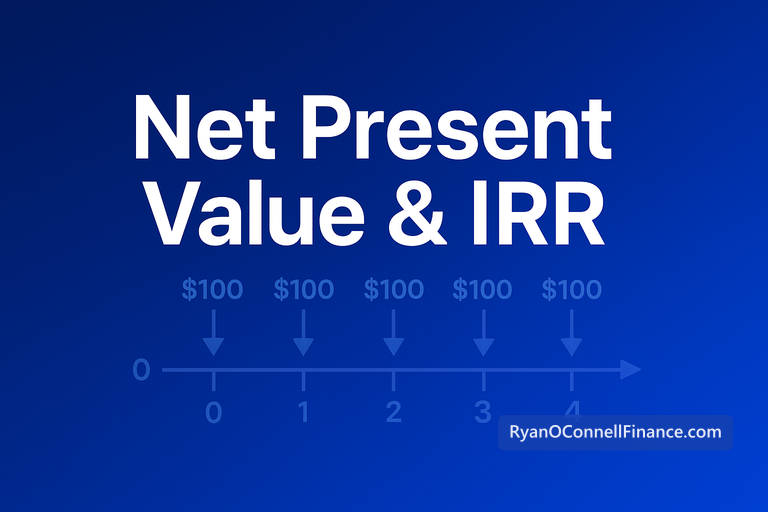
Net Present Value & IRR: Formulas, Examples, and When They Disagree
Net present value (NPV) and internal rate of return (IRR) are the two most widely used capital budgeting tools.
Corporate Finance Fundamentals
12 parts · 3 hours
Financial Ratio Analysis: A Complete Guide to Liquidity, Profitability, Leverage & Market Ratios
Learn how to use financial ratio analysis to evaluate company liquidity, profitability, leverage, efficiency, and market valuation with real-world examples…
Annuities, Perpetuities & Growing Cash Flows: The Annuity Formula Explained
Learn the annuity formula for present and future value of ordinary annuities, annuity due, perpetuities, and growing cash flows with real-world mortgage…
Interest Rates: EAR, APR & the Yield Curve
Learn how to convert between APR and EAR, understand compounding frequencies, apply the Fisher equation for real interest rates, and interpret yield curve…
Capital Budgeting & Free Cash Flow Estimation: Formula, Components, and Examples
Learn the free cash flow formula (FCF = NOPAT + Depreciation – CapEx – Change in NWC), how to identify incremental cash flows, and techniques for sensitivity…
DCF Valuation & Comparable Company Analysis: A Practitioner Guide From Financial Modeling
How investment bankers and analysts value companies using discounted cash flow analysis, comparable company analysis (trading comps), and precedent…
Learn how companies raise equity capital through IPOs, seasoned equity offerings, and modern alternatives. Covers the IPO process from the issuer perspective…
Corporate Debt Financing: Bonds, Covenants & Credit
Learn about corporate bonds, debt covenants, credit ratings, and repayment provisions. Understand the types of corporate debt, how credit spreads work…
Capital Structure: Modigliani-Miller Theorem, Tradeoff Theory & Optimal Leverage
The Modigliani-Miller theorem shows that in perfect capital markets, firm value is independent of capital structure.
Dividend Policy: Payout vs Retention & Share Repurchases
Learn how companies choose between paying dividends, repurchasing shares, and retaining earnings — including MM irrelevance, signaling theory, and tax…
Pro Forma Financial Statements: Percent-of-Sales Method, EFN & Growth Rate Formulas From Financial Modeling
Learn how to build pro forma financial statements using the percent-of-sales method, calculate external financing needed (EFN), and determine sustainable…
Working Capital Management & the Cash Conversion Cycle
Working capital management ensures firms have enough liquidity to meet short-term obligations while minimizing idle asset costs.
Mergers and Acquisitions: Synergies, Takeover Defenses & LBOs
Comprehensive guide to mergers and acquisitions covering merger types, synergy analysis, acquisition NPV, hostile vs friendly takeovers, takeover defenses…
Capital Budgeting & Valuation Metrics
5 parts · 57 min
Payback Period & Discounted Payback Period: Formula and Examples
Learn what the payback period and discounted payback period measure, how to calculate them, and how they compare to NPV for capital budgeting decisions.
Profitability Index Explained: Formula, Examples & Capital Rationing
The profitability index (PI) measures the value a project creates per dollar invested, making it essential for capital rationing decisions.
WACC: Weighted Average Cost of Capital Explained
The weighted average cost of capital (WACC) is the blended cost of equity and after-tax debt that serves as the hurdle rate for corporate investment decisions…
Dividend Discount Model & Gordon Growth Model Explained
The dividend discount model (DDM) values a stock by discounting all expected future dividends to present value.
DuPont Analysis Explained: 3-Factor & 5-Factor ROE Decomposition
DuPont analysis decomposes Return on Equity into profitability, efficiency, and leverage components. Learn the 3-factor and 5-factor DuPont formulas…
Startup & Venture Capital Finance
8 parts · 1½ hours
Introduction to Entrepreneurial Finance: 8 Key Differences from Corporate Finance
Entrepreneurial finance differs from corporate finance in 8 fundamental ways. Learn how uncertainty, staged financing, and active investors change everything…
VC Term Sheet Explained: Key Provisions Every Founder Must Know
Learn every provision in a VC term sheet — valuation, liquidation preference, antidilution, board composition, protective provisions, and more.
Startup Cap Tables: How to Build, Read & Manage Ownership
Learn how to build, read, and manage a startup cap table. Understand share classes, dilution mechanics, and ownership tracking through funding rounds.
Antidilution Provisions: Full Ratchet vs Weighted Average Explained
Learn how antidilution provisions protect investors in down rounds. Compare full ratchet vs weighted average mechanisms, understand pay-to-play clauses…
SAFE Notes vs Convertible Notes: Which Is Better for Your Startup?
SAFEs and convertible notes are the most common instruments for early-stage startup financing. This guide explains how each works, how valuation caps…
The VC Method of Valuation: How Investors Value Startups
Learn the Venture Capital Method for startup valuation. Master the formulas for post-money, pre-money, and required ownership, plus hurdle rates and dilution…
First Chicago Method: Scenario-Based Startup Valuation
The First Chicago Method values startups using probability-weighted scenarios for more realistic expected values.
Staged Financing & Real Options: How Milestones Affect Startup Valuation
Staged venture capital financing invests capital in sequential rounds tied to milestones. Learn the reverse induction method for calculating ownership across…
More articles
10 articles · 2 hours
Absorption vs Variable Costing From Accounting
Learn absorption vs variable costing with two-period income statements, fixed-overhead inventory reconciliation, reporting rules and practical managerial uses.
Learn break even analysis with unit and revenue formulas, a worked example, price-cut effects, target operating profit, and the margin of safety for sales.
Double-Entry Accounting Explained From Accounting
Learn double-entry accounting with debit and credit rules, journal entries, and eight worked transactions that reconcile T-accounts and the accounting equation.
EBITDA Explained: Formula and Examples
Learn what EBITDA measures, calculate it from net income or EBIT, and understand adjusted EBITDA, margins, and why earnings differ from operating cash flow.
Real Options: Valuation, Types, and Examples From Options & Derivatives
Real options apply option pricing theory to capital investment decisions, recognizing that management flexibility to expand, abandon, or defer projects has…
Reverse DCF: Implied Growth From Financial Modeling
Use reverse DCF to find revenue growth and operating margins implied by a share price, with a full valuation example, sensitivity grid, and practical checks.
Scenario Analysis: Base, Bull and Bear From Equities
Learn scenario analysis with base, bull and bear cases. Follow revenue, margins, EPS and P/E through a stock valuation example and interpret the results.
Sensitivity Analysis Explained From Financial Modeling
Learn sensitivity analysis with a complete profit example, tornado rankings, realistic input ranges, and decision thresholds that show which assumptions matter.
The Enron Scandal Explained From Accounting
The Enron scandal explained: how accounting estimates, conflicted partnerships, and failing hedges led to bankruptcy, and what investors can learn from it.
Variance Analysis: Budget vs Actual
Learn variance analysis with a budget vs actual profit bridge. Separate sales volume, price, variable spending, and fixed costs using a complete worked example.
Tools for this topic
- NPV CalculatorFree online calculator
- Cap Table & Dilution CalculatorFree online calculator Excel model: Cap Table & Dilution Calculator
- Interest Rate ConverterFree online calculator Excel model: Interest Rate Converter
- IRR CalculatorFree online calculator
- WACC CalculatorFree online calculator
- Annuity & Perpetuity CalculatorFree online calculator Excel model: Annuity & Perpetuity Calculator
Browse other topics
Videos on Corporate Finance
All 24 Corporate Finance videos →


Professional certificates
Explore Top Finance Certificates
Access official certificates from Wharton Online & Columbia Business School Executive Education, powered by Wall Street Prep. Save up to $500 with my exclusive discount code:
Affiliate disclosure: I may earn a commission if you enroll through my certificate program links.