It involves studying how individuals, businesses, and governments allocate resources, make financial choices, and interact in the pursuit of maximizing utility or profit. Economics in finance encompasses areas such as financial markets, investments, risk management, monetary policy, and financial institutions, providing insights into the behavior of financial actors and the overall functioning of the economy.
Start here
3 articles · 38 min
-
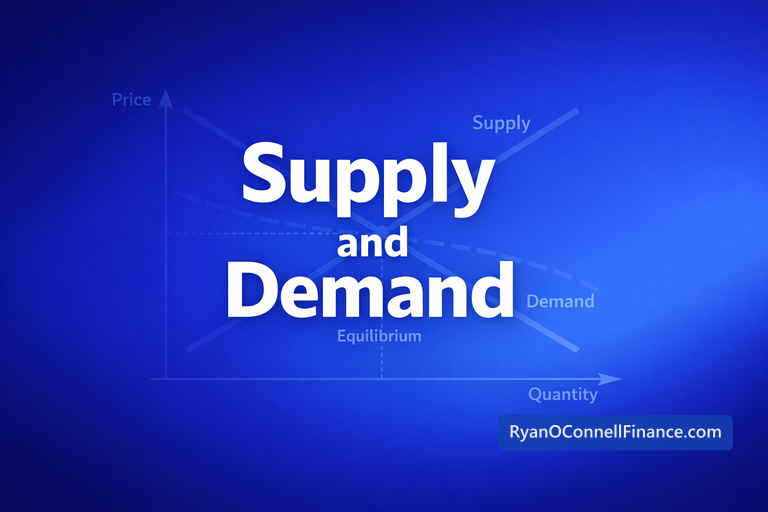
Supply and Demand: How Markets Determine Prices
Supply and demand is the foundational economic model explaining how prices are set, how markets reach equilibrium, and what causes surpluses and shortages.
-
Gross Domestic Product (GDP)
Gross domestic product (GDP) is the total market value of all final goods and services produced within a country.
-
Inflation & Consumer Price Index (CPI) Explained: How It Works & Why It Matters
Learn what inflation is, how the Consumer Price Index (CPI) measures it, and why it matters for investment decisions.
Economics Essentials
30 parts · 6½ hours
Opportunity Cost: Definition, Formula, and Real-World Examples
Opportunity cost is the value of the best alternative you forgo when making a decision. Learn the definition, formula, explicit vs implicit costs…
Production Possibilities Frontier (PPF): Definition, Graph, and Examples
The production possibilities frontier (PPF) shows the maximum combinations of two goods an economy can produce.
Learn how price elasticity of demand measures consumer responsiveness to price changes, including the midpoint method, determinants of elasticity…
Learn what price ceilings and price floors are, when they are binding, and their real-world effects — from rent control and gasoline price caps to agricultural…
Consumer Surplus & Producer Surplus
Consumer surplus and producer surplus measure the benefits buyers and sellers receive from market transactions.
Deadweight Loss & the Costs of Taxation
Deadweight loss is the reduction in total surplus when a tax prevents mutually beneficial trades from occurring.
Comparative Advantage & Gains from Trade
Comparative advantage explains why nations, firms, and individuals benefit from specialization and trade, even when one party is more productive at everything.
Tariffs, Quotas & Trade Policy
Tariffs and quotas are the primary tools governments use to restrict international trade. This guide explains how tariffs affect domestic prices, consumer…
Real vs Nominal GDP, GDP Deflator & Chain Weighting
Learn the difference between real and nominal GDP, how the GDP deflator works, why the BEA uses chain weighting, and how to avoid common analytical mistakes…
Economic Growth: Productivity, Determinants & Policy
Economic growth is the single most important factor determining living standards across countries and over time.
The loanable funds market explains how saving and investment interact to determine the real interest rate. Learn the S = I identity, supply and demand…
Crowding Out Effect & Government Deficits
The crowding out effect explains how government borrowing raises interest rates and displaces private investment, reducing the net impact of deficit spending…
Types of Unemployment: Frictional, Structural, Cyclical & the Natural Rate
Learn the three types of unemployment — frictional, structural, and cyclical — plus the natural rate, NAIRU, efficiency wages, and what determines long-run…
Unemployment Rate & Labor Force Participation Rate
The unemployment rate measures the percentage of the labor force that is jobless and actively seeking work. This guide covers how the BLS calculates…
Minimum Wage: Economic Effects & Debate
Learn the economics of the minimum wage — the competitive model vs monopsony, Card-Krueger evidence, who earns the minimum wage, and the ongoing policy debate.
Money Supply & Money Creation: How Banks Create Money
The money supply is one of the most important concepts in macroeconomics. It determines how much purchasing power flows through an economy, shapes…
The Federal Reserve System: Structure & Mandate
The Federal Reserve System is the central bank of the United States, responsible for monetary policy, bank supervision, financial stability, and the payments…
Quantity Theory of Money: The Equation of Exchange Explained
The quantity theory of money explains how money supply growth determines inflation through the equation of exchange MV = PY, velocity of money, classical…
The Costs of Inflation: Shoeleather, Menu Costs & More
Learn the six real costs of inflation — shoeleather costs, menu costs, relative-price distortions, tax penalties, confusion, and arbitrary wealth…
Monetary and Fiscal Policy: How Central Bank Decisions Drive Financial Markets
Comprehensive guide to monetary and fiscal policy — how the Federal Reserve sets interest rates, expansionary vs contractionary policy, the Fisher equation…
Trade Balance, Balance of Payments & Capital Flows
Learn how the trade balance, balance of payments, and capital flows are connected. Covers net exports, the NX = NCO identity, the saving-investment identity…
Exchange Rate Determination: Nominal & Real Exchange Rates
The real exchange rate measures the relative price of domestic goods in terms of foreign goods. Learn the RER formula, how appreciation and depreciation affect…
Aggregate Demand & Aggregate Supply: The AD-AS Model Explained
The AD-AS model explains how the overall price level and total output are determined, how demand shocks and supply shocks cause recessions and inflation…
Stages of the Business Cycle: Expansion, Peak, Contraction & Trough Explained
Learn the four stages of the business cycle — expansion, peak, contraction, and trough — how the NBER officially dates recessions, and what the 2007-2009 Great…
The Multiplier Effect & Fiscal Policy
A guide to the fiscal multiplier effect — the spending multiplier formula, tax multiplier, real-world examples from ARRA 2009 and CARES Act 2020…
Automatic Stabilizers & Discretionary Policy
Automatic stabilizers are built-in fiscal mechanisms — like the progressive tax system and unemployment insurance — that automatically cushion economic…
Probability of Recession: Key Indicators and the NY Fed Model
Learn how economists estimate recession probability using yield curve inversion, the NY Fed probit model, and leading economic indicators — plus portfolio…
The Phillips Curve: Inflation-Unemployment Trade-off & Sacrifice Ratio
Learn what the Phillips curve is, the expectations-augmented equation, the inflation-unemployment trade-off, the sacrifice ratio, why the curve broke down…
Inflation Expectations: Adaptive vs Rational Explained
Learn how adaptive and rational inflation expectations differ, how they shift the Phillips curve, and why central bank credibility is critical to anchoring…
Budget Deficit vs National Debt: Economics and Sustainability
Understand the difference between the budget deficit and national debt. Covers debt-to-GDP, debt dynamics, historical U.S. debt trends, and fiscal…
Firms, Markets & Market Failure
10 parts · 2½ hours
Monopoly in Economics: Market Power, Pricing & Deadweight Loss
A monopoly in economics exists when a single firm is the sole seller with no close substitutes. Learn how monopolists set prices using MR = MC, why monopoly…
Game Theory & Oligopoly: Nash Equilibrium, Prisoner’s Dilemma & Cartels
Game theory in economics explains how firms in oligopoly markets make strategic decisions. Learn Nash equilibrium, the prisoner’s dilemma, dominant strategies…
Costs of Production in Economics: Fixed, Variable, Marginal & Average Cost Curves
Learn the costs of production in economics — fixed costs, variable costs, marginal cost, average total cost, economies of scale, and long-run cost curves…
Firms in Competitive Markets: Profit Maximization, MC=MR & the Shutdown Rule
Learn how firms in perfectly competitive markets maximize profit using MC = MR, when to shut down or exit, why long-run economic profit is zero…
Externalities: Market Failure, Pigouvian Taxes & the Coase Theorem
Learn how externalities cause market failure and how Pigouvian taxes, cap-and-trade systems, and the Coase theorem address inefficiency in markets.
Learn how indifference curves and budget constraints explain consumer choice. Covers marginal rate of substitution, optimal bundles, income and substitution…
Income Inequality: Gini Coefficient, Lorenz Curve & Poverty Measures
Learn how economists measure income inequality using the Gini coefficient and Lorenz curve. Covers quintile analysis, poverty measurement, causes…
Monopolistic Competition: Product Differentiation, Excess Capacity & Advertising
Monopolistic competition is a market structure with many firms selling differentiated products. Learn about short-run and long-run equilibrium, excess…
Public Goods & Common Resources: Free Riders, Excludability & the Tragedy of the Commons
Learn about public goods, common resources, the free rider problem, and the tragedy of the commons. Understand excludability, rivalry, and solutions including…
Factor Markets & Labor Demand: Marginal Product of Labor, Wage Determination & Derived Demand
Learn how the marginal product of labor determines wages and employment. Understand VMP, derived demand, diminishing returns, and competitive vs monopsony…
Economics for Investors
10 parts · 1½ hours
Business Cycle Indicators: Leading, Coincident, and Lagging Signals
Learn how analysts classify and interpret business cycle indicators. Understand leading, coincident, and lagging indicators, composite indexes like the LEI…
Credit Cycles vs Business Cycles: How Credit Amplifies Economic Fluctuations
Credit cycles track lending activity, leverage, and credit quality. Learn how credit expansion and tightening amplify business cycles through the financial…
Fiscal Policy Stance, Automatic Stabilizers, and Policy Lags
Learn how to interpret fiscal policy stance beyond headline deficits. Covers structural vs cyclical budget balance, automatic stabilizers, discretionary…
Why Monetary Policy Sometimes Fails: Limitations and Constraints
Understand why central bank monetary policy sometimes fails to achieve its objectives. Learn about the effective lower bound, liquidity traps, fiscal…
Central Bank Independence, Credibility, and Inflation Targeting
Learn how central bank independence, credibility, and transparency determine monetary policy effectiveness. Compare inflation targeting vs exchange-rate…
Geopolitical Risk in Investment Analysis
Learn how geopolitical risk affects investment portfolios. Understand state actors, sanctions, event vs thematic risk, signposts, and impact channels…
Trade Blocs and Economic Integration
Learn about free trade areas, customs unions, common markets, and monetary unions. Understand trade creation vs trade diversion and how bloc design affects…
Comparing Market Structures for Business and Investment Analysis
Compare the four main market structures — perfect competition, monopolistic competition, oligopoly, and monopoly — and learn how investors use market structure…
Breakeven and Shutdown Points for Firms
Learn when firms should continue operating at a loss, shut down temporarily, or exit permanently. Covers the short-run shutdown rule (P < min AVC), long-run…
Market Concentration: Concentration Ratios and the HHI Index
Learn how to measure and interpret market concentration using concentration ratios (CR4, CR8) and the Herfindahl-Hirschman Index (HHI).
Currency Markets & Exchange Rates
3 parts · 23 min
FX Market Participants and Currency Quote Conventions From International Finance
Learn how to read exchange rate quotes, understand base and quote currency conventions, interpret bid-ask spreads, and calculate currency appreciation…
Cross Exchange Rate: Formula, Quote Inversion & Bid-Ask Construction From International Finance
Learn how to calculate cross exchange rates using quote inversion and the three orientation cases. Includes bid-ask cross-rate construction with the worst-of…
Forward Exchange Rates: Forward Points, Outright Rates, and Premiums From International Finance
Learn how to read FX forward quotes, convert forward points to outright rates, and calculate annualized premiums.
More articles
9 articles · 1½ hours
Bretton Woods Explained From International Finance
Bretton Woods explained: how Keynes and White shaped the dollar system, why implementation took years, and how fixed exchange rates broke down in 1971–1973.
Fiscal policy uses spending and taxes to influence growth, jobs, and inflation. Learn expansionary and contractionary policy, stabilizers, and key trade-offs.
Inverted Yield Curve Explained From Fixed Income
An inverted yield curve means short Treasury yields exceed long yields. Explore its causes, key spreads, real examples, and limits as a recession signal.
Money Supply Measures: M0 to M4 From Money & Banking
Compare money supply measures from M0 to M4, including U.S. M1 and M2, euro-area M3, U.K. M4, and the definition changes that affect monetary statistics.
Quantitative Easing Explained From Money & Banking
Quantitative easing explained: how bond purchases create reserves, affect long-term yields, and differ from rate cuts, tapering, and quantitative tightening.
Learn how the Solow growth model links saving, capital, depreciation and technology to steady states, catch-up growth and lasting gains in output per worker.
South Sea Bubble: The 1720 Crash From Money & Banking
Explore the South Sea Bubble of 1720: how government debt, installment subscriptions, credit and political corruption fueled the boom, crash and its aftermath.
The Mississippi Bubble of 1720 From Money & Banking
Explore the Mississippi Bubble of 1720: John Law’s debt conversion, banknotes, share-price support, collapse, and the lessons for financial credibility.
Why Does the Fed Target 2% Inflation?
Why does the Fed target 2% inflation instead of zero? Explore interest-rate room, deflation risk, wage adjustment, measurement limits, and the target’s history.
Tools for this topic
- Annualized Return CalculatorFree online calculator Excel model: Annualized Return Calculator
- Bond Duration CalculatorFree online calculator
- Cost Curves CalculatorFree online calculator Excel model: Cost Curves Calculator
- Breakeven and Shutdown Point CalculatorFree online calculator
- Budget Constraint CalculatorFree online calculator Excel model: Budget Constraint Calculator
- Competitive Firm Profit & Shutdown CalculatorFree online calculator Excel model: Competitive Firm Profit & Shutdown Calculator
Browse other topics
Videos on Economics
All 30 Economics videos →


Professional certificates
Explore Top Finance Certificates
Access official certificates from Wharton Online & Columbia Business School Executive Education, powered by Wall Street Prep. Save up to $500 with my exclusive discount code: