
Tax-Aware Portfolio Management: A Complete Guide to Tax-Aware Investing

Table of Contents
For taxable investors, taxes represent the single largest drag on investment returns — often reducing compounded wealth by 1 to 2 percentage points annually. Tax-aware investing is a disciplined approach that integrates tax considerations into every portfolio decision, from asset allocation and account placement to lot selection and rebalancing. Just as implementation shortfall measures the hidden costs of trade execution, tax drag measures the hidden cost of ignoring taxes.
What Is Tax-Aware Investing and Why Does It Matter?
Tax-aware investing means systematically minimizing the tax burden on a portfolio’s returns without compromising the investment strategy. The goal is to maximize after-tax wealth — the money the investor actually keeps — rather than optimizing pre-tax returns alone.
A 2 percentage point annual tax drag reduces terminal wealth by more than 40% over a 30-year horizon compared to a tax-free account. Tax efficiency is not a minor optimization — it is one of the most impactful levers available to long-term investors.
Tax drag compounds over time because every dollar paid in taxes is a dollar that can no longer earn returns. For taxable investors, after-tax benchmarks are essential for evaluating portfolio performance accurately. Tax efficiency should be treated as a core portfolio construction criterion alongside risk and return.
An important asymmetry shapes tax-aware strategy: capital losses fully offset capital gains dollar-for-dollar, but the $3,000 annual limit applies to net capital losses deducted against ordinary income. Wash-sale restrictions further limit the flexibility to harvest losses. Understanding these constraints is essential for effective tax management.
Consider a hypothetical $500,000 portfolio earning a constant 8% before tax or 6% after a 2 percentage point annual tax drag, with no external cash flows.
| Years invested | 6% after tax (USD) | 8% pre-tax (USD) |
|---|---|---|
| 0 | 500000 | 500000 |
| 5 | 669113 | 734664 |
| 10 | 895424 | 1079462 |
| 15 | 1198279 | 1586085 |
| 20 | 1603568 | 2330479 |
Hypothetical constant-return comparison; values rounded to the nearest dollar. No additional liquidation tax is modeled.
After 20 years, the after-tax portfolio has about $727,000 less wealth, a 31% reduction relative to the pre-tax comparison. The widening gap reflects lost compounding as well as taxes paid.
Asset Location: Placing Investments in the Right Account Type
Asset location is the practice of placing each investment in the account type where it receives the most favorable tax treatment. The core principle: match each asset’s tax characteristics to the account that best shelters or complements them.
| Asset Type | Taxable Account | Traditional Tax-Deferred (IRA/401k) | Roth / Tax-Free |
|---|---|---|---|
| Corporate bonds | Poor (interest taxed as ordinary income) | Good (shields high-rate income) | Best (tax-free growth on high yield) |
| REITs | Poor (non-qualified dividends) | Good (shields ordinary income) | Best (tax-free growth) |
| High-turnover active funds | Poor (frequent short-term gains) | Good (shields realized gains) | Good |
| Index funds / ETFs | Best (low turnover, LT capital gains rates, step-up at death) | OK | OK |
| Municipal bonds | Good (tax-exempt interest) | Poor (lower yield, no benefit, ordinary income at withdrawal) | Poor (wastes tax exemption) |
| Growth stocks (buy-and-hold) | Best (defer gains, step-up at death) | OK (converts gains to ordinary income at withdrawal) | Best (tax-free growth) |
In taxable accounts, prefer low-turnover funds like the Vanguard Total Stock Market ETF (VTI) or Schwab U.S. Broad Market ETF (SCHB) over actively managed mutual funds that distribute capital gains annually. For fixed income, a fund like the Vanguard Total Bond Market ETF (BND) belongs in tax-deferred accounts, while the Vanguard Real Estate ETF (VNQ) is best sheltered from current taxation due to its non-qualified REIT dividends. Tax-managed funds and direct indexing strategies offer even finer control by harvesting individual-security losses and managing lot-level tax exposure. A core-satellite approach with a tax-efficient indexed core is a natural fit for taxable accounts.
Holding municipal bonds in a traditional tax-deferred account (traditional IRA, 401k) is a classic error. Munis pay lower yields specifically because their interest is tax-exempt — but inside a traditional tax-deferred account, you get the lower yield without the tax benefit, and all withdrawals are taxed as ordinary income. Munis belong in taxable accounts where their tax exemption provides real value.
In taxable accounts, unrealized gains benefit from a stepped-up cost basis at death under current U.S. law, and charitable gifting of appreciated securities avoids realizing the gain entirely. These features make taxable accounts strategically valuable for long-horizon, low-turnover positions.
Investors with concentrated appreciated shares may also evaluate exchange funds, which pool contributed stock through a partnership structure. Potential gain deferral comes with qualification rules, carryover basis, costs and liquidity restrictions; it is not the same as exchanging shares in an ETF.
After-Tax Return Calculation Methods
Measuring after-tax performance requires accounting for the taxes a portfolio actually incurs. Two primary methods exist, each serving a different purpose.
Preliquidation accounts only for taxes realized during the measurement period — taxes on dividends received, interest earned, and gains from securities actually sold. This is the standard method for ongoing portfolio evaluation and the required approach under GIPS standards for after-tax composites.
Mark-to-liquidation assumes all unrealized gains are immediately liquidated and taxed at the end of the measurement period. It is a supplemental, conservative measure that may overstate the tax burden because it ignores the time value of money on deferred taxes. Under current U.S. inherited-basis rules (stepped-up cost basis at death), mark-to-liquidation may also overstate the relevant liability for estate scenarios where gains will never be realized by the original owner.
When state and local taxes are deductible against federal liability, the combined effective rate is: Teff = Tfed + Tstate × (1 − Tfed) + Tlocal × (1 − Tfed). This formula applies only when the deduction is available; under current law, the SALT deduction cap may limit federal deductibility for many individual investors, making rates effectively additive in those cases.
A hypothetical $1,000,000 portfolio ends the year at $1,080,000 with no external cash flows. The ending value is measured before paying the taxes calculated below. During the year, $15,000 in long-term capital gains and $8,000 in qualified dividends were realized.
Assume a 20% federal rate on both amounts and a 5% state tax that is fully deductible against federal liability. Ignore net investment income tax, local taxes, and transaction costs.
Effective rate = 20% + 5% × (1 − 0.20) = 24%
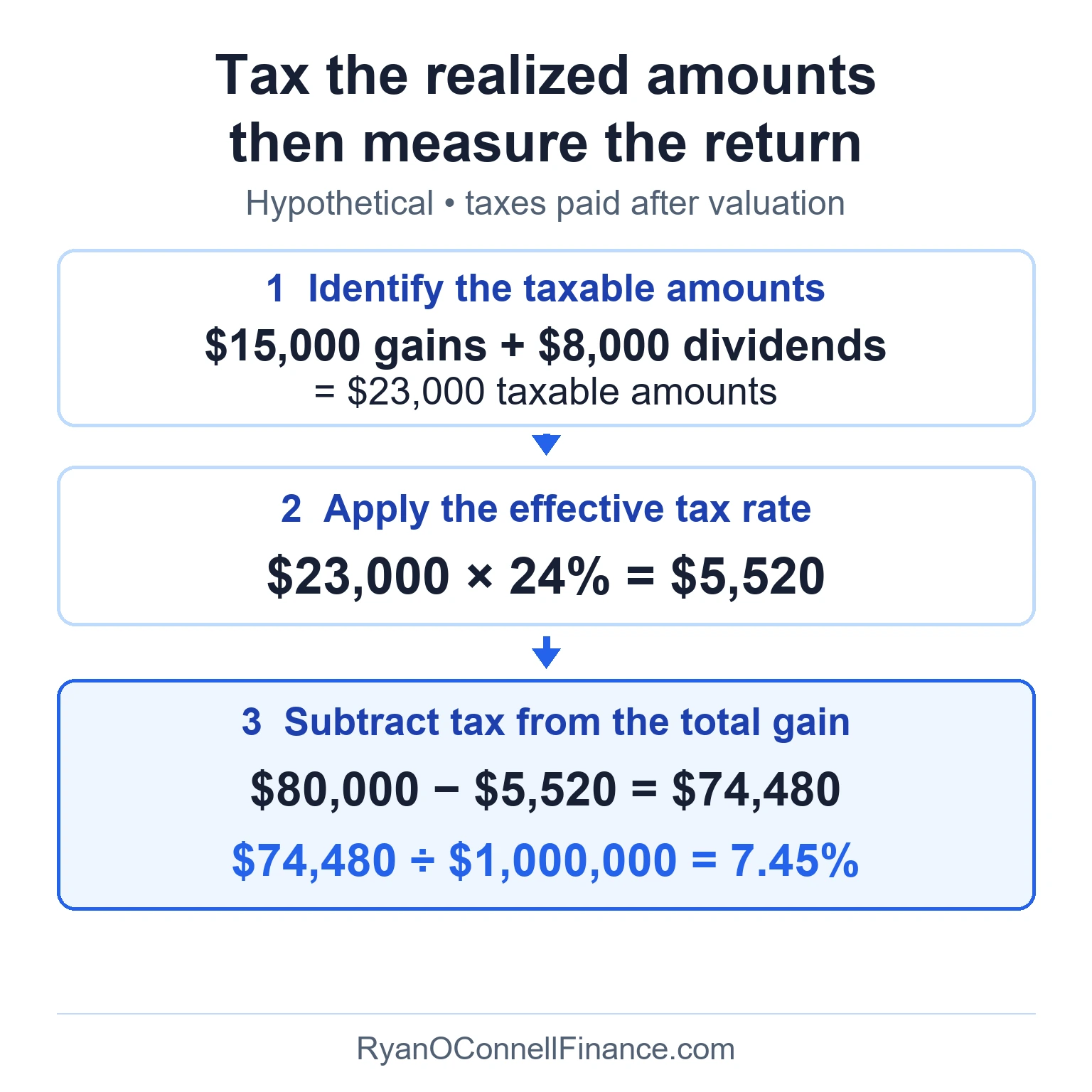
The 24% effective rate applies to the $23,000 of realized taxable amounts in this example. The resulting $5,520 tax reduces the portfolio’s return from 8.00% to 7.45%, a tax drag of 0.55 percentage points.
No published market index fully reflects individual tax situations, making after-tax alpha measurement inherently approximate. Practitioners use customized shadow portfolios or ETF-based benchmarks adjusted for estimated tax impact to evaluate tax-aware manager value-add.
Preliquidation is the standard for ongoing evaluation because it reflects actual taxes paid. Mark-to-liquidation is useful as a conservative stress test — what would the return look like if you had to sell everything today? Use both together for a complete picture, but don’t treat mark-to-liquidation as the primary measure for ongoing portfolios.
Tax-Loss Harvesting and Gain Deferral
Tax-loss harvesting is the practice of selling securities that have declined in value to realize a capital loss, then reinvesting the proceeds in a similar — but not substantially identical — security to maintain market exposure. Realized losses can offset capital gains subject to the tax netting rules. Losses that cannot be used currently may be carried forward; any deduction against ordinary income is limited.
Tax-loss harvesting can reduce current taxes when the loss is currently usable against gains. In a pure-deferral comparison with unchanged effective tax rates and no trading costs or tracking differences, its benefit is the time value of postponing the tax payment. Carryforwards, changing rates and implementation costs can change that result.
An investor holds the Vanguard Total Stock Market ETF (VTI) with a $50,000 unrealized loss. She sells VTI and buys the Schwab U.S. Broad Market ETF (SCHB) as a replacement — a different fund tracking a different index, but providing similar total-market exposure.
For this hypothetical, assume the loss immediately offsets gains taxed at an effective 24% rate. Relative to retaining the original holding, the replacement has a $50,000 lower basis. Assume this creates $12,000 of additional tax when the replacement is sold in 10 years at the same tax rate. Use a 7% annual discount rate and ignore trading costs and tracking differences.
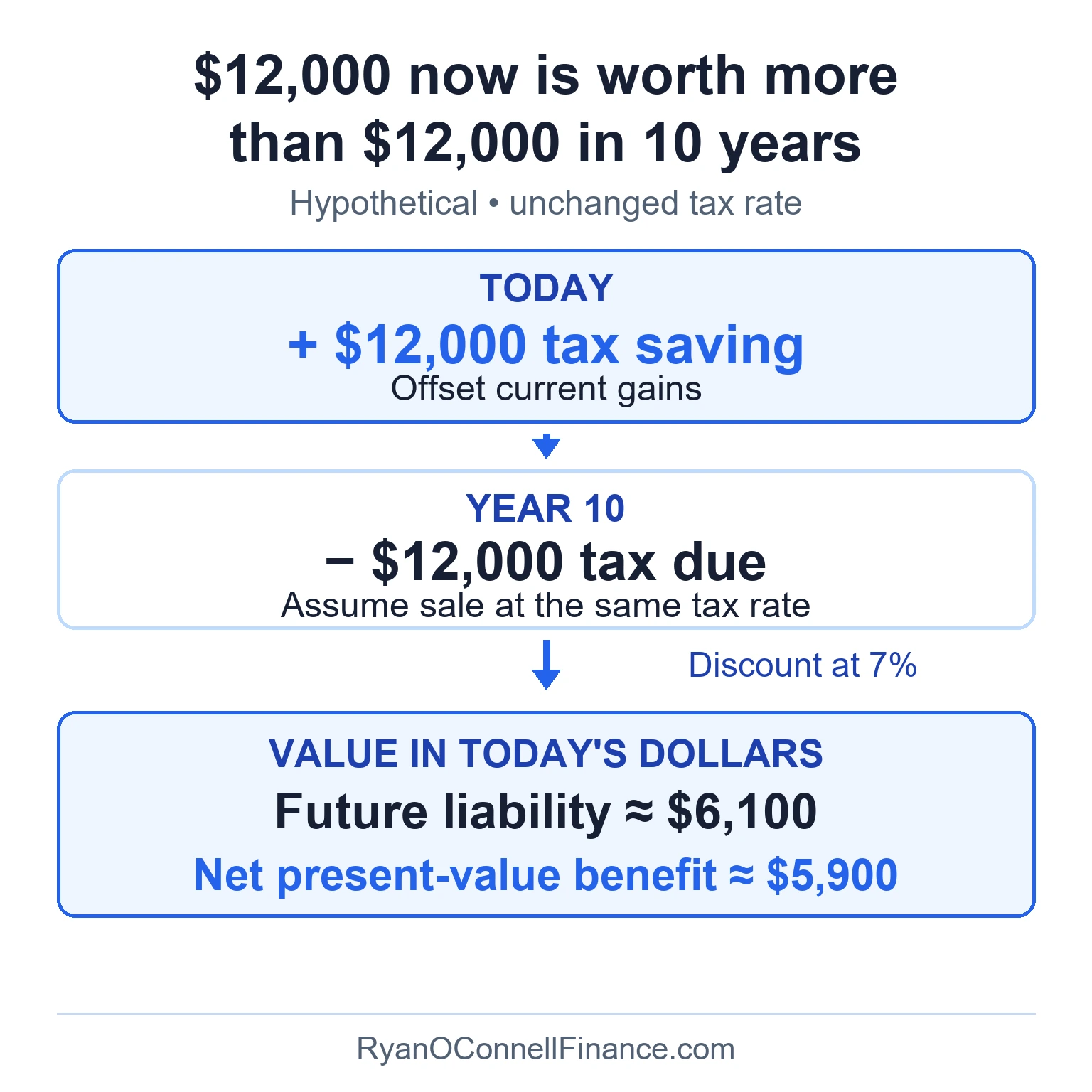
The approximately $5,900 net present-value benefit reflects postponing the tax payment for 10 years. Its size depends on when the deferred tax is paid, the applicable tax rates, and whether the harvested loss can be used immediately.
The wash-sale rule prohibits deducting a loss if you purchase the same or a substantially identical security within 30 days before or after the sale. This applies across all your accounts — including a spouse’s accounts, IRAs, Roth IRAs, and automated purchases from DRIPs or auto-invest programs. Swapping a total-market fund for a different broad-market ETF from another provider is a common approach, but the IRS has not provided a bright-line safe harbor for what constitutes “substantially identical.” Note: if the replacement purchase occurs in an IRA or Roth IRA, the loss is permanently disallowed — unlike taxable-account wash sales, there is no basis adjustment to offset the disallowed loss later. Consult a tax advisor for your specific situation.

A purchase before the loss sale can affect the deduction even if no purchase is made afterward.
Tax-Lot Selection Methods: Specific ID vs FIFO
When selling a partial position, the investor must identify which specific tax lots are being sold. The IRS recognizes three basis methods: specific identification, FIFO (first in, first out), and average cost (available for mutual fund shares and certain shares acquired through dividend reinvestment plans).
Under specific identification, investors choose which lots to sell on a per-trade basis. HIFO (highest in, first out) is a popular decision rule within specific identification: sell the lots with the highest cost basis first to minimize the current realized gain.
| Method | How It Works | Best For |
|---|---|---|
| Specific ID (HIFO rule) | Sell highest-cost-basis lots first | Minimizing current realized gains |
| Specific ID (tax-bracket aware) | Choose lots based on holding period and gain budget | Balancing LT/ST rates and gain timing |
| FIFO | Sell oldest lots first | Default method if no election is made |
| Average Cost | Uses average basis of all shares | Simplicity (mutual funds, DRIPs) |
HIFO often minimizes current realized gains, but specific identification gives you more control. For example, you might choose a long-term lot over a higher-basis short-term lot to access the lower long-term capital gains rate — or sell a modest-gain lot to stay within a lower tax bracket. Set specific identification as your default with your brokerage and evaluate lot-by-lot when rebalancing or harvesting.
To see why holding period matters, suppose two lots each contain 100 shares and the investor will sell one lot at $100 per share. Assume the older lot’s gain is taxed at 20% and the newer lot’s gain at 37%. Evaluate each sale in isolation, ignoring other gains or losses, net investment income tax, state taxes, and trading costs.
The older lot has a $70 per-share basis; the newer lot has an $80 basis.
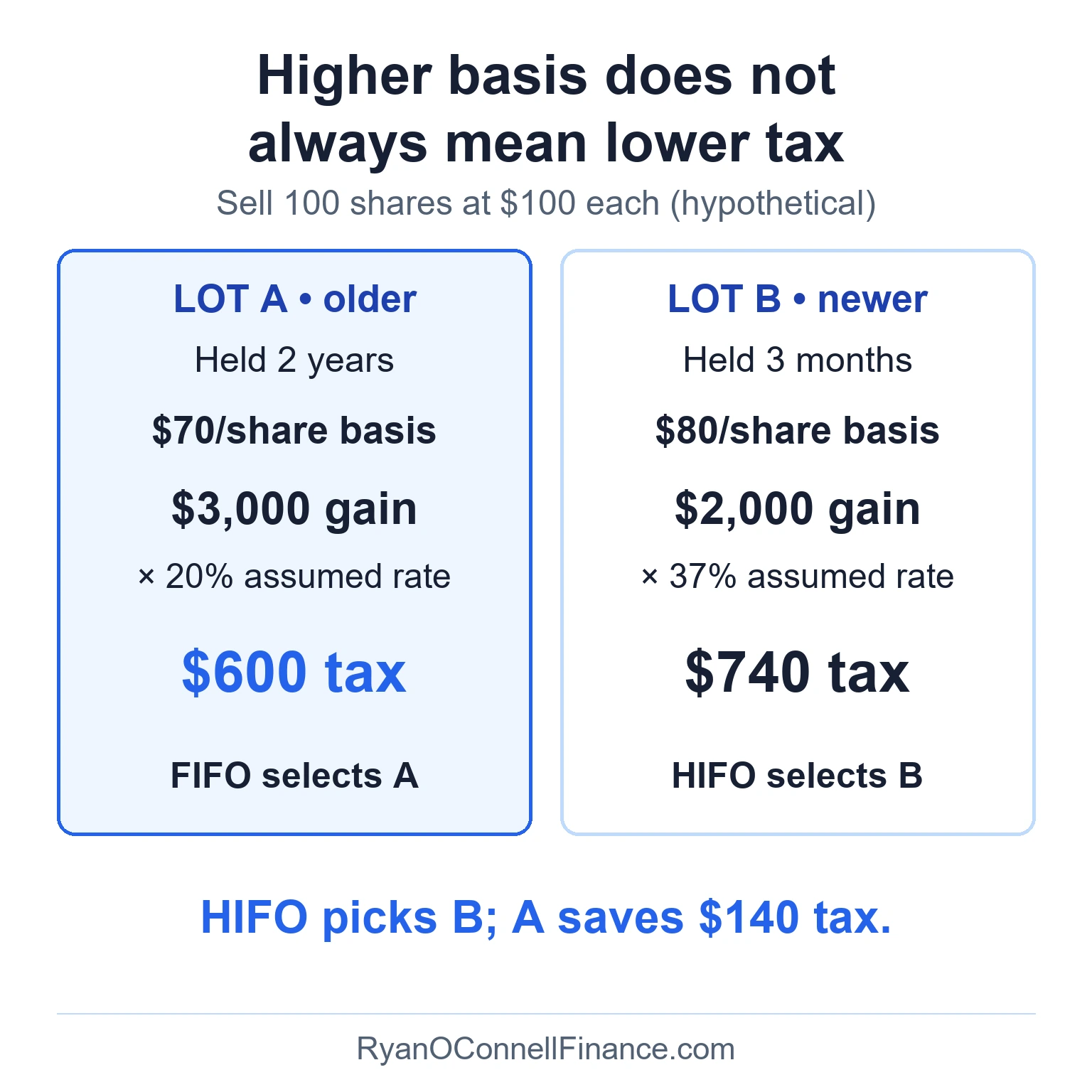
HIFO chooses the $80-basis lot and realizes the smaller gain. Choosing the older $70-basis lot instead produces $140 less current tax under these assumptions.
Tax-Aware Rebalancing
Rebalancing a portfolio back to target weights often requires selling appreciated positions — triggering taxable events in taxable accounts. Tax-aware investors minimize unnecessary realizations by coordinating rebalancing across account types.
Prioritize rebalancing trades within tax-deferred and Roth accounts, where trades create no current tax liability. In taxable accounts, use incoming cash flows, dividends, and tax-loss harvesting proceeds to nudge allocations back toward target — avoiding unnecessary sales of appreciated positions.
Before selling appreciated positions to rebalance, check whether new contributions, dividend reinvestment, or harvested-loss proceeds can restore your target weights organically. For a deeper treatment of rebalancing mechanics, corridor design, and threshold strategies, see our guide on portfolio rebalancing.
Tax-Aware Investing vs Tax-Agnostic Investing
Not every investor needs a tax-aware approach. The choice depends on the investor’s account structure, tax status, and the size of their taxable assets.
Tax-Aware Investing
- Optimizes after-tax returns
- Three-bucket asset location (taxable, traditional, Roth)
- Active tax-loss harvesting
- Specific-ID lot selection
- Wider rebalancing tolerance in taxable accounts
- Tax-managed funds and direct indexing
- Best for: investors with large taxable accounts and high marginal rates
Tax-Agnostic Investing
- Optimizes pre-tax returns only
- No account-type differentiation
- No loss harvesting strategy
- Default lot selection (FIFO)
- Standard rebalancing rules
- Simpler implementation and monitoring
- Best for: tax-exempt entities (pensions, endowments, foundations)
Tax awareness matters most for investors with large taxable accounts, high marginal tax rates, and long time horizons. For tax-exempt entities like pension funds and endowments, the added complexity provides no benefit. Investors whose assets are entirely in tax-sheltered retirement accounts face lower complexity, but can still benefit from traditional-versus-Roth asset location decisions — placing tax-inefficient assets in traditional accounts and high-growth assets in Roth accounts.
Common Mistakes
Even experienced investors make tax-related errors that erode after-tax returns. Here are the most common:
1. Holding municipal bonds in a traditional tax-deferred account. Munis yield less because their interest is tax-exempt. Inside a traditional IRA or 401(k), you get the lower yield with no tax benefit, and all withdrawals are taxed as ordinary income.
2. Triggering the wash-sale rule. Purchasing the same or a substantially identical security within 30 days before or after the loss sale can disallow the loss deduction. Common failure points include automated purchases in DRIPs, spouse’s accounts, and IRA or Roth contributions buying the same fund.
3. Ignoring replacement-security tracking error. When harvesting losses, swapping into a fund with meaningfully different factor exposures introduces unintended portfolio drift. Choose replacement securities that closely track the same market segment.
4. Over-trading to harvest small losses. Transaction costs, bid-ask spreads, and the complexity of managing many small tax lots can exceed the savings from harvesting small-dollar losses. Set a minimum dollar threshold for harvesting activity.
5. Ignoring state and local taxes. Investors in high-tax states face combined marginal rates well above the federal rate alone. The multi-jurisdictional effective rate can significantly change the relative attractiveness of different strategies and vehicles.
Limitations of Tax-Aware Investing
Tax-aware strategies add complexity and are not universally beneficial. The optimal approach depends heavily on individual circumstances, and the tax code itself is a moving target.
1. Tax code complexity and frequent changes. A strategy optimized for current tax law may become suboptimal under future legislation. Rate changes, deduction limits, and new rules can shift the calculus significantly.
2. Individual dependency. The optimal tax-aware strategy depends on marginal rates, state of residence, account mix, income sources, and estate plans. There is no universal tax-aware playbook.
3. Asset location can conflict with optimal asset allocation. If tax-deferred capacity is limited relative to total assets, the investor may face trade-offs between tax efficiency and target allocation weights.
4. Tax-loss harvesting has diminishing returns. In sustained bull markets, cost bases converge toward current prices and harvesting opportunities dry up. The strategy is most valuable in volatile or declining markets, and less so after extended rallies.
Frequently Asked Questions
Disclaimer
This article is for educational and informational purposes only and does not constitute tax or investment advice. Tax rules, rates, and strategies cited are based on current U.S. tax law and may change with future legislation. Individual results vary based on tax situation, state of residence, and account structure. Always consult a qualified tax advisor and financial professional before implementing tax-aware investment strategies.
Keep reading
Next in this series
Part 13 of 16 in Portfolio Construction & Management
Portfolio Rebalancing Disciplines: CPPI, Corridors & Perold-SharpeMore in Portfolio Management
-
Investment Policy Statement & RRTTLLU Framework: Complete Guide
Learn what an investment policy statement (IPS) is, how to write one using the RRTTLLU framework, and why it is the cornerstone of the portfolio management…
-
Systematic vs Unsystematic Risk: What’s the Difference?
Learn the difference between systematic (market) risk and unsystematic (company-specific) risk, why diversification eliminates only one type…
-
Annualized Return (CAGR): Formula, Calculation, and Examples
Learn how to calculate annualized returns (CAGR) and understand the critical difference between geometric mean and arithmetic mean for measuring multi-year…


